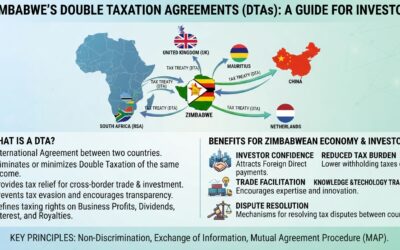
Analysis of Statutory Instrument 40 of 2016: The South Africa Zimbabwe Double Tax Agreement (DTA).
1. Overview.
Published under Proclamation 3 of 2016 via Statutory Instrument 40 of 2016 (S.I. 40 of 2016), the Double Tax Agreement (DTA) between the Republic of Zimbabwe and the Republic of South Africa came into effect to supersede the archaic 1965 agreement established during the Southern Rhodesia era. Concluded on August 4, 2015, and operationalized following formal state notifications, S.I. 40 of 2016 provides a modernized, comprehensive bilateral treaty framework designed to eliminate double taxation, allocate taxing rights between source and residence states, prevent fiscal evasion, and establish mutual administrative and enforcement assistance between the Zimbabwe Revenue Authority (ZIMRA) and the South African Revenue Service (SARS).
For South African corporations, engineering contractors, service providers, and institutional investors executing projects or deriving income within Zimbabwe, navigating S.I. 40 of 2016 is a critical compliance mandate. The treaty interacts directly with Zimbabwe’s Income Tax Act [Chapter 23:06], the Finance Act, and the Capital Gains Tax Act, overriding domestic law where discrepancies exist, provided that substantive conditions and treaty qualification requirements are rigorously met.
2. Permanent Establishment (PE) Thresholds and Corporate Contracting Impact
The single most vital operational determinant for South African companies entering into contracts in Zimbabwe is Article 5 (Permanent Establishment). Under Zimbabwean domestic law, foreign entities rendering services can quickly trigger corporate tax liabilities. S.I. 40 of 2016 defines and limits these thresholds under specific operational categories:
A. Building Sites and Construction Projects (Article 5(3)(a))
- Rule: A building site, construction, assembly, or installation project—or supervisory activities connected therewith—constitutes a permanent establishment only if such site, project, or activity continues for a period of more than six months.
- Impact & Compliance: South African civil engineering and construction firms executing infrastructure or mining development contracts in Zimbabwe must meticulously track project lifecycles. Crossing the 6-month aggregate threshold exposes the entire project’s attributable profits to Zimbabwean corporate income tax (currently standard corporate tax plus AIDS levy). Subcontractors must evaluate their timelines independently; however, interconnected projects orchestrated by related entities face strict aggregation scrutiny.
B. Service and Consultancy PEs (Article 5(3)(b))
- Rule: The furnishing of services, including consultancy, managerial, or technical services, by a South African enterprise through employees or personnel constitutes a permanent establishment only where activities of that nature continue (for the same or a connected project) within Zimbabwe for a period or periods exceeding in the aggregate 183 days within any twelve-month period commencing or ending in the year of assessment concerned.
- Impact & Compliance: This 183-day rule provides safe harbor for short-term consultants, itinerant auditors, and specialized IT implementers. However, compliance tracking requires continuous logging of staff days on the ground in Zimbabwe. Exceeding 183 aggregate days mandates the registration of a formal Zimbabwean branch or subsidiary, filing corporate tax returns, and attributing profits under Article 7 (Business Profits).
C. Agency and Dependent Agents (Article 5(5))
- Rule: If a person (other than an independent broker or general commission agent acting in the ordinary course of business) acts on behalf of a South African enterprise and habitually exercises an authority to conclude contracts in the name of the enterprise, that enterprise is deemed to have a permanent establishment in Zimbabwe.
- Impact & Compliance: South African firms utilizing local Zimbabwean representatives or sales agents must ensure that contract-signing authority is retained strictly in South Africa or executed via independent legal channels. Granting local representatives broad power of attorney can inadvertently trigger a taxable corporate branch presence.
3. Comprehensive Tax Head Analysis and Compliance Implications
Article 2 of S.I. 40 of 2016 outlines the specific existing taxes covered. For South African businesses operating in Zimbabwe, understanding the interaction between treaty caps and domestic tax heads is essential for cash flow optimization and statutory compliance.
A. Business Profits (Article 7) vs. Income Tax (Chapter 23:06)
- Treaty Provision: Business profits of a South African enterprise are taxable only in South Africa unless the enterprise carries on business in Zimbabwe through a permanent establishment. If a PE exists, ZIMRA may tax only the profits attributable to that PE, calculated on an arm’s length basis as if it were a distinct and separate enterprise.
- Deductible Expenses: Under Article 7(3), executive and general administrative expenses incurred—whether in South Africa or elsewhere—must be allowed as deductions when determining the taxable profits of the Zimbabwean PE, provided they are incurred for the business of the PE.
- Compliance Impact: Taxpayers must maintain rigorous separate accounting books for Zimbabwean operations. Transfer pricing documentation aligning with OECD standards and Section 98B of the Zimbabwean Income Tax Act is mandatory to justify management fee allocations and shared overheads.
B. Dividends and Non-Resident Shareholders’ Tax (NRST) (Article 10)
- Treaty Provision: Dividends paid by a Zimbabwean resident company to a South African resident beneficial owner may be taxed in Zimbabwe according to its domestic laws; however, the tax so charged shall not exceed:
- 5 per cent of the gross amount of dividends if the beneficial owner is a company that directly holds at least 25 per cent of the capital of the dividend-paying company.
- 10 per cent of the gross amount of dividends in all other cases.
- Compliance Impact: This provision overrides higher domestic NRST rates, providing substantial relief for South African parent companies repatriating earnings from Zimbabwean subsidiaries. Compliance requires filing valid tax residency certificates issued by SARS and proving beneficial ownership to ZIMRA to secure the capped withholding rate at source.
C. Interest and Residents’/Non-Residents’ Tax on Interest (Article 11)
- Treaty Provision: Interest arising in Zimbabwe and paid to a South African resident beneficial owner may be taxed in Zimbabwe, but the tax charged shall not exceed 5 per cent of the gross amount of interest. Furthermore, interest is completely exempt from source taxation if:
- The payer or recipient is a Contracting State government, political subdivision, or local authority.
- The interest is paid by or to the Central Bank (e.g., Reserve Bank of Zimbabwe or South African Reserve Bank).
- The interest is paid to a wholly owned government institution or body.
- The interest arises from debt instruments listed on a recognized stock exchange (explicitly including the Johannesburg Stock Exchange and the Zimbabwe Stock Exchange).
- Compliance Impact: Corporate treasuries structuring intercompany loans or issuing listed corporate bonds can achieve significant tax optimization. Cross-border debt must be properly documented, and where non-exempt, withholding tax must be capped at 5%, supported by a valid SARS Certificate of Residence.
D. Royalties and Non-Residents’ Tax on Royalties (NRTR) (Article 12)
- Treaty Provision: Royalties arising in Zimbabwe and paid to a South African resident beneficial owner may be taxed in Zimbabwe, but the tax charged shall not exceed 10 per cent of the gross amount. Royalties encompass payments for the use of copyrights, patents, trademarks, designs, secret formulas, or industrial/commercial/scientific experience.
- Compliance Impact: Intellectual property licensing agreements between South African licensors and Zimbabwean licensees must explicitly reference S.I. 40 of 2016 to cap withholding tax at 10%. Licensees are legally mandated to withhold and remit this tax to ZIMRA, failing which penalties and interest accrue to the local payer.
E. Technical Fees and Non-Residents’ Tax on Fees (NRTF) (Article 13)
- Treaty Provision: Technical fees arising in Zimbabwe (defined as payments of any kind to any person, other than an employee, for services of an administrative, technical, managerial, or consultancy nature) and paid to a South African resident may be taxed in Zimbabwe, but the tax charged shall not exceed 5 per cent of the gross amount.
- Compliance Impact: This is one of the most frequently invoked articles for South African contractors providing specialized management, engineering, or IT support to Zimbabwean entities. While domestic NRTF rates can be higher, S.I. 40 of 2016 caps the liability at 5%. To comply, invoice descriptions must clearly delineate technical/consultancy components from pure sales of goods, and the Zimbabwean client must withhold the 5% upon payment or credit.
F. Capital Gains and Capital Gains Tax (Article 14)
- Treaty Provision: Gains derived by a South African resident from the alienation of immovable property situated in Zimbabwe—or from the alienation of shares in a company whose assets consist directly or indirectly principally of such immovable property—may be taxed in Zimbabwe. Gains from movable property forming part of a PE’s business property are similarly taxable in Zimbabwe. All other capital gains are taxable solely in South Africa.
- Compliance Impact: Transactions involving corporate restructuring, M&A activity, or disposal of real estate holding companies crossing the Limpopo must account for Zimbabwean Capital Gains Tax (CGT). Due diligence must evaluate whether asset backing triggers source-state taxation.
4. Administrative Cooperation, Information Exchange, and Enforcement
S.I. 40 of 2016 goes far beyond traditional tax allocation by embedding robust enforcement mechanisms that corporate taxpayers cannot ignore:
- Exchange of Information (Article 25): SARS and ZIMRA are empowered to exchange information “foreseeably relevant” for enforcing domestic tax laws. Crucially, Article 25(5) explicitly states that bank secrecy, fiduciary duties, or ownership obscurity cannot be used by a Contracting State to decline a request for information held by banks, financial institutions, or nominees.
- Assistance in the Collection of Taxes (Article 26): Both revenue authorities agreed to lend mutual assistance in collecting revenue claims (including taxes, interest, administrative penalties, and collection costs). Under Article 26(6), disputes regarding the existence, validity, or amount of a revenue claim originating in one state cannot be litigated before the courts of the other state.
- Mutual Agreement Procedure (MAP) (Article 24): Taxpayers facing double taxation or taxation not in accordance with the treaty may present their case to their resident competent authority within three years of the first notification of the action.
5. Strategic Recommendations for South African Contractors in Zimbabwe
To insulate cross-border operations from severe tax exposure, audits, and statutory penalties, corporate management must institute the following protocols:
- Active Timeline Monitoring: Implement rigorous software tracking for all staff deployment days in Zimbabwe to stay safely below the 183-day service PE threshold, or alternatively, pre-register a compliant branch office.
- Mandatory Documentation Compliance: Procure annual Certificates of Residence from SARS for all South African entities receiving dividends, interest, royalties, or technical fees to legally substantiate treaty-reduced withholding tax caps (5% or 10%).
- Arm’s Length Transfer Pricing: Maintain bulletproof transfer pricing documentation supporting management fees, technical service charges, and intra-group recharges under Article 9 and Article 7 principles to withstand joint ZIMRA-SARS audits.
- Substance over Form Alignment: Ensure that all corporate structures possess genuine commercial rationale, preventing recharacterization under domestic General Anti-Avoidance Rules (GAAR) and ensuring unhindered access to treaty benefits.