Navigating Retrospective VAT Registration in Zimbabwe: Statutory Triggers, Commercial Exposure, and Judicial Precedents
Overview
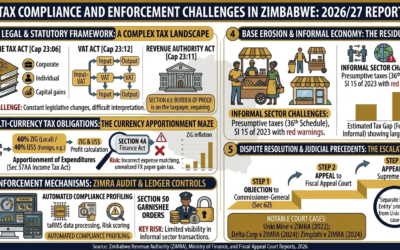
Value Added Tax (VAT) is a core indirect tax mechanism in Zimbabwe, governed by the Value Added Tax Act [Chapter 23:12] and administered by the Zimbabwe Revenue Authority (ZIMRA). A pivotal statutory requirement of the Zimbabwean VAT regime is the obligation placed on traders to monitor turnover and register as “registered operators” once statutory thresholds are reached.
When an entity fails to register at the legal moment when its obligation arises, ZIMRA does not merely enforce compliance on a prospective basis. Instead, under Section 23 of the Act, the Commissioner-General assigns an Effective Date of Registration (EDR) retroactively to the exact historical point when the statutory breach occurred. This process—known as retrospective (or backdated) VAT registration—exposes commercial entities in Zimbabwe to severe financial liabilities, compounding interest, punitive civil penalties of up to 100%, and multi-currency compliance entanglements.
This paper presents an exhaustive analysis of retrospective VAT registration in Zimbabwe. It examines the statutory triggers under Chapter 23:12, the legal mechanics of time-of-supply and input tax disallowance, the financial and operational impact calculated at the prevailing 15.5% VAT rate, and the body of Zimbabwean case law from the High Court, Fiscal Appeal Court, and Supreme Court that defines trade, supply, consideration, and ZIMRA’s administrative powers.
1. Statutory Foundations of VAT Registration in Zimbabwe
Under Section 6(1)(a) of the Value Added Tax Act [Chapter 23:12], VAT is charged, levied, and collected on the supply by any registered operator of goods or services supplied in the course or furtherance of any trade carried on by that person.
The statutory mechanics governing mandatory registration are embodied in Section 23 (“Registration of persons making supplies in the course of trades”) of the Act.
+-----------------------------------------------------------------------------------+
|               STATUTORY VAT REGISTRATION TRIGGERS IN ZIMBABWE                     |
+-----------------------------------------------------------------------------------+
| 1. Historical 12-Month Test     | Cumulative taxable supplies exceeding prescribed |
| (Section 23(1)(a))              | threshold at the end of any given month.          |
+---------------------------------+-------------------------------------------------+
| 2. Prospective 12-Month Test    | Reasonable grounds to believe taxable supplies   |
| (Section 23(1)(b))              | will exceed threshold in next 12 months.          |
+---------------------------------+-------------------------------------------------+
| 3. Contractual / Mining Rules   | Mandatory statutory triggers for specific      |
| (Section 23(1)(c) as amended)   | sector-based approvals or mining concessions.    |
+-----------------------------------------------------------------------------------+
1.1 The Rolling 12-Month Test
Section 23(1)(a) mandates that every person who carries on any trade and is not registered becomes liable to register at the end of any month if the total value of taxable supplies made by that person in the period of 12 months ending at the end of that month has exceeded the statutory threshold (currently statutory threshold equivalents in USD or local currency units as updated in annual Finance Acts).
A crucial point of confusion for Zimbabwean businesses is mistaking the rolling 12-month period for a company’s financial year or a calendar year. The statutory test requires continuous, month-by-month historical monitoring. If a trader breaches the threshold in October, the legal liability to apply for registration arises within 30 days, and ZIMRA is empowered to fix the EDR back to November 1.
1.2 The Commissioner-General’s Power to Backdate EDR
Where ZIMRA discovers during a tax audit, data-matching exercise, or bank turnover investigation that an entity breached the Section 23 threshold historically without notifying the Authority, Section 23(4) grants the Commissioner-General explicit authority to register the person with effect from the date on which that person first became liable to be registered.
Once an entity is assigned a retrospective EDR, it is legally deemed to have been a registered operator throughout the backdated period. Consequently, every transaction undertaken during that period is reclassified as a supply made by a registered operator, creating an immediate statutory duty to account for output VAT.
2. Primary Triggers and Causes of Retrospective VAT Registration
Retrospective registration in Zimbabwe frequently arises from subtle operational missteps, legal reclassifications, or statutory shifts rather than deliberate tax evasion.
                         ROOT CAUSES OF BACKDATED EDR IN ZIMBABWE
                                            │
      ┌─────────────────────────────────────┼─────────────────────────────────────┐
      ▼                                     ▼                                     ▼
1. Turnover Miscalculation           2. Supply Misclassification          3. Loss of Statutory Exemptions
Failing to monitor rolling 12-month  Treating taxable supplies as exempt   Repeal of EPZ status or misapplying
thresholds continuously.             or outside-the-scope of VAT.          "association not for gain" rules.
      │                                     │                                     │
      └─────────────────────────────────────┼─────────────────────────────────────┘
                                            │
                                            ▼
                              4. Reclassification of Transactions
                              Treating asset disposals, mining rights, or
                              liquidation sales as non-taxable capital items.
2.1 Misclassification of Exempt vs. Zero-Rated Supplies
Businesses often fail to distinguish between Exempt Supplies (Section 11) and Zero-Rated Supplies (Section 10):
- Zero-Rated Supplies: Count toward the statutory registration threshold under Section 23, even though tax is charged at 0%. Entities supplying zero-rated goods (such as basic foodstuffs or exports) who exceed the threshold must register.
- Exempt Supplies: Excluded from the calculation of taxable supplies. However, if a business incorrectly treats standard-rated services (e.g., commercial property management or management fees) as exempt financial services or educational services, ZIMRA will reclassify those revenues upon audit, retroactively pushing the entity over the registration threshold.
2.2 Legislative Changes and Loss of Special Status
A distinct cause in Zimbabwean tax history has been the repeal or modification of statutory tax incentives. For instance, entities that historically operated within Export Processing Zones (EPZs) under Chapter 14:07 enjoyed tax exemptions. When statutory frameworks were repealed or altered (e.g., replaced by the Zimbabwe Investment and Development Agency Act [Chapter 14:38]), entities failing to recognize the loss of their exempt status continued trading without VAT registration, subsequently facing massive retrospective EDR assessments on domestic sales.
2.3 One-Off Capital Transactions and Liquidation Sales
Under the broad statutory definition of “trade” in Section 2(1) and the deemed supply rules under Section 7(6) and Section 7(14), the disposal of a business as a going concern or the sale of business assets during restructuring or liquidation constitutes a supply made in the course or furtherance of trade. Unregistered businesses undergoing asset liquidations often discover that a single large asset disposal breaches the Section 23 threshold, triggering retrospective registration on the entire transaction.
2.4 Imported Services (Section 6(1)(c))
Zimbabwean corporate entities acquiring foreign-sourced consulting, software, or technical services frequently fail to account for VAT on imported services under Section 6(1)(c) and Section 8(1a). Unregistered entities receiving substantial imported services can find that ZIMRA treats these transactions as triggers requiring backdated compliance and output tax assessments.
3. Statutory Framework and Legal Mechanics
Understanding retrospective registration requires an analysis of how key provisions in Chapter 23:12 interact once a backdated EDR is established.
3.1 The Output Tax Fraction at 15.5%
When ZIMRA backdates an EDR, all historical revenues earned during the unregistered period are treated as VAT-inclusive gross consideration, unless the business can prove that VAT was charged separately on top of the consideration.
Under Section 2(1), the tax fraction is defined as:
Tax Fraction = r/ (100 + r)Where r represents the statutory rate of tax fixed in the Charging Act (Finance Act [Chapter 23:04]). Applying Zimbabwe’s statutory rate of 15.5%, the tax fraction is calculated as:
Tax Fraction = 15.5 / (100 + 15.5) = 15.5 / 115.5) = 0.134199 or (13.42%)
Mathematical Illustration:
If an unregistered Zimbabwean business generated ZWG 10,000,000 or USD 1,000,000 in gross revenue during a two-year unregistered retrospective period, ZIMRA calculates the backdated output tax debt using the tax fraction:
Output Tax Liability = Gross Revenue times 15.5/115.5
Output Tax Liability = $1,000,000 times 0.134199 = $134,199.13
The business is assessed an immediate primary tax debt of $134,199.13, directly eroding historical gross profit.
3.2 Time of Supply Rules (Section 8)
Under Section 8(1), a supply of goods or services is deemed to take place at the earliest of:
- The time an invoice is issued by the supplier or recipient;
- The time any payment of consideration is received by the supplier;
- The removal of movable goods, or taking possession of immovable goods; or
- The performance of services.
For retrospective registrations, Section 8 ensures that each historical transaction is pinned to a specific past tax period under Section 27, enabling ZIMRA to charge compounding interest from the exact date each historical bi-monthly return was originally due.
3.3 Input Tax Deductions and Disallowance Rules (Sections 15 & 16)
While a retrospectively registered operator is theoretically entitled under Section 15(3) to claim input tax incurred on purchases used in making taxable supplies, major legal obstacles arise:
+------------------------------------------------------------------------------------+
|                  BARRIERS TO HISTORICAL INPUT TAX RECOVERY                         |
+------------------------------------------------------------------------------------+
| 1. Tax Invoice Requirement   | Must hold valid "fiscal tax invoices" showing supplier|
| (Section 20 & Section 27)    | VAT numbers and FDMS verifiable details.            |
+------------------------------+----------------------------------------------------+
| 2. Pre-Registration Limits   | Capital goods held at EDR must satisfy strict      |
| (Section 15(3) Provisos)     | valuation and usage criteria.                      |
+------------------------------+----------------------------------------------------+
| 3. Prescribed Time Limits    | Statutory time bars prevent claiming input tax     |
| (Section 15(4))              | beyond specified historical tax periods.           |
+------------------------------------------------------------------------------------+
Furthermore, under Section 16(2), input tax deduction is outright denied for passenger motor vehicles, entertainment, and expenses where valid fiscal invoices complying with Section 20 were not retained.
4. Financial, Commercial, and Operational Exposure for Zimbabwean Enterprises
The commercial consequences of a backdated EDR in Zimbabwe are severe, often posing an existential threat to going-concern status.
                     COMPOUNDING FINANCIAL IMPACT OF BACKDATED EDR
                                          │
     ┌────────────────────────────────────┼────────────────────────────────────┐
     ▼                                    ▼                                    ▼
1. Primary Tax Debt               2. Civil Penalties                   3. Compounding Interest
Recalculated on gross revenue     Up to 100% of the unpaid tax         Prescribed statutory interest
using the 15.5/115.5 fraction.    under Section 39 / Revenue Act.      accrued per month from EDR.
     │                                    │                                    │
     └────────────────────────────────────┼────────────────────────────────────┘
                                          │
                                          ▼
                            4. Multi-Currency Accounting Complexity
                            Tracking liabilities in dual currency (USD and ZWG)
                            at historic official vs. transaction exchange rates.
4.1 Inability to Recover Output Tax from Customers
- Business-to-Consumer (B2C) Context: Retailers, hospitality operators, and direct consumer service providers cannot issue backdated invoices to individual retail buyers. The 15.5% VAT liability must be absorbed entirely out of past revenues as a unrecoverable loss.
- Business-to-Business (B2B) Context: While corporate clients may theoretically accept supplementary tax invoices, commercial contracts that do not explicitly state “plus VAT” leave the supplier with no legal mechanism to compel buyers to pay additional sums years after the transaction. Furthermore, clients may have closed, dissolved, or reached their own tax statutory period limits, refusing to accept backdated documentation.
4.2 Multi-Currency Tax Framework (USD vs. ZWG)
Zimbabwe operates a multi-currency monetary system involving foreign currency (USD) and local currency (ZiG / ZWG). Under Zimbabwe’s tax laws (including provisions in the Finance Act and Section 28 of Chapter 23:12), tax must be accounted for and settled in the currency of trade.
When ZIMRA performs a retrospective audit spanning several years, it reconstructs transaction ledgers in both USD and local currency. If a business conducted sales in USD without registering, ZIMRA assesses the retrospective 15.5% VAT debt in actual USD, along with USD-denominated penalties and interest. This eliminates any possibility of discharging historical tax debts through local currency devaluation.
4.3 Punitive Civil Penalties and Interest
Under the Value Added Tax Act and Section 39 read with the Revenue Authority Act [Chapter 23:11]:
- Late Registration & Non-Payment Penalties: ZIMRA is empowered to levy civil penalties equal to 100% of the tax debt (Potential Lost Revenue).
- Statutory Interest: Interest accrues monthly at the prescribed rate on all unpaid VAT from the original statutory due dates.
In practice, the combination of principal output tax ($13.42\%$ of gross sales), 100% penalties, and compounding interest results in a total ZIMRA assessment that frequently exceeds 30% to 40% of the total gross historic turnover of the business.
5. Comprehensive Analysis of Zimbabwean Judicial Precedents
The Zimbabwean courts—comprising the High Court (HH), the Special Court for Income Tax Appeals, the Fiscal Appeal Court (FAC), and the Supreme Court (SC)—have developed an extensive body of jurisprudence interpreting key provisions of the Value Added Tax Act [Chapter 23:12]. These rulings establish firm boundaries on trade, supply, consideration, exported goods, and ZIMRA’s statutory authority.
+---------------------------------------------------------------------------------------------------+
|                        SUMMARY OF LANDMARK ZIMBABWEAN VAT CASE LAW                                |
+---------------------------------------------------------------------------------------------------+
| Case Citation                       | Key Legal Principle Established                             |
+-------------------------------------+-------------------------------------------------------------+
| GTO Association v CG, ZIMRA         | Narrow interpretation of "association not for gain"; fees   |
| (19-HH-464)                         | charged for commercial services constitute taxable trade.   |
+-------------------------------------+-------------------------------------------------------------+
| Law Society of Zimbabwe v ZIMRA     | Statutory fees and compulsory contributions received for    |
| (18-HH-409)                         | regulatory functions constitute "consideration" for trade.  |
+-------------------------------------+-------------------------------------------------------------+
| S.T. (Pvt) Ltd v ZIMRA (16-HH-696)  | Loss of EPZ status subjects historical sales to local VAT;  |
| & AMD Services v ZIMRA (20-HH-344)  | strict proof required for export zero-rating.               |
+-------------------------------------+-------------------------------------------------------------+
| TG v ZIMRA (19-HH-578)              | Asset disposals by liquidators of defunct entities remain   |
|                                     | taxable supplies made in the course of trade.               |
+-------------------------------------+-------------------------------------------------------------+
| E.J (Pvt) Ltd v ZIMRA (19-HH-528)   | Continuous property rental and disposal activities fall     |
|                                     | squarely within the statutory definition of trade.          |
+-------------------------------------+-------------------------------------------------------------+
| MMI (Pvt) Ltd v CG, ZIMRA           | Mining claims and real rights constitute "goods"; transfers |
| (19-HH-700)                         | attract output VAT.                                         |
+-------------------------------------+-------------------------------------------------------------+
| Mylo (Pvt) Ltd v ZIMRA (16-HH-717)  | Broad definition of "supply" covers barter and non-monetary |
|                                     | transactions designed to fulfill third-party requirements.   |
+-------------------------------------+-------------------------------------------------------------+
| Afritrade International v ZIMRA     | Supreme Court confirmation on strict evidentiary rules for  |
| (21-SC-003)                         | proving non-taxable cross-border transactions.              |
+-------------------------------------+-------------------------------------------------------------+
5.1 Defining “Trade” and “Association Not for Gain”
GTO Association v The Commissioner General of ZIMRA (19-HH-464)
In GTO Association, the applicant sought exemption from VAT obligations under the definition of an “association not for gain” in Section 2(1). The High Court examined whether an entity carrying on activities without formal profit distribution could escape classification as a trade.
The Court held that where an organization charges fees for services rendered, and its operational activities mirror commercial enterprises, it falls squarely within the statutory definition of “trade” under Section 2(1)(a). The Court reaffirmed that the statutory threshold for “association not for gain” status requires strict compliance with all constitutional and operational criteria. Entities operating on a fee-for-service basis cannot claim immunity from VAT registration once threshold levels are reached.
Law Society of Zimbabwe v ZIMRA (18-HH-409)
The Law Society challenged ZIMRA’s attempt to levy VAT on statutory practicing fees, regulatory levies, and administrative contributions collected from legal practitioners. The applicant argued that regulatory fees do not constitute “consideration” for a taxable supply of services in the course of trade.
The High Court ruled in favor of ZIMRA, holding that the definition of “consideration” in Section 2(1) is intentionally broad and encompasses any payment made in response to or for the inducement of a supply of facilities, rights, or advantages. The decision affirmed that statutory professional bodies engaged in ongoing administrative and regulatory functions carry on a “trade” for VAT purposes, making their gross receipts subject to threshold tests and potential retrospective registration.
5.2 Asset Disposals, Liquidations, and Real Rights
TG v ZIMRA (19-HH-578)
In TG v ZIMRA, a defunct carpet manufacturing factory went into liquidation. Four years after operations ceased, the liquidator disposed of the factory assets and machinery. ZIMRA assessed VAT on the liquidation sale, arguing that under Proviso I to Section 2(1) (“trade”) and Section 7(14), anything done in connection with the commencement or termination of a trade is deemed to be done in the course of that trade.
The High Court upheld ZIMRA’s assessment, establishing that the cessation of business operations does not terminate VAT liability. Disposals executed during winding-up or liquidation remain taxable supplies. Unregistered entities liquidating assets remain liable for registration and output tax on the proceeds.
MMI (Pvt) Ltd v The Commissioner General, ZIMRA (19-HH-700)
In MMI (Pvt) Ltd, the Court considered whether the sale and transfer of mining claims and mining sites constituted a supply of “goods” under Section 2(1). The appellant argued that mining rights were incorporeal rights falling outside the scope of corporeal movable property.
The High Court held that the statutory definition of “goods” explicitly includes “fixed property and any real right in any such thing or fixed property.” Because mining claims confer real rights in land, their transfer constitutes a taxable supply of goods under Section 6(1)(a). Entities trading in mining rights or ceding mining claims for consideration must count these revenues toward their Section 23 threshold.
E.J (Pvt) Ltd v ZIMRA (19-HH-528)
The appellant engaged in renting commercial properties and subsequently disposed of several real estate holdings. It argued that property disposals were capital transactions rather than income-generating trade activities. The High Court rejected this distinction, ruling that under Section 2(1) and Section 7(6), the continuous renting and subsequent disposition of immovable property constitutes a trade, making the gross capital proceeds subject to output tax.
5.3 Exported Goods, EPZ Repeals, and Cross-Border Supplies
S.T. (Pvt) Ltd v ZIMRA (16-HH-696) & AMD Services (Pvt) Ltd v ZIMRA (20-HH-344)
Both S.T. (Pvt) Ltd and AMD Services dealt with entities that historically operated in Export Processing Zones (EPZs) under Chapter 14:07. Following legislative amendments and the repeal of EPZ frameworks, the entities continued trading, assuming their zero-rated or exempt status remained intact. ZIMRA conducted audits and issued retrospective EDR assessments, charging 15.5% VAT on all domestic sales and unverified export transactions.
The High Court confirmed that:
- Zero-rating under Section 10 for exported goods requires strict documentary proof acceptable to the Commissioner-General under Section 2(1) (e.g., stamped bill of entry, proof of foreign payment, and customs clearance documents).
- Upon the statutory repeal of an exemption framework, the burden rests entirely on the trader to register for VAT under Section 23. Failure to do so exposes the enterprise to retrospective EDR assessments on its gross revenues.
A.T. International Ltd v ZIMRA (15-HH-823) & Afritrade International Limited v Zimra (21-SC-003)
In A.T. International and Afritrade, the courts examined cross-border transactions and imported services under Section 6(1)(c). The Supreme Court in Afritrade affirmed that where a local entity receives services or goods within Zimbabwe, or fails to prove that goods were physically consigned outside the country under Section 2 (“exported”), ZIMRA is legally entitled to reclassify the receipts as local taxable supplies, triggering backdated EDR liabilities.
5.4 Valuation and Consideration Rules
Mylo (Pvt) Ltd v Zimra (16-HH-717)
The High Court examined barter and non-monetary transactions, ruling that “supply” under Section 2(1) includes any arrangement designed to fulfill a deficiency or requirement of a third party. The Court held that non-monetary consideration must be quantified at Open Market Value under Section 3, and included in turnover calculations for Section 23 registration threshold tests.
R (Pvt) Ltd v Zimra (19-HH-792) & ZS (Pvt) Ltd v Zimra (20-FAC-113)
These decisions from the High Court and Fiscal Appeal Court established that where transactions occur between connected persons or without clear invoice pricing, ZIMRA is empowered under Section 3(4) and 3(5) to construct the open market value of supplies to determine threshold breaches and calculate backdated output tax assessments.
6. Strategic Mitigation and Best Practices for Zimbabwean Enterprises
When a business in Zimbabwe identifies a historic breach of the Section 23 VAT registration threshold, immediate structured intervention is necessary to prevent financial ruin.
                         RETROSPECTIVE VAT RISK MANAGEMENT MATRIX
                                            │
      ┌─────────────────────────────────────┼─────────────────────────────────────┐
      ▼                                     ▼                                     ▼
1. Turnover Audit                    2. Voluntary Disclosure Program      3. Invoicing & B2B Recovery
Conduct rolling 12-month review      Submit unprompted application to     Re-issue supplementary fiscalized
to identify exact breach date.       ZIMRA under the VDP framework.       invoices to B2B corporate clients.
      │                                     │                                     │
      └─────────────────────────────────────┼─────────────────────────────────────┘
                                            │
                                            ▼
                              4. Input Tax Reconstruction
                              Gather valid Section 20 fiscal invoices and
                              negotiate Time-to-Pay (TTP) arrangements.
6.1 Leveraging ZIMRA’s Voluntary Disclosure Program (VDP)
The most effective legal mechanism to mitigate penalties following a threshold breach is ZIMRA’s Voluntary Disclosure Program (VDP). Under Section 39 read with administrative guidelines:
- Unprompted Disclosure: If an entity voluntarily approaches ZIMRA to disclose a historic threshold breach before ZIMRA issues an audit notification, the Commissioner-General has administrative discretion to waive 100% of civil penalties.
- Prompted Audit Disclosure: If disclosure occurs after an audit notice is issued, penalty waivers are generally refused, exposing the firm to the full 100% penalty assessment.
6.2 Reconstruction of Fiscalized Input Tax
To reduce the net retrospective liability, the business must perform a rigorous audit of its historic procurement ledgers:
- Contact registered suppliers from the backdated period to request valid fiscalized tax invoices that contain verifiable details linked to ZIMRA’s Fiscalisation Data Management System (FDMS) under Section 20.
- Reconstruct capital asset registers held at the EDR date to utilize pre-registration input tax provisions under Section 15(3).
6.3 Contractual Audits and B2B Supplementary Invoicing
For B2B clients, the business should review historical supply contracts. Where contracts contain standard terms stating that prices are “exclusive of VAT” or incorporate general tax adjustment clauses, the business can issue formal supplementary fiscalized tax invoices to enable corporate clients to claim corresponding input tax deductions on their current VAT returns.
6.4 Negotiating Time to Pay (TTP) Installment Frameworks
Where the final retrospective assessment threatens solvency, the entity should leverage its completed historical audit figures to negotiate a formal Time to Pay (TTP) agreement with ZIMRA’s debt recovery unit. ZIMRA frequently approves structured payment plans spanning 12 to 36 months, provided the business remains fully compliant with current tax filing obligations.
7. Conclusion
Retrospective VAT registration under the Value Added Tax Act [Chapter 23:12] represents one of the most severe tax exposure risks for commercial entities in Zimbabwe. Because an Effective Date of Registration (EDR) is fixed retroactively to the date when a statutory threshold is first breached, an unregistered business suddenly finds its historic gross revenue subjected to a 15.5% tax fraction assessment ($\frac{15.5}{115.5}$).
When combined with compounding interest, 100% civil penalties under Section 39, foreign currency compliance rules, and rigid fiscalized input tax disallowance standards under Sections 15, 16, and 20, a retrospective VAT assessment can quickly exceed a firm’s cumulative retained earnings.
Judicial decisions from the High Court and Supreme Court—such as GTO Association, TG v ZIMRA, Law Society of Zimbabwe, and S.T. (Pvt) Ltd—demonstrate that Zimbabwean courts strictly enforce statutory definitions of trade, supply, consideration, and registration rules. Ignorance of rolling 12-month calculation mechanics or reliance on informal exemptions provides no legal defense against backdated EDRs.
To protect commercial viability, growing enterprises in Zimbabwe must institute automated turnover tracking systems, continuously review the tax status of their supplies, ensure full FDMS fiscalisation, and utilize voluntary disclosure mechanisms immediately upon discovering a historical threshold breach.