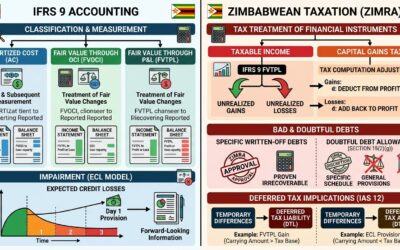
IFRS 16 Accounting vs. Taxation in Zimbabwe
Right-of-Use Assets, Lease Liabilities, Financial vs. Tax Distinctions, and Relevant Tax Case Law
Deep Dive.
The implementation of IFRS 16 Leases (effective 1 January 2019) eliminated the traditional distinction between operating and finance leases for lessees. Lessees are now required to recognize a Right-of-Use (ROU) asset and a corresponding Lease Liability on the balance sheet for virtually all leases, recognizing depreciation on the ROU asset and interest expense on the lease liability over the lease term.
In Zimbabwe, this creates a fundamental conflict between financial reporting standards (IFRS) and the statutory tax laws enforced by the Zimbabwe Revenue Authority (ZIMRA) under the Income Tax Act [Chapter 23:06] (ITA). Zimbabwean tax law strictly adheres to historical, contractual, and statutory realization principles. ZIMRA does not recognize the ROU asset or lease liability framework for tax purposes. Consequently, statutory tax adjustments and deferred tax tracking (IAS 12) are mandatory for entities operating in Zimbabwe.
Accounting Model vs. Tax Model
Lessee Accounting under IFRS 16
Under IFRS 16, a lease is defined as a contract that conveys the right to control the use of an identified asset for a period of time in exchange for consideration.
- Initial Measurement:
- Lease Liability: Present value of future lease payments discounted using the interest rate implicit in the lease or the lessee’s incremental borrowing rate.
- ROU Asset: Initial liability amount + initial direct costs + lease payments made at/before commencement + restoration costs less lease incentives received.
- Subsequent Measurement:
- P&L Impact: Replaced rent expense with Depreciation of ROU Asset (typically straight-line) and Interest Expense on Lease Liability (using the effective interest rate method). Total P&L expense is front-loaded in the early years of the lease.
Taxman’s Position (ZIMRA / Income Tax Act [Chapter 23:06])
ZIMRA ignores the single lessee model introduced by IFRS 16 and continues to apply traditional statutory rules:
- Section 15(2)(a) – General Deduction Formula:
- Allows deductions for expenditure and losses actually incurred for the purposes of trade or in the production of income, provided they are not of a capital nature.
- Actual rental payments payable under the lease contract during the tax year are deductible as allowable operating expenditure.
- Section 15(2)(c) read with the Fourth Schedule – Capital Allowances:
- Wear and tear allowances (Special Initial Allowance / Annual Allowance) are granted only to the legal or economic owner of the underlying asset (or under specific statutory lease-purchase/hire-purchase scenarios under Section 17).
- ROU assets are non-physical accounting constructs and do not qualify for capital allowances under the Fourth Schedule.
- Section 16(1)(a) & Section 16(1)(e) – Non-Deductible Capital & Reserves:
- Accounting depreciation on ROU assets is disallowed under Section 16(1)(a) as capital expenditure/amortization.
- Interest computed via accounting discounting methods (EIR) is adjusted back to reflect contractual obligation rules.
Lessee Accounting vs. ZIMRA Rules
| Feature / Transaction | IFRS 16 Lessee Accounting | ZIMRA / Income Tax Act Treatment | Tax Return (IT1) Adjustment Required |
| Balance Sheet Recognition | ROU Asset and Lease Liability recognized on balance sheet. | Ignored. Underlying asset remains on lessor’s tax balance sheet (unless statutory hire purchase). | None directly on balance sheet; timing differences flow into Deferred Tax. |
| Rental Payments Made | Cash outflow split between lease liability principal reduction and interest expense. | Fully deductible under Sec 15(2)(a) as an expense incurred in the production of income. | Deduct total actual contractual lease payments paid/accrued in the tax year. |
| ROU Asset Depreciation | Expensed in Profit & Loss over the lease term. | Disallowed. Accounting depreciation is of a capital nature (Sec 16(1)(a)). | Add back ROU Asset Depreciation to Profit Before Tax. |
| Lease Interest Expense | Recognized in P&L using the Effective Interest Rate (EIR) method. | Disallowed as separate interest claim if it represents finance charges embedded in an operating lease contract. | Add back IFRS 16 Interest Expense. |
| Initial Direct Costs | Added to the carrying amount of ROU Asset and amortized. | Deductible in the year incurred under Sec 15(2)(a) if revenue nature, or capitalized if capital nature. | Deduct immediately if allowed as an operating trade expense under tax rules. |
| Lease Modifications & Gain/Loss | Re-measurement of liability; gain/loss recognized in P&L if scope reduced. | Ignored for income tax purposes unless a contractual debt release triggers Sec 8(1)(k). | Adjust out accounting gains (deduct) or losses (add back). |
| Passenger Motor Vehicle Leases | ROU Asset recognized and depreciated based on full PV of lease payments. | Deductions subject to statutory cap under Sec 16(1)(k) (US$50,000 ceiling). | Expenditure exceeding statutory lease limit cap must be added back. |
Lessor Accounting and Lease Classification
Lessor accounting under IFRS 16 remains substantially unchanged from IAS 17 (classified as either Finance Lease or Operating Lease).
Operating Leases (Lessor)
- Accounting: Lessor retains the asset on its balance sheet, records depreciation, and recognizes lease income on a straight-line basis.
- Taxation (ZIMRA):
- Lease rental income is included in Gross Income under Section 8(1) upon receipt or accrual.
- Lessor claims Capital Allowances (SIA/Wear & Tear) under Section 15(2)(c) & Fourth Schedule as legal owner of the asset used for trade.
- Repairs incurred by the lessor are allowable under Section 15(2)(b).
Finance Leases & Hire-Purchase (Lessor vs. Lessee)
- Accounting: Lessor derecognizes the underlying asset and recognizes a Lease Receivable.
- Taxation (ZIMRA / Section 17 & 18):
- Under Section 17 (Hire-Purchase / Suspensive Sales), if ownership passes upon completion of payments, the entire agreement amount is deemed to accrue to the seller (lessor) on the agreement date, with allowances for uncollected amounts under Proviso (i).
- Capital allowances pass to the lessee/purchaser if the contract qualifies as an agreement where ownership transfers upon fulfillment of conditions.
Special Zimbabwean Complexities
Passenger Motor Vehicle Lease Ceiling (Section 16(1)(k))
- Under Section 16(1)(k) of the Income Tax Act, lease expenditure incurred in leasing a passenger motor vehicle (as defined in the Fourth Schedule) is capped at a cumulative limit of US$50,000.
- Tax Adjustment: When an entity leases a executive/passenger vehicle, the total deductible lease payments over the life of the lease cannot exceed this threshold. Any excess IFRS 16 lease charges/rent payments must be permanently added back to taxable income.
Dual-Currency & Currency Translation Issues (Section 37AA)
- In Zimbabwe’s multi-currency environment, lease agreements are often denominated in foreign currency (USD) while local operations use local currency (ZiG).
- Section 37AA of the Income Tax Act requires taxpayers earning income in foreign currency to submit separate tax returns for foreign currency transactions.
- Lease liabilities and ROU assets translated under IAS 21 / IFRS 16 generate exchange gains/losses in P&L. Unrealized exchange gains/losses on lease obligations are adjusted for tax purposes under Section 8(2) and Section 15(1)(a) until realized.
Relevant Tax Case Law & Judicial Precedents
Tax disputes involving lease accounting, statutory capitalization, and matching principles rely on established Zimbabwean and persuasive Southern African precedent:
Case Law on Accounting vs. Statutory Tax Principles
1. Sub-Nigel Ltd v CIR (1948 AD 380 / 15 SATC 381)
- Principle: Autonomy of Income Tax Law over Financial Accounting Standards.
- Key Holding: Income tax liability is determined strictly by the provisions of the Income Tax Act, not by accounting concepts (such as IFRS). Even if IFRS 16 mandates the capitalization of a lease as an ROU Asset and charging depreciation/interest, tax law looks strictly at whether an expenditure was actually incurred during the year of assessment under the general deduction formula.
2. Pyott Ltd v COT (1945 AD 128 / 13 SATC 121)
- Principle: Disallowance of statutory reserves and non-physical accounting provisions.
- Key Holding: Provisions and accounting reserve entries created to reflect future liabilities or amortizations are not deductible unless explicitly permitted by statute. This supports ZIMRA’s disallowance of ROU asset depreciation and IFRS 16 unwinding interest.
3. ZIMRA v Stanbic Bank Zimbabwe Ltd (SC 19/13)
- Principle: Capital vs. Revenue Expenditure on Leased/Occupied Property.
- Key Holding: Repairs and maintenance on leased premises used for trade are deductible under Section 15(2)(b), but structural improvements or capital acquisitions are not. ROU assets created by lease agreements do not qualify as capital asset ownership for claiming Fourth Schedule capital allowances unless explicit statutory ownership transfer criteria are met.
4. COT v “A” Company (Rhodesian / Zimbabwean High Court)
- Principle: Actual Incurrence of Obligation.
- Key Holding: Expenditure is deductible in the tax year in which the legal obligation to pay arises. For an operating lease, the tax deduction accrues period-by-period as rent becomes legally due, overriding the front-loaded P&L expense profile created by IFRS 16 interest and depreciation.
Matrix for Deferred Tax (IAS 12)
Because IFRS 16 alters the carrying amounts on the accounting balance sheet without changing the tax bases, IAS 12 Deferred Tax accounting is significantly affected.
+---------------------------------------------------------------------------------------------------------+
| Balance Sheet Item   | Carrying Amount (IFRS 16) | Tax Base (ZIMRA) | Deferred Tax Impact               |
+---------------------------------------------------------------------------------------------------------+
| ROU Asset            | Cost less Accumulated     | Nil              | Taxable Temporary Difference      |
|                      | Depreciation              | (No tax asset)   | (Deferred Tax Liability - DTL)    |
+---------------------------------------------------------------------------------------------------------+
| Lease Liability      | PV of remaining lease     | Nil              | Deductible Temporary Difference   |
|                      | payments                  | (Deduction on    | (Deferred Tax Asset - DTA)        |
|                      |                           | payment)         |                                   |
+---------------------------------------------------------------------------------------------------------+
| Net Deferred Tax     | Usually Net DTA/DTL based | Net Impact       | Net DTA recognized subject to     |
|                      | on initial offset rules  |                  | probability of future taxable     |
|                      | (IAS 12 amendments)      |                  | profit.                           |
+---------------------------------------------------------------------------------------------------------+
Tax Computation Steps for Zimbabwean Lessees
When completing the IT1 Income Tax Return for an entity complying with IFRS 16:
- Add Back (Tax Computation Add-backs):
- Total ROU Asset Depreciation expensed in P&L.
- Total IFRS 16 Lease Interest Expense expensed in P&L.
- Any unrealized foreign exchange losses on lease liabilities recorded in P&L.
- Any accounting loss recognized on lease modifications.
- Deduct (Tax Computation Deductions):
- Total actual contractual lease payments (rent) paid or accrued during the tax year (pursuant to Section 15(2)(a)).
- Any unrealized foreign exchange gains on lease liabilities recorded in P&L.
- Any accounting gain recognized on lease modifications.
- Apply Statutory Caps:
- Verify whether leased vehicles exceed the Section 16(1)(k) cap of US$50,000 and disallow lease payments above the limit.