Statutory Instrument 166 of 2024 and RBZ Foreign Exchange Guidelines
Overview
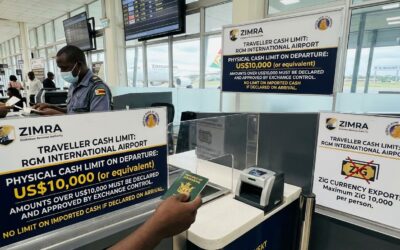
Statutory Instrument 166 of 2024 (Exchange Control (General) (Amendment) Order, 2024 [No. 21]), gazetted on October 7, 2024, repeals SI 20A of 2023 and adjusts the physical cash transport limits for individuals leaving Zimbabwe. Under SI 166 of 2024, the maximum physical currency allowed on a person or in baggage upon departure (as well as inside airport/port departure and transit lounges) is capped at:
- Foreign Currency: An amount equivalent to US$2,000 total (or its equivalent in other foreign currencies).
- Local Currency (ZiG): An amount equivalent to US$2,000 in Zimbabwe Gold (ZiG) notes and coins.
This legislation was introduced concurrently with the Reserve Bank of Zimbabwe’s monetary policy adjustments, foreign exchange auction/interbank directives, and enforcement measures aimed at curtailing illicit financial flows (IFFs), physical currency flight, and informal arbitrage following the devaluation of the ZiG in late September 2024.
Key Provision Breakdowns
Physical Allowance Adjustments
- Reduction in Foreign Currency Allowance: Reverses previous higher physical cash thresholds (which were set at US$10,000 under earlier regulations and previously reduced to US$5,000 under SI 20A of 2023), establishing a strict US$2,000 physical cap.
- Transit & Departure Lounge Limits: Section 14 explicitly criminalizes the possession of cash exceeding the equivalent of US$2,000 in departure or transit lounges without prior Exchange Control authorization under SI 109 of 1996.
- Dual Currency Cap: Separately caps physical local currency (ZiG) and foreign currency (USD or equivalent) at US$2,000 value each.
Interplay with RBZ Foreign Exchange Directives (FXD Directives)
SI 166 of 2024 works in tandem with broader Reserve Bank of Zimbabwe Exchange Control Directives:
- Digitalisation of Cross-Border Payments: Forces all transactions exceeding the US$2,000 physical cash limit onto electronic/banking channels (SWIFT, credit/debit cards, official wire transfers).
- Export Retention & Liquidation Rules: Does not alter the statutory export retention ratio (typically 75% retained in USD, 25% surrendered/converted to local currency at the prevailing official interbank exchange rate), but restricts the ability of exporters or informal trade operators to physically repatriate or export cash yields.
- Importers’ Allocation Mechanism: FX Directives require formal importers to access foreign currency primarily via the Interbank Foreign Exchange Market through authorized dealers (banks), limiting informal physical cash importation.
Impact Analysis
A. Implications for Foreign & Domestic Investors
- Capital Controls & Repatriation Friction: Tightening physical cash exit limits reinforces investor perception of stringent exchange controls. While corporate profit and dividend repatriation are governed by bank wire transfers rather than physical cash, the tightening signals tighter overall liquidity and foreign reserve management by the central bank.
- Increased Transaction Costs: Investors and executive personnel travelling across borders must rely exclusively on electronic cards or formal banking arrangements for business expenses exceeding US$2,000, incurring bank processing fees and exchange spread costs.
- Ease of Doing Business: Unscheduled audit checks and strict enforcement at ports of entry increase administrative friction for cross-border business travel and informal investment operations.
B. Implications for Importers & Informal Cross-Border Traders (ICBTs)
- Severe Constraint on Informal Importers: A substantial portion of Zimbabwe’s retail and informal sector relies on Informal Cross-Border Traders (ICBTs) who physically travel to regional hubs (e.g., South Africa, Mozambique, Zambia, China, UAE) carrying cash to purchase fast-moving consumer goods (FMCG), hardware, and apparel. The US$2,000 limit severely curtails their purchasing scale per trip.
- Formalization of Import Channels: Forces medium and small importers toward formal banking channels (telegraphic transfers/letters of credit). However, due to backlogs, spreads, or documentation requirements at commercial banks, many micro-importers face operational bottlenecks.
- Supply Chain Disruption in Informal Retail: Small businesses unable to secure formal foreign exchange lines face reduced inventory volumes, leading to localized supply squeezes or higher shelf prices to cover the increased cost of digital foreign payments.
C. Macroeconomic & Systemic Implications
- Curbing Illicit Financial Flows (IFFs) & Cash Smuggling: The primary macroeconomic objective of SI 166 of 2024 is to plug leakage of physical USD liquidity from the domestic economy into regional informal circulation.
- Foreign Currency Liquidity Retention: By restricting cash outflows, the RBZ attempts to force USD velocity back into domestic commercial bank deposits, increasing formal banking sector liquidity.
- Impact on the Parallel Market:
- Short-term: Restricts physical cash drain, which can help stabilize physical USD availability domestically.
- Medium-term: If formal channels fail to satisfy legitimate foreign currency demand for imports and travel, it risks driving informal premiums higher as economic agents seek workaround mechanisms (e.g., informal remittance offsets).
- Underpinning the ZiG Currency: Capping physical ZiG export prevents offshore dumping or speculative offshore trading of physical domestic banknotes.
Southern Africa (SADC)
| Country | Physical Cash Exit Allowance | Regulatory Stance / Mechanisms | Primary Policy Objective |
| Zimbabwe (SI 166/2024) | US$ 2,000 (or equivalent) | Strict capital controls, mandatory banking declarations, digital channel enforcement. | Curb acute cash flight, support ZiG, restrict informal import cash drain. |
| South Africa | ZAR 25,000 (cash) / ZAR 1,000,000 (Single Discretionary Allowance p.a. via banks) | Highly developed banking system; South African Reserve Bank (SARB) requires declaration above limits. | Financial surveillance, tax compliance (SARS), anti-money laundering (AML). |
| Zambia | US$ 5,000 (equivalent in cash without approval) | Bank of Zambia regulations require declaration of amounts $\ge$ US$5,000 or equivalent. | AML/CFT tracking, foreign reserve monitoring. |
| Botswana | BWP 10,000 or US$ 10,000 equivalent | Liberalized capital account; physical amounts exceeding limit require simple declaration. | Compliance with FATF standard financial transparency. |
| Mozambique | MZN 10,000 / US$ 5,000 equivalent | Central Bank (Banco de Moçambique) controls on physical exits; declaration required. | Preserve formal foreign exchange reserves. |
Comparative Insights
- Tightest Limits in SADC: Zimbabwe’s US$2,000 threshold is among the lowest physical currency allowances in the Southern African Development Community (SADC) region.
- Structural Dependence on Cash: Unlike South Africa or Botswana, where card usage and digital cross-border settlements are seamless, Zimbabwe operates in a highly dollarized, cash-reliant informal economy. Thus, a low limit impacts daily commerce more severely in Zimbabwe than in peer nations.
- Capital Account vs. Surveillance: While peers like Zambia and Botswana use cash limits primarily for AML/CFT tracking and reporting, Zimbabwe uses them actively as a tool for exchange rate stabilization and liquidity conservation.
Recommendations
Strategic Conclusions
- Policy Intent: SI 166 of 2024 is an administrative capital control measure designed to defend foreign currency reserves and force economic activity into the formal banking system following currency volatility.
- Asymmetric Risk: The burden falls heavily on informal importers, small enterprises, and cross-border traders who lack established corporate lines of credit or efficient access to formal interbank foreign exchange allocations.
- Institutional Trust Imperative: The success of SI 166 of 2024 in formalizing trade depends entirely on the efficiency, availability, and cost-effectiveness of the formal banking system’s foreign exchange settlement channels.
Recommendations
- For Importers & Businesses: Transition purchasing frameworks away from cash-in-hand models toward telegraphic transfers (TTs), corporate VISA/Mastercard solutions, and trade credit facilities with foreign suppliers.
- For Investors: Focus on structuring capital inputs and exit strategies via formal banking avenues and registered Exchange Control approvals rather than relying on cash handling. Ensure full compliance with Reserve Bank of Zimbabwe registration for inbound capital loans or equity.
- For Policymakers: Pair physical cash restrictions with streamlined interbank FX allocation mechanisms for Small and Medium Enterprises (SMEs) to prevent supply chain bottlenecks and minimize parallel market incentives.