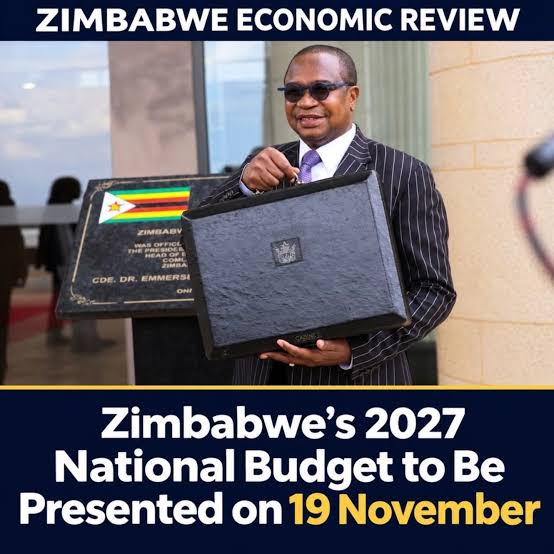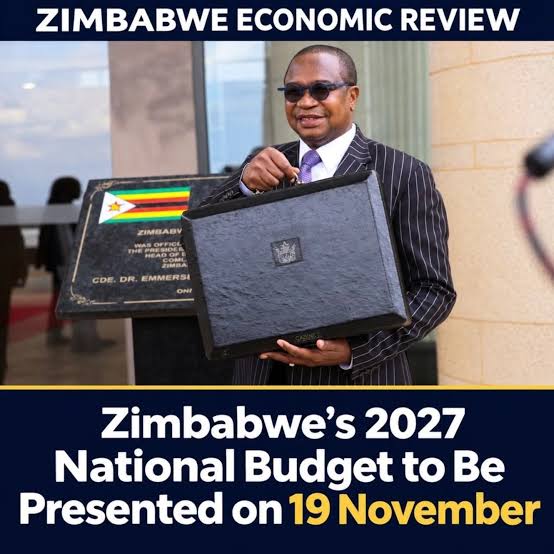
The 2027 National Budget Statement running with the theme (“Accelerating Economic Transformation and Building Resilience to Climate and Global Shocks”, presented to Parliament by Hon. Prof. Mthuli Ncube, Minister of Finance, on 19 November 2026 specifically the Macro-Fiscal Framework and Revenue Mobilisation Towards Vision 2030 .
Macro-Fiscal Context & Revenue Mobilisation Strategy (2027–2030)
- Medium-Term Revenue Target: Under National Development Strategy 2 (NDS2) and the Medium-Term Revenue Strategy (MTRS), Government aims to raise the revenue-to-GDP ratio from 17.5% (2026) to 22.0% by 2030 (and 18.1% of GDP in 2027).
- 2027 Fiscal Envelope :
- Total Revenue: ZiG349.54 billion (US$12.5 billion), comprising ZiG335.6 billion (US$12.0 billion) in tax revenue and ZiG13.9 billion (US$498 million) in non-tax revenue.
- Total Expenditure: ZiG358.30 billion (US$12.8 billion) (18.6% of GDP), yielding a modest projected fiscal deficit of ZiG8.76 billion (0.5% of GDP).
- Macroeconomic Baseline: Real GDP growth projected at 3.5% in 2027 (moderating from 5.0% in 2026 due to a projected Super El Niño drought), single-digit ZiG and USD inflation, and an interbank exchange rate anchored around ZiG25–27/US$.
- Six Core Tax Policy Pillars :
- Enhancing transaction traceability via banking and digital payment systems.
- Broadening the tax base by closing sectoral gaps (real estate, digital economy, informal retail, transport, construction).
- Aligning digital services taxation with international benchmarks.
- Strengthening enforcement via ICT integration (TaRMS, e-TRACE, ASYCUDA) and data sharing.
- Rationalising tax expenditures to target productive, export-oriented, and job-creating investments.
- Granting targeted tax relief to combat bracket creep, lower transaction costs, and boost voluntary compliance.
Tax Relief Measures (Budget and Finance Bill Clauses )
Personal Income Tax (PAYE) Bracket Restructuring (Budget ; Bill Clauses)
- Policy Rationale: Eliminates “bracket creep” for low-income earners, injects US$81 million back into household disposable income, and unifies USD and ZiG employment taxation.
- Statutory Mechanism (Bill Clauses 2–4):
- Repeals section 14(2)(b) of the Finance Act [Cap. 23:04] and inserts Section 14A, suspending the separate local-currency brackets in section 14(2)(a) from 1 January 2027.
- Under Clause 3(2), any employment income earned in ZiG is converted into its USD equivalent at the exchange rate on the date of accrual and taxed under the single USD-denominated table.
- Proposed PAYE Tax Table (Monthly & Annual Equivalents):
| Monthly Taxable Income (US$ / ZiG Equiv.) | Annual Taxable Income (US$) | Marginal Tax Rate |
| Up to US$150.00 *(up from US$100)* | Up to US$1,800 | 0% (Tax-Free Threshold) |
| US$150.01 to US$300.00 | US$1,801 to US$3,600 | 20% |
| US$300.01 to US$700.00 | US$3,601 to US$8,400 | 25% |
| US$700.01 to US$1,200.00 (Bill: US$1,183.33) | US$8,401 to US$14,200 | 30% |
| US$1,200.01 to US$3,000.00 | US$14,201 to US$36,000 | 35% |
| Above US$3,000.00 | Above US$36,000 | 40% |
- Technical & Drafting Observations:
- Budget vs. Bill Variance: Table 39 of the Budget Speech sets the 30% band ceiling at US$1,200/month (US$14,400/year), whereas the Departmental Draft Finance Bill (Clauses 3 & 4) sets the annual ceiling at US$14,200 (US$1,183.33/month). Additionally, Clause 4’s table contains a typographical overlap (
US$ 14 001 to US$ 36 000instead ofUS$ 14 201 to US$ 36 000). Expect alignment during Parliamentary Committee Stage. - Currency Arbitrage Eliminated: Employees earning split USD/ZiG salaries can no longer claim two separate tax-free thresholds.
- Budget vs. Bill Variance: Table 39 of the Budget Speech sets the 30% band ceiling at US$1,200/month (US$14,400/year), whereas the Departmental Draft Finance Bill (Clauses 3 & 4) sets the annual ceiling at US$14,200 (US$1,183.33/month). Additionally, Clause 4’s table contains a typographical overlap (
Deemed Interest Rate on Employer-Assisted Loans (Budget ; Bill Clause )
- Change: Amends section 8(1)(f) II (2)(b)(i)(h) of the Income Tax Act [Cap. 23:06] effective 1 January 2027:
- Foreign Currency Loans (> US$100): Benchmark rate reduced from SOFR + 5% to SOFR + 3.5% per annum.
- Local Currency (ZiG) Loans (> US$100 equivalent): Benchmark rate fixed at 15% per annum.
- Drafting Note: Clause 6 retains legacy text referencing “the year of assessment beginning on the 1st January, 2021” inside the substituted paragraph despite the opening effective date of 1 January 2027, a minor drafting anomaly requiring clean-up.
Intermediated Money Transfer Tax (IMTT) Reduction & Reconciliation Rule (Budget ;Bill Clause)
- Rate Reductions (Effective 1 January 2027):
- ZiG Transactions (
s.22G(1)(a)): Reduced from 1.5% to 1.25% (maintaining a 50 bps preference over USD). - USD Transactions (
s.22G(1)(b)): Reduced from 2.0% to 1.75%. - High-Value Cap: Capped at a flat US$10,150 (or ZiG equivalent) on single transactions >= US$500,000.
- ZiG Transactions (
- Fiscal Cost & Anti-Leakage Safeguard: Foregoes approximately US$100 million in revenue to encourage formal electronic settlement. Crucially, companies claiming IMTT as a tax-deductible expense must now prove to ZIMRA that their declared quarterly gross revenues reconcile with deposits made through the formal financial system (Budget para. 616).
- Critical Bill Drafting Error: Clause 5(b) of the Bill writes “one comma zero seven five per centum” (1.075%) in words alongside “(1,75%)” in figures—confirming the Budget Speech rate is 1.75%, so the words must be corrected before enactment.
Other Targeted Tax & Customs Relief Measures (Budget pp. 228–232)
- Going-Concern Business Sales (
s.10(1)(e), VAT Act; Bill Clause 8): Restores 0% VAT (zero-rating) on the sale of a business (or separately operable part) as a going concern between registered operators to eliminate 30-day upfront VAT financing bottlenecks, subject to a strict new anti-avoidance precondition (Proviso (iii)): both the supplier and the recipient must have been fully VAT-compliant (registration and tax payments) for the entire 12 months preceding the date of supply. Any default within that 12-month window disqualifies the transaction and triggers standard 15.5% VAT. - Electric Vehicles & Green Transport (p. 229): Customs duty on electric vehicles and attendant charging infrastructure reduced from 25% to 10%.
- ICT Gadgets & ATMs (pp. 229–230): Customs duty on cellular phones slashed from 25% to 0% (to undercut grey-market smuggling and capture formal retail VAT), and customs duty removed (0%) on Automated Teller Machines (ATMs) from 1 January 2027.
- Assistive Devices for Persons with Disabilities (p. 231): Removal of customs duty on wheelchairs, hearing aids, sight-correcting lenses/frames, and white canes for visually impaired persons (effective 1 January 2027).
- Dairy & Food Relief (pp. 231–232): Repeal of the 5% Dairy Revitalisation Levy on imported dairy products, and removal of VAT on freshwater fish (aligning it with other exempt proteins).
Industrial Support & Sectoral Stimulus Packages (Budget pp. 232–237; Bill Clause 9)
- Provincial Special Economic Zones (SEZs) (pp. 232–234): Time-bound, performance-based incentives for genuinely new investments in designated Provincial SEZs (strictly barring relocation/splitting of existing businesses):
- Preferential Corporate Income Tax (CIT) rates;
- Accelerated capital allowances on new plant and machinery;
- Customs duty exemptions on approved capital equipment; and
- Expedited VAT refunds.
- Fertiliser Manufacturing Stimulus (pp. 234–235): Effective 1 November 2026, a Rebate of Duty on raw materials, specialised intermediate inputs, and capital equipment across the fertiliser value chain (targeting expansion of ammonium nitrate output from minimal levels toward the 380,000 MT national demand), conditioned on progressive retail price reductions toward global benchmarks.
- Energy & Power Generation (p. 235): Rebate of duty on specified renewable and non-renewable power generation equipment, including energy storage facilities and ancillary equipment for approved projects.
- Motor Vehicle Assembly SKD Duty Suspension (pp. 235–236): Effective 1 December 2026, 0% customs duty (down from 10%–40%) on Semi-Knocked Down (SKD) kits imported by approved local assemblers for motorcycles, electric cargo motorcycles, goods vehicles up to 20 tonnes, electric passenger vehicles, and trailers/semi-trailers (positioning local assemblers for AfCFTA).
- Sanitary Wear Manufacturing (pp. 236–237): Expands the Sanitary Wear Manufacturer’s Rebate from 1 January 2027 to cover eco-friendly and reusable materials (such as towelling).
- Telecommunications VAT Deferment & Duty Removal (p. 237; Bill Clause 9): Amends
s.12A(4)of the VAT Act from 1 January 2027 to extend import VAT deferment to prescribed telecommunications capital equipment and maintenance/refurbishment spare parts (excluding road motor vehicles), alongside removal of residual customs duties.
Revenue-Enhancing Measures (Budget pp. 237–247; Bill Clauses 7 & 10)
Value Added Tax & Virtual Assets (pp. 237–239; Bill Clause 7)
- VAT Exemption for Licensed Virtual Asset Service Providers (VASPs) (Clause 7): Amends the definition of “financial services” in
s.2(1)of the VAT Act to include VASPs registered/licensed under the Securities and Exchange Act [Cap. 24:25]. Consequently, VASP intermediation fees become VAT-exempt (no output VAT charged, but input VAT on overheads/IT infrastructure is blocked/apportioned). - Punitive Minimum VAT Compliance Surcharge (pp. 238–239):
- Targets VAT-registered operators failing to fiscalise, file returns, or keep proper records, as well as operators trading above the compulsory registration threshold without registering (explicitly flagging FMCG, building materials/bricks, and motor spares).
- Imposes a mandatory minimum nominal surcharge of US$500,000 per tax period in default, regardless of actual turnover or VAT liability, in addition to underlying VAT and statutory penalties.
- Automatic Income Tax Registration & Whistleblower Reward: Crossing the compulsory VAT threshold automatically triggers CIT/PIT registration, backed by a new public informer reward scheme for successful tax recoveries.
Extractive Sector Overhaul: Royalties, Export Taxes & Deemed Valuation (pp. 240–244; Bill Clause 10)
- Diamonds — Two-Tier Royalty (p. 240): Replaces the flat 10% royalty to cushion miners against lab-grown diamond price pressure:
- 5% where international diamond price is below US$100/carat;
- 10% on the incremental value above US$100/carat.
- Gold — Windfall Incremental Royalty (p. 241): Charges a 10% mineral royalty on the incremental value above US$5,000/oz (amid record bullion prices averaging US$4,600/oz in 2026).
- Platinum Group Metals (PGMs) — Graduated Export Tax (p. 241; Bill Clause 10): Redefines “unbeneficiated platinum” in
s.12Dof the VAT Act effective 1 January 2027 as any process short of producing refined individual PGMs, imposing non-recoverable export levies based on international refined metal prices:- PGM Washed Ore: 10.0%
- PGM Concentrate: 5.0%
- Converter / Smelter Matte: 2.5%
- PGM-Rich Concentrate + Base Metals: 1.0% (in Budget Table 42; note Bill Clause 10 omits this 1% tier—likely to be aligned in Committee Stage)
- Refined Individual PGMs (Pellets/Ingots) & New Producers (first 5 years post-1 Jan 2018): 0%
- Coal — Point-of-Export Liability (p. 242): To curb transfer pricing and artificial deferral, mineral royalties and the Corporate Social Responsibility Levy (CSRL) on coal become due at the point of export (or upon conclusion of sale for local sales), with fallback assessment at export/final consumer price if payment proof is missing.
- Lithium — Deemed Lithium Sulphate Valuation Formula (pp. 242–244):
- Export tax, royalties, and CSRL on exported lithium concentrate are assessed on the gross fair market value of the equivalent recoverable lithium sulphate using MMCZ Multi-Product Pricing and statutory conversion ratios:
- 5% grade concentrate: 6:1 (tons of concentrate to tons of lithium sulphate)
- 6% grade concentrate: 5:1
- No deduction for transportation costs is permitted when computing export tax (deductible only for Income Tax), while locally beneficiated lithium sulphate attracts 0% export tax.
- Export tax, royalties, and CSRL on exported lithium concentrate are assessed on the gross fair market value of the equivalent recoverable lithium sulphate using MMCZ Multi-Product Pricing and statutory conversion ratios:
- Dimensional Stones & General Mining Rules (p. 257): Export tax on dimensional stones affirmed at 5% (uncut/unpolished), 2.5% (cut/unpolished <= 5cm), and 0% (cut/polished <= 5cm). Export taxes and CSRL are explicitly non-deductible for Income Tax, while Special Mining Lease holders with >= 15% State shareholding are exempted from Additional Profit Tax and allowed to deduct mineral transport costs.
Digital Economy & Offshore Digital Services Taxation (pp. 244–247)
- Elimination of VAT / DSWT Double Taxation (p. 245): Imported digital services are exempt from reverse-charge VAT where Digital Services Withholding Tax (DSWT) has already been withheld by a financial institution on the same transaction.
- Procurement of
e-TRACESystem (p. 245): ZIMRA will procure the Electronic-Transaction Recording, Analysing, Controlling and Exchange System (e-TRACE) to monitor and track cross-border electronic payments to offshore digital platforms (streaming, cloud, e-hailing, online marketplaces, gambling, SaaS). Clarifies that DSWT does not apply to physical goods bought online (which pay customs duty/import VAT at the border). - Income Tax Nexus on Non-Resident Digital Platforms (pp. 246–247): Expands source rules based on user location, introduces electronic registration/filing for non-resident digital providers, and targets revenue fragmentation and artificial restructuring.
Tax Administration, Property, Trusts & Enforcement Measures (Budget pp. 247–261; Bill Clause 11)
Capital Gains Tax (CGT) and Trust Anti-Avoidance Overhaul (pp. 249–251; Bill Clause 11)
- Major CGT Reforms (Budget p. 250):
- ZSE Listed Securities: Complete removal of CGT and Capital Gains Withholding Tax on disposals of shares listed on the Zimbabwe Stock Exchange (boosting capital market liquidity).
- Virtual Assets: Introduces CGT on disposals/transfers of virtual assets and brings crypto platforms within the definition of a “depositary”.
- Special CGT Harmonisation: Eliminates double taxation where 20% Special CGT applies (offshore transfers of mining title/immovable property) and exempts disposals of specified assets by locally incorporated companies from Special CGT.
- Purchaser Withholding Obligation & 15-Day Filing: Designates the purchaser as withholding agent where no depositary/conveyancer is involved, and standardises CGT return filing to 15 days from transaction date.
- Family Trust Exemption vs. Trust-to-Trust Anti-Avoidance (pp. 250–251):
- Relief: Exempts the transfer of a Principal Private Residence (PPR) into a family trust from CGT.
- Anti-Avoidance: Treats changes in trustees or beneficiaries that shift economic ownership, entitlement, or effective control of immovable property between trusts as a taxable CGT disposal (excluding REITs).
- High Court “Substituted Trustee” Recovery Mechanism (Bill Clause 11 – New
s.29Aof CGT Act):- Attaches CGT liability directly to trustees and grants ZIMRA full attachment remedies against trust property.
- If a trust fails or has a trustee vacancy, the asset is deemed to revert to the settlor/founder, who becomes personally liable for CGT.
- Where the settlor is deceased/untraceable and trustees are vacant or all resident outside Zimbabwe, ZIMRA may apply to the High Court (after Gazette and newspaper notice) to appoint a Substituted Trustee—remunerated directly out of trust assets—to litigate and satisfy the CGT debt.
Immovable Property Stamp Duty & Rental Income Tax (pp. 251–253)
- Progressive Stamp Duty Table on Immovable Property Transfers (in Currency of Trade):
| Property Value (US$ / ZiG Equivalent) | Proposed Stamp Duty Rate |
| Below US$5,000 | 1.0% |
| US$5,000.01 to US$20,000 | 2.0% |
| US$20,000.01 to US$100,000 | 3.0% |
| US$100,000.01 to US$300,000 | 5.0% |
| Above US$300,000 | 7.5% |
- Rental Income Tax & Tenant Withholding Enforcement (pp. 252–253):
- Corporate-registered landlords self-assess on net rental profit (deducting expenses) and are exempt from presumptive tax.
- Non-compliant landlords face 15% Presumptive Rental Income Tax on gross rent, and ZIMRA will use TaRMS data to designate tenants (or estate agents, within 10 days) as mandatory withholding agents to deduct and remit the 15% tax directly.
- Elderly Relief: First US$3,000/year of rental income is exempt for landlords aged 55+ (note: general age-related tax exemptions across Taxes Acts are harmonised at 59 years on p. 259).
Excise, Customs & Cross-Cutting Enforcement Powers (pp. 247–249, 253–261)
- Cigarette Excise Simplification (pp. 247–248): Replaces the hybrid regime (US$5 / 1,000 cigas + 25% ad valorem) with a flat specific excise duty of US$15 per 1,000 cigarettes effective 1 January 2027.
- Single Consolidated VAT Return (p. 248): Aligns legislation with TaRMS by mandating a single VAT return with separate currency-of-trade declarations.
- Digital Stamps & Petroleum Track-and-Trace (pp. 248–249, 253–254): Rolls out digital track-and-trace tax stamps for alcohol, tobacco, and high-risk excisable goods, alongside phased mandatory fuel fiscalisation.
- Used Motor Vehicle Automated Valuation & Clearing Crackdown (pp. 254–256):
- Effective 1 January 2027, replaces invoice-based CIF valuation for used vehicles (greater than 2 years old, excluding luxury/high-performance vehicles > 3,800cc or 450hp) with a fixed Automated Motor Vehicle Valuation Framework based on make, model, engine capacity, and year of manufacture regardless of physical condition.
- Prohibits third-party “runners” from clearing private vehicles—only the actual importer or an accredited/registered Clearing Agent may lodge declarations.
- Quarterly Reporting on “Deemed Smuggled Products” (p. 256): Compels manufacturers and retailers of high-risk goods (Annexure 4) to file quarterly volume/value reconciliations matching ZIMRA import/production data.
- Sweeping ZIMRA Enforcement & Penalty Powers (pp. 258–261):
- US$30/day Late Return Penalty across Income Tax, VAT, and CGT Acts.
- Property Caveats & All-Tax Liens: Empowers ZIMRA to place caveats blocking property transfers until tax debts are settled and extends statutory liens to all tax heads.
- Non-Deductibility of Tax Penalties & Interest codified in law.
- Licensing Body Sanctions: Penalises regulatory/licensing authorities and insurers that issue licences, permits, or cover to emerging-sector operators (e.g., transport) without a valid Tax Clearance Certificate (ITF263).
- Cancellation of Tax Agent Licences for practitioners aiding tax evasion/avoidance, and SIA (25% p.a. over 4 years) extended to all fiscalisation devices.
- Transport Axle Overload Fee: Increased sharply to US$10 per kg to curb road damage from heavy mineral haulage.
Key Legislative Gaps and Watchlist Between Budget Speech and Departmental Draft Bill
We have noted discrepancies between Finance Bill as it is an early Departmental Draft (containing Clauses 1–11 and listing Clauses 18–20 in the Arrangement of Sections), tax practitioners and corporates should monitor the final Gazetted Finance Bill for:
- Un-drafted Budget Proposals: Several major Budget Speech measures are not yet in Clauses 1–11 of the Departmental Draft and must be inserted before enactment specifically:
- (a) the US$500,000 Minimum VAT Compliance Surcharge;
- (b) ZSE CGT abolition, virtual asset CGT, and trust-to-trust beneficial ownership CGT;
- (c) progressive Stamp Duty rates (1%–7.5%);
- (d) Diamond (5%/10%), Gold (10% above US$5,000/oz), Coal, and Lithium (6:1 / 5:1 sulphate) royalty/export tax formulas; and
- (e) the US$30/day late filing penalty.
- Drafting Errata Requiring Correction in Clauses 1–11:
- Clause 4 PAYE Table: Bracket
14(2)(d)ceiling (US$14,200 vs Budget Speech US$14,400) and theUS$ 14 001typo in row14(2)(e). - Clause 5(b) USD IMTT Rate: Words “one comma zero seven five per centum” (1.075%) vs figures “(1,75%)” (1.75%).
- Clause 6 Loan Fringe Benefit: Legacy “1st January, 2021” reference inside text taking effect 1 January 2027.
- Clause 10 PGM Export Tax: Inclusion of the 1% tier for PGM-rich concentrate + base metals (present in Budget Table 42, omitted in Bill Clause 10).
- Clause 4 PAYE Table: Bracket