As the April 20, 2026, deadline looms, the Zimbabwean business landscape is currently navigating one of the most critical regulatory shifts in decades. The transition from a manual, paper-based registry to the Centralised Integrated Platform for the Administration of Business Entities (CIPZ) is no longer a distant goal—it is a mandatory legal requirement that determines whether your business lives or dies.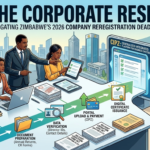
This article explores the legislative roots of company reregistration, the precise requirements you need to meet, and the severe, “corporate-death” consequences of missing the deadline.
1. The Legal Foundation: Why Now?
The mandate for reregistration is not merely an administrative request; it is a statutory obligation born out of the Companies and Other Business Entities Act [Chapter 24:31] (the “COBE Act”), which replaced the old 1951 Companies Act.
Specifically, Section 303(9) of the COBE Act grants the government the power to require all existing entities to reregister. This was further formalized through Statutory Instrument 108 of 2025, which officially set the final cutoff date:
The Deadline: All companies and Private Business Corporations (PBCs) registered before February 2024 must complete reregistration by April 20, 2026.
The primary goal of this legislation is to “clean” the national register of “ghost” or “shell” companies and ensure every active business is integrated into the digital CIPZ system for better transparency and corporate governance.
2. Requirements for Reregistration
Reregistration is more than just re-submitting your old papers. It is a “compliance audit” that ensures your company’s records are accurate and up-to-date. To successfully reregister on the CIPZ portal, you must prepare the following:
A. Historical Compliance (The “Cleanup” Phase)
Before the Registrar accepts your reregistration, your “house” must be in order.
-
Annual Returns: You must file all outstanding Annual Returns. If your company hasn’t filed returns for five years, you must pay the backdated fees and penalties before proceeding.
-
Share Capital Redenomination: With the transition from the old ZWL to the ZiG (and the use of USD), companies must ensure their share capital is correctly expressed in accordance with current monetary guidelines.
B. Updated Constitutional Documents
The COBE Act introduced new requirements for a company’s “constitution” (formerly Memorandum and Articles of Association).
-
Original Documents: Scanned copies of your original Certificate of Incorporation and CR forms (CR5, CR6, or the old CR14).
-
Modernized Articles: You may need to amend your Articles of Association to align with the new COBE Act provisions (e.g., regarding electronic meetings and director responsibilities).
C. Digital Personnel Data
The new system is data-heavy. You will need:
-
Verified Digital Details: Valid email addresses and phone numbers for every director and shareholder.
-
National IDs: Clear, scanned copies of National IDs or Passports for all officers.
D. Governance Documents
-
Board Resolution: A formal minute of a directors’ meeting authorizing the reregistration.
-
Shareholder Resolution: A special resolution where shareholders agree to the reregistration.
-
Affidavit of Authority: A sworn statement by a director or authorized representative affirming they have the legal right to reregister the entity.
3. The Reregistration Process: A Step-by-Step Flow
The process has moved entirely online to the CIPZ Portal.
-
Account Creation: Register a user account on the portal.
-
Entity Search: Locate your existing manual record in the system using your old registration number.
-
Data Entry: Input the current details of directors, office addresses, and shareholdings.
-
Document Upload: Attach the scanned PDFs of your resolutions, IDs, and constitutional documents.
-
Payment: Pay the prescribed reregistration fee.
-
Issuance: Once approved, the system generates a new Digital Certificate of Incorporation and updated CR forms (CR5 and CR6).
4. The Consequences of Non-Compliance
The government has been clear: there will be no “soft landing” for those who miss the April 20, 2026, deadline. The consequences are designed to be “automatic” and “fatal” to the business entity.
I. Automatic Deregistration (Struck Off)
Under the COBE Act, any company that fails to reregister will be automatically struck off the register. Your company effectively “ceases to exist” as a legal person. It is not suspended; it is dissolved.
II. Loss of Limited Liability
This is perhaps the most dangerous consequence. Once a company is deregistered, the “corporate veil” is pierced. If you continue to trade under a defunct company, the directors may become personally liable for all business debts and legal obligations. Your personal assets (cars, homes) could be seized to pay business creditors.
III. Financial and Operational Paralysis
-
Frozen Bank Accounts: Banks are required to hold valid KYC (Know Your Customer) documents. Once the Registrar’s database shows your company is “Struck Off,” banks will freeze your accounts, preventing any withdrawals or payments.
-
ZIMRA Tax Clearance (ITF263): You will be unable to obtain a Tax Clearance Certificate. Without an ITF263, any client paying you more than the set threshold is legally required to withhold 30% of the payment and remit it to ZIMRA.
-
Void Contracts: Legally, a non-existent entity cannot enter into a contract. Your existing leases, supply agreements, and service contracts could become legally unenforceable.
IV. Loss of Brand Identity
Once a company is struck off, its name returns to the “public pool.” A competitor could theoretically register a new company using your exact name, and you would have little legal recourse to stop them since your entity no longer exists.
5. Conclusion: Act Now, Not Later
The reregistration exercise is a hurdle, but it is also an opportunity to modernize your corporate structure and ensure your business is ready for the digital economy. Waiting until April 2026 is a high-risk strategy; portal congestion and document errors could leave you stranded on the wrong side of the deadline.