Why Your Business Should Be Compliant with ZIMRA.
In the modern Zimbabwean economic landscape, the line between a thriving enterprise and a failing one is often drawn by a single factor: Regulatory Compliance. While many entrepreneurs view tax as a burden or a complexity to be avoided, the reality is that compliance with the Zimbabwe Revenue Authority (ZIMRA) is one of the most significant competitive advantages a business can possess.
Registering your business with ZIMRA is not merely an act of following the law; it is a foundational business strategy. This comprehensive guide explores why ZIMRA compliance is vital for success, the tangible benefits of registration, the catastrophic costs of negligence, and how to build a robust system for long-term sustainability.
Understanding ZIMRA’s Role in the Business Ecosystem
ZIMRA is the statutory body responsible for assessing, collecting, and accounting for revenue on behalf of the Government of Zimbabwe. For a business, ZIMRA is more than a “tax collector” it is a gatekeeper. To operate in the formal economy, access credit, or trade with large-scale partners, a business must exist within the ZIMRA database.
The Legal Framework
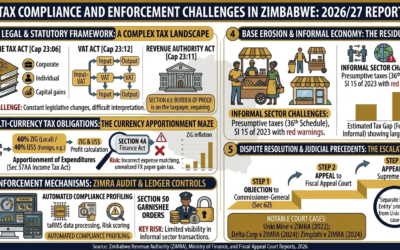
Under the Income Tax Act [Chapter 23:06] and the Value Added Tax Act [Chapter 23:12], any person or entity carrying on trade in Zimbabwe is legally required to register for taxation. Failing to do so is a criminal offense, but more importantly, it creates an “invisible” business that cannot grow beyond informal, cash-based transactions.
The Multi-Faceted Benefits of ZIMRA Registration
Registering with ZIMRA and maintaining “Compliant Client” status unlocks doors that remain locked to informal operators.
A. Easy Access to the Tax Clearance Certificate (ITF263)
The Tax Clearance Certificate, commonly known as the ITF263, is perhaps the most powerful document in Zimbabwean commerce.
-
The 30% Withholding Rule: Under the law, if a registered business pays an unregistered person/entity for goods or services, they are legally obligated to withhold 30% of the gross amount and remit it to ZIMRA.
-
Cash Flow Protection: For a compliant business with an ITF263, you receive 100% of your invoice value. For a non-compliant business, losing 30% of your revenue upfront can instantly wipe out your profit margins and cripple your working capital.
B. High Probability of Winning Bids and Tenders
In both the public and private sectors, the procurement process is highly regulated. Whether you are bidding for a government contract through the Procurement Regulatory Authority of Zimbabwe (PRAZ) or applying to be a vendor for a large multinational corporation, a valid Tax Clearance Certificate is a non-negotiable requirement.
-
Compliance as a Filter: Large organizations use ZIMRA compliance as a primary filter to vet the reliability of suppliers. Without it, your bid is disqualified before it is even read.
C. Enhanced Corporate Image and Trust
In business, “perception is reality.” Being registered with ZIMRA signals to trade counterparts—including banks, suppliers, and investors—that your business is a legitimate, stable, and transparent entity.
-
International Trade: If you intend to export goods or import raw materials, being registered for a Business Partner (BP) Number is essential for clearing customs.
D. Immunity from Fines and Interest
ZIMRA operates on a system of self-assessment and voluntary compliance. Compliant clients who file returns and pay duties on time are not subjected to the punitive measures used to correct non-compliant behavior. This allows you to reinvest those potential “fine funds” back into the growth of your business.
E. Reduced Audit Frequency
ZIMRA utilizes a Risk-Based Audit Approach. Businesses that consistently file accurate returns on time and maintain transparent records are flagged as “low risk.” This means you are less likely to undergo intrusive and time-consuming audits, allowing you to focus your energy on core business operations.
The Hidden and Explicit Costs of Non-Compliance
Many business owners believe they are “saving money” by staying off the ZIMRA radar. This is a dangerous fallacy. The costs of non-compliance are cumulative and often terminal for a business.
A. Punitive Penalties and Additional Taxes
When ZIMRA discovers an unregistered or non-compliant business, they don’t just ask for the missing tax; they apply penalties of up to 100% of the principal tax due.
-
Interest: In addition to penalties, interest is charged on the outstanding amount at a rate that is often much higher than bank lending rates.
-
Back-dating: ZIMRA has the power to back-date your tax liability to the day you started trading, creating a massive debt overnight.
B. The Threat of Garnish Orders
One of ZIMRA’s most potent recovery tools is the Garnish Order. If you have an outstanding tax debt, ZIMRA can instruct your bank to freeze your account and transfer the funds directly to them. This can happen without a court order, leading to:
-
Bounced checks to suppliers.
-
Inability to pay staff salaries.
-
Immediate halt in operations due to lack of liquidity.
C. Legal Repercussions and Court Cases
Non-compliance can lead to civil litigation or criminal prosecution. Being embroiled in legal battles with the state is not only expensive in terms of legal fees but also devastating to the business’s public image. A business associated with tax evasion will find it nearly impossible to secure credit from financial institutions.
D. Time Wasting and Operational Friction
When a business is non-compliant, management spends an inordinate amount of time “firefighting”—responding to ZIMRA inquiries, negotiating payment plans, and trying to hide assets. This is time that should be spent on innovation and sales.
The Blueprint for Compliance: Best Practices
To avoid the pitfalls of non-compliance, a business must adopt a culture of “Compliance by Design.” This involves five key pillars:
-
Submit Returns on Time: Mark your calendar for VAT, PAYE, and Income Tax deadlines. Even if you don’t have the money to pay immediately, always file the return. This avoids the “Failure to Submit” penalty.
-
Pay Taxes on Time: View tax money (like VAT or PAYE) as money held in trust for the government. It should never be treated as working capital for the business.
-
Accuracy in Declaration: Ensure that your “Taxable Income” is calculated correctly. Misrepresenting income or overstating expenses can be flagged during a desk audit, leading to “Additional Tax” assessments.
-
Keep Proper Accounting Records: This is the most critical pillar. Without records, you cannot prove your compliance.
The Vital Role of Record Keeping
Zimbabwean legislation stipulates that a business must maintain accounting records for at least six years. This is not just for ZIMRA’s benefit; it is for yours.
Why Records Matter:
-
Performance Analysis: Records allow you to see your Profit and Loss trends. You can identify which products are performing and which are draining resources.
-
Effective Management: Good records enable you to manage your Accounts Receivable (who owes you money) and Accounts Payable (who you owe), ensuring you never run out of cash.
-
Business Efficiency: Systems like QuickBooks, Xero, or even a well-maintained Excel ledger reduce errors and duplication of work.
-
Informed Decision Making: Should you expand? Should you hire more staff? These decisions should be based on data found in your records, not on “gut feeling.”
-
Assessment Clarity: During a ZIMRA audit, if your records are in order, the process is quick and painless. If your records are shambolic, ZIMRA may use Best Judgment Assessments, which often result in a higher tax bill than you actually owe.
Compliance as a Growth Strategy
In conclusion, being compliant with ZIMRA is the difference between running a “hustle” and building a Business. Compliance provides the legal protection, financial stability, and market reputation necessary to scale in Zimbabwe’s competitive economy.
By registering today, filing accurately, and keeping meticulous records for the required six years, you are not just “paying the government”—you are insuring your business against failure and positioning yourself for the highest levels of success.
Final Thought: The cost of compliance is a scheduled expense. The cost of non-compliance is an unpredictable catastrophe. Choose wisely.
Benefits of Registering your Business with ZIMRA.
Compliance among other strategies is very vital for success of a business. Registering with ZIMRA is being compliant with the Laws of Zimbabwe.
- Enables easy access of your tax clearance certificate.
- Fines, interest, penalties are not levied on compliant clients.
- High probability of winning Bids and tenders.
- Creates a good image with trade counterparts
- Few audits to check compliance.
Costs of non compliant with ZIMRA.
- Penalties, additional taxes, interests as a result of being non compliant.
- Loss on tenders and Bids
- Garnish
- Time wasting
- Court cases which will affect image of the business.
- Leakages of cash flow as a result of being non compliant.
What the Business needs to avoid non compliant costs?
- Submit returns on time.
- Pay taxes on time.
- Pay the correct tax.
- Declare the correct tax due.
- Keep proper accounting records
Benefits of proper accounting records.
Our legislation postulates that the business should keep accounting records for at least six years. Advantages of records keeping include;
- Shows performance of a business.
- Enables effective management of business.
- Business efficiency is derived from good records keeping.
- Improved decision from good record keeping.
- Updated records enables clear assessment.