Dividends vs. Capital Gains: Testing the “Bird in the Hand” Theory on the ZSE and VFEX
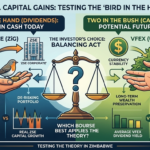 The “Bird in the Hand” theory, famously championed by Myron Gordon and John Lintner, suggests that investors value dividends more highly than potential future capital gains. In a volatile economic climate, the logic is simple: a cash payment today is certain (the bird in the hand), while a future share price increase is risky (the two in the bush).
In the context of Zimbabwe’s dual-exchange system—the Zimbabwe Stock Exchange (ZSE) and the Victoria Falls Stock Exchange (VFEX)—this theory is currently being put to the test as investors weigh currency stability against immediate cash returns.
1. The Theory: Bird in Hand vs. Growth
The core of this theory is the reduction of uncertainty. According to the Gordon Growth Model (
In Zimbabwe’s high-inflation history, the “Bird in the Hand” isn’t just a preference—it’s a survival strategy. Investors often prefer companies that distribute profits quickly before the purchasing power of the local currency can erode.
2. Performance Comparison: ZSE vs. VFEX (2025-2026)
The performance of the two bourses over the past year highlights how “certainty” is priced differently in different currencies.
ZSE: The ZiG Hedge
The ZSE, now trading in the ZiG currency, has historically acted as an inflation hedge. However, in 2025, the market saw a “brutal wake-up call” as the All Share Index faced downward pressure in real terms.
-
Current Trend: Investors on the ZSE are increasingly “dividend-hungry.” Because the ZiG environment carries exchange rate risk, the “Bird in the Hand” (the dividend) is only valuable if paid out and converted or reinvested immediately.
-
Top Performers: Blue-chip counters like Delta Corporation and Econet remain the primary targets for dividend seekers due to their consistent payout ratios.
VFEX: The Bullish USD Haven
The VFEX is the success story of 2025/2026. As a USD-denominated exchange, it eliminates the “currency risk” bush, leaving only the “market risk” bush.
-
Performance: The VFEX All Share Index surged by 54% in 2025, reaching a market cap of nearly US$2 billion.
-
Dividend Application: On the VFEX, the “Bird in the Hand” theory is even more potent. A dividend in USD is a hard-asset return. Counter-intuitively, because the capital gains on the VFEX have been so strong (the “two in the bush” are actually appearing), some investors are willing to tolerate lower yields in exchange for the 50%+ annual growth seen in counters like Simbisa Brands or Innscor.
3. Comparative Summary Table
| Metric | ZSE (ZiG) | VFEX (USD) |
| Primary Attraction | Inflation Hedging | Currency Stability & Growth |
| Dividend Value | Subject to currency erosion | Hard currency value retention |
| 2025 Index Performance | Volatile / Marginal Real Growth | +54% (Bullish) |
| Investor Sentiment | High preference for “Bird in Hand” | Balanced between yield and growth |
4. Why the “Bird” Matters in 2026
As we move through 2026, the application of this theory is shifting. On the ZSE, the “bird” (dividend) is being used to de-risk portfolios. On the VFEX, the “bird” is a bonus on top of massive capital appreciation.
Key Takeaway for Investors:
If you prioritize immediate cash flow to meet local liabilities, the high-dividend-paying heavyweights on the ZSE are your “birds.” However, if you are looking for long-term wealth preservation, the VFEX offers both a “bird” in hard currency and a much larger “bush” of capital gains.
Looking to rebalance your portfolio?
The 2026 dividend season is just starting for many December-year-end companies.