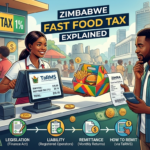
 In Zimbabwe, the introduction of the “Fast Food Tax” represents a significant shift in fiscal policy, blending revenue mobilization with public health objectives. Officially implemented on January 1, 2025, this tax targets the growing consumption of processed foods and their associated health risks, such as obesity and non-communicable diseases.
This article provides a comprehensive breakdown of the legal framework, liability, and the practicalities of remitting this tax through the Zimbabwe Revenue Authority’s (ZIMRA) Tax and Revenue Management System (TaRMS).
1. Legal Framework and Legislation
The Fast Food Tax was introduced through the 2025 National Budget Statement and subsequently codified into law via the Finance Act [Chapter 23:04] (specifically the Finance Act of 2024/2025 amendments).
The primary legislative instrument governing this levy is Section 12F of the Value Added Tax Act [Chapter 23:12], as amended. While it is technically a surcharge or a specific levy on sales, it is integrated into the broader domestic tax framework managed by ZIMRA.
Key Legislative Facts:
-
Effective Date: 1 January 2025.
-
Rate: Initially proposed at 0.5%, the rate was clarified and implemented at 1% of the sales value for specified fast food items.
-
Objective: To discourage the consumption of highly processed foods and generate revenue for the national health fund and fiscal reserves.
2. Who is Liable?
Liability for the Fast Food Tax falls on specific business entities rather than the individual consumer directly (though the economic burden is often passed on).
Eligible Businesses
Any registered operator who operates a:
-
Fast Food Retail Outlet: Establishments primarily focused on quick-service food.
-
Restaurant: Formal dining establishments that sell the specifically listed fast-food items.
Taxable Food Items
The law is very specific about what constitutes “fast food.” Liability arises if you sell:
-
Pizzas, Burgers, and Hot Dogs.
-
Shawarmas and Tacos.
-
French Fries (Chips) and Chicken (fried or processed).
-
Doughnuts and similar confectionery products.
Note on Liability: Even if a business is a “high-end” restaurant, if they sell a “burger” or “french fries” as defined in the Act, they are liable to account for the 1% tax on those specific transactions.
3. Who Remits the Tax?
The Registered Operator (the business owner) is the person responsible for remitting the tax to ZIMRA.
While the business is the “remitter,” they have two choices in how they handle the cost:
-
Passing it on: The business increases the menu price by 1% to recover the tax from the customer.
-
Absorption: Large chains (like Simbisa Brands) have occasionally opted to absorb the tax to remain competitive, meaning the 1% comes directly out of their profit margin.
Regardless of who pays the “economic” price, the legal obligation to calculate, report, and pay the tax lies solely with the business entity.
4. How to Remit via TaRMS
The Tax and Revenue Management System (TaRMS) is Zimbabwe’s digital portal for domestic taxes. Remitting the Fast Food Tax involves a two-step process: Return Submission and Payment Allocation.
Step 1: Registration of the Tax Type
Before you can remit, you must ensure the “Fast Food Tax” obligation is active on your TaRMS profile.
-
Log into the Self-Service Portal (SSP) .
-
Navigate to Taxpayer Registration.
-
Add the Fast Food Tax (FFT) tax type to your profile. The effective date should be 1 January 2025 (or your start-of-trade date).
Step 2: Submitting the Return
-
Frequency: Monthly.
-
Deadline: The return must be submitted on or before the 5th day of the following month (e.g., January sales are reported by February 5th).
-
Process: Select the Fast Food Tax return form in the SSP, enter your gross sales value for the specified items, and the system will automatically calculate the 1% due.
Step 3: Making the Payment
-
Deadline: Payment must be made by the 10th day of the following month.
-
The Single Account Concept: In TaRMS, you do not pay “into” a specific tax head. Instead, you transfer funds to the ZIMRA Commissioner General Single Account at your linked commercial bank.
-
Validation: Use your TIN (Taxpayer Identification Number) as the reference. Once the money hits the ZIMRA bank account, TaRMS detects it and keeps it in your “Single Account” balance.
-
Settlement: Once your return is submitted (Step 2), the system automatically “grabs” the money from your Single Account balance to settle the Fast Food Tax liability.
5. Summary Table for Compliance
| Feature | Detail |
| Tax Rate | 1% of sales value |
| Return Due Date | 5th of every month |
| Payment Due Date | 10th of every month |
| Platform | TaRMS (Self-Service Portal) |
| Relevant Law | Finance Act / VAT Act Section 12F |
| Currency | Payable in the currency of transaction (USD/ZiG) |
Need help with your Taxes, look no further, at Lucent Consultancy we got you covered from
- Compliance
- Advisory
- Planning
- Audit representation.