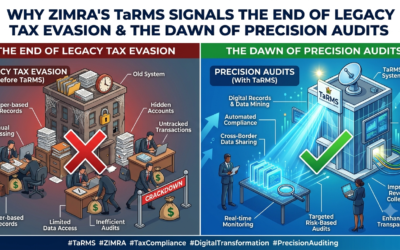
The integration of the Tax and Revenue Management System (TaRMS) and the Fiscalisation Data Management System (FDMS) as outlined in Public Notice 63 of 2025 is a transformative step for Zimbabwe’s tax landscape. While it offers unparalleled efficiency through automation, it also imposes rigid technical and administrative burdens on taxpayers.
Lets explore the benefits and disadvantages of this new measure.
1. Benefits of the TaRMS/FDMS Integration
For the compliant taxpayer, the new system moves ZIMRA from a “paper-heavy” entity to a modern digital partner.
-
Automated Accuracy: The Automatic Input Tax Schedule eliminates the tedious manual entry of invoices. Since the system pulls data directly from the FDMS (the supplier’s side), the risk of human error in typing invoice numbers or amounts is virtually eliminated.
-
Faster Refund Processing: Because ZIMRA has real-time access to the “mirror” data (your purchase is your supplier’s sale), the verification time for VAT refunds is significantly reduced.
-
Protection Against Fraud: The system automatically manages Credit and Debit Notes, preventing the common fraudulent practice of using “ghost” credit notes to artificially reduce VAT liability.
-
Convenient Monitoring: The integration allows for a “Single Account” view. You can see your sales data, purchase claims, and tax status in one place, with an automatic link between the TaRMS and FDMS portals.
-
Level Playing Field: By making Tax Clearance (ITF263) conditional on successful fiscalisation, ZIMRA is forcing informal or semi-formal “grey market” operators to either comply or lose their ability to do business with the government and large corporations.
2. Disadvantages and Challenges
The transition is not without significant “growing pains,” particularly regarding technical stability and strict deadlines.
-
Supplier Dependence: This is the most critical disadvantage. Your ability to claim input tax is now entirely dependent on your supplier’s compliance. If your supplier’s fiscal machine is broken, offline, or they simply fail to upload the data, that invoice will not appear in your TaRMS portal, and you cannot claim the 15.5% VAT.
-
The “Invisible Invoice” Trap: Under the new rules, any invoice dated before December 1, 2025, that was not claimed by December 10, 2025, is now effectively dead. The upgraded system will not accept them, leading to a direct financial loss for businesses that were slow to reconcile their books.
-
Technical Instability: High-traffic periods (near the 10th of the month) have historically caused the TaRMS portal to slow down or glitche. With the new integration, a system failure at ZIMRA or a network outage at your premises can prevent you from issuing valid invoices, which in turn blocks your tax clearance.
-
Manual Entry Remains for Imports: The “Automation” is not yet 100% complete. Taxpayers must still manually capture VAT on Imported Goods and Services. This “hybrid” approach means you still need a high-level accounting team to ensure no manual claims are missed.
-
High Cost of Compliance: Small businesses must invest in expensive hardware or software-based Virtual Fiscal Devices (APIs). While ZIMRA offers a 50% cost-claim incentive, the upfront capital remains a barrier for startups.
-
Rigid Enforcement: The system is “binary”—you are either compliant or you are not. There is less room for the administrative “explanations” that were possible under the old manual system.
Comparison Summary: The Taxpayer Experience
| Feature | The “Pro” (Benefit) | The “Con” (Disadvantage) |
| Data Entry | No more typing in purchase schedules. | If the system misses an invoice, you can’t claim it. |
| VAT Refund | Processed faster due to auto-matching. | Refund denied if a single supplier is un-fiscalised. |
| Compliance | Instant Tax Clearance via the portal. | Clearance blocked automatically for hardware errors. |
| Record Keeping | Digital, cloud-based logs in TaRMS. | High risk of data loss if the 12-month claim window is missed. |
Final Verdict for Taxpayers
The FDMS measure is a double-edged sword. It rewards tech-savvy, organized businesses with faster processing and less paperwork, but it severely penalizes those with weak accounting systems or non-compliant suppliers. To survive this transition, your business must treat “Fiscal Health” as being just as important as cash flow.