Starting a business in Zimbabwe is a bit like embarking on a long-distance road trip from Harare to Victoria Falls. You have the map (your business plan), the fuel (your capital), and the destination (your goals). However, there are “Roadblocks” along the way that aren’t just there for decoration, they are mandatory checkpoints.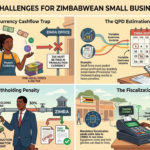
In the world of business, these roadblocks are Tax Compliance. Ignoring them doesn’t just mean a delay; it can mean having your “vehicle” impounded by the Zimbabwe Revenue Authority (ZIMRA).
The Compliance Roadblock: Tax Challenges for Zimbabwean Small Businesses
From the Budget, the 2026 fiscal environment, tax compliance has moved from “suggested” to “strictly enforced” through digital systems. For a small business owner, the following challenges often feel like trying to solve a Rubik’s cube while driving.
1. The “Quarterly Payment Dates” (QPDs) Confusion
Most new business owners think they only pay tax at the end of the year. In Zimbabwe, ZIMRA strongly believe in “Time value Theory” ,wants their share while you are still making the money. This is called Provisional Tax.
-
The Layman Reality: Imagine you’re at a buffet. Instead of paying at the door or at the end, the waiter comes every 15 minutes to take a bite out of your plate.
-
The Challenge: You must estimate how much profit you will make for the whole year and pay it in four installments (March, June, September, and December). If you underestimate by more than 10%, ZIMRA hits you with interest and penalties.
-
Example: “Tatenda’s Tech Hub” predicts a profit of $10,000 for the year. He pays $250 every quarter. But in December, he lands a huge contract and his profit jumps to $50,000. Because he didn’t adjust his “estimates” during the year, he now owes the tax plus a heavy “under-estimation” penalty.
2. The Multi-Currency Headache (USD vs. ZiG)
Zimbabwe operates in a multi-currency system, and ZIMRA is very clear: Tax must be paid in the currency of the transaction.
-
The Layman Reality: If you sell a loaf of bread for USD, the tax is in USD. If you sell it for Zimbabwe Gold (ZiG), the tax is in ZiG.
-
The Challenge: Small businesses often mix these funds in one “pot.” At the end of the month, they might have plenty of ZiG but no USD left to pay the USD tax. ZIMRA does not accept “I have the equivalent in ZiG.” They want the greenbacks.
-
Example: A local hair salon, “Royal Curls,” accepts both currencies. They use their USD to pay for imported Brazilian hair (stock) and keep the ZiG for local expenses. At tax time, they realize they owe $400 in USD tax but only have ZiG in the bank. They are now “non-compliant” despite having money.
3. The 30% Withholding Tax “Trap”
If you do business with another company and you don’t have a valid ITF263 (Tax Clearance Certificate), that company is legally required to take 30% of your payment and send it straight to ZIMRA.
-
The Layman Reality: It’s like a “security deposit” that you never get back easily.
-
The Challenge: For a small business with thin margins (say you make 20% profit), having 30% of your total revenue taken means you are now operating at a loss before you’ve even paid your rent.
-
Example: “Musa Construction” wins a $1,000 contract to fix a roof for a big corporation. Musa forgot to renew his tax clearance. The corporation pays Musa only $700 and sends $300 to ZIMRA. Musa can’t afford the materials to finish the job because his cash flow is crushed.
4. The Fiscalisation “Ghost”
Since January 2026, ZIMRA has moved to TaRMS (Tax and Revenue Management System) and mandatory fiscalisation for almost everyone.
-
The Layman Reality: ZIMRA has a “spy” in your cash register.
-
The Challenge: Every time you ring up a sale, a digital “fiscal device” sends that data to ZIMRA in real-time. The challenge for small businesses is the cost of the equipment and the technical glitches. If your internet is down or your device fails, you are technically breaking the law by selling without a fiscal receipt.
-
Example: “Mai Chisamba’s Grocery” has a power cut. Her fiscal printer dies. She continues selling using a manual receipt book. A ZIMRA “mystery shopper” walks in, gets a manual receipt, and Mai Chisamba is fined $25 per day for every day she was “non-interfaced.”
5. The “VAT Registration” Threshold
Small businesses often fear the 15.5% Value Added Tax (VAT). Currently, if your turnover reaches US$25,000 (or ZiG equivalent) per year, you must register for VAT.
-
The Layman Reality: You become a tax collector for the government.
-
The Challenge: Once you register, your prices must go up by 15.5%. If your competitors aren’t registered, they look “cheaper” than you. If you don’t register when you should have, ZIMRA can backdate your bill, meaning they charge you for the tax you should have collected from customers a year ago!
-
Example: A small printing shop reaches the $25 000 limit but stays “under the radar.” Two years later, ZIMRA audits them and finds they should have been registered. They hit the shop with a bill for $7,750 (15.5% of two years’ revenue) plus 100% penalty. The shop has to close down.
Conclusion: The “Compliance Parachute”
Compliance isn’t just about paying money; it’s about Record Keeping.
In Zimbabwe, the 2026 regulations mean ZIMRA has more “visibility” into your business than ever before through bank data and mobile money tracking. The best way to keep your plans from being “crushed” is to:
-
Get an Accountant: Even a part-time one.
-
Separate your Wallets: Keep USD for USD taxes.
-
Stay Valid: Never let your ITF263 expire.