
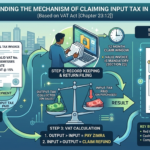
This article provides a comprehensive exploration of the mechanism of claiming input tax, with a specific focus on the legal framework of the Value Added Tax (VAT) Act [Chapter 23:12] in Zimbabwe (and similar principles in regional acts like the South African VAT Act).
The Engine of Business: Understanding the Mechanism of Claiming Input Tax
In the world of commerce, Value Added Tax (VAT) is often viewed as a burden—a 15.5% surcharge that makes goods more expensive. However, for a Registered Operator, VAT is not a cost, but a flow-through. The “magic” that prevents VAT from becoming an expense for your business is the Input Tax Claim.
Under Section 23 of the VAT Act, businesses that meet certain turnover thresholds must register as VAT operators. Once registered, they gain a powerful advantage: the ability to “claw back” the VAT they pay to their suppliers.
1. The Core Concept: Input vs. Output Tax
To understand how to claim, you must first understand the two sides of the VAT coin:
-
Output Tax: This is the VAT you collect from your customers when you sell a product or service. You are essentially acting as a tax collector for the government.
-
Input Tax: This is the VAT you pay to your suppliers when you buy stock, equipment, or services for your business.
The Mechanism: At the end of every tax period, you perform a simple subtraction:
If your Input Tax is higher than your Output Tax, the Revenue Authority (e.g., ZIMRA) owes you a refund.
2. The Gateway: Section 23 and Registration
You cannot claim input tax unless you are a Registered Operator. Under Section 23, registration is:
-
Compulsory: If your taxable supplies (sales) exceed a specific threshold (e.g., US$25,000 or the equivalent in ZiG) in a 12-month period.
-
Voluntary: If you expect to exceed the threshold or have already started making taxable sales.
The Advantage: An unregistered business pays $115.50 for a widget ($100 + $15.50 VAT) and that $15.50 is a lost cost. A Section 23 Registered Operator pays the same $115.50 but gets to claim the $15.50 back, making their actual cost only $100.
3. The “Golden Ticket”: Section 20 and the Tax Invoice
The law is strict: No valid invoice, no claim. Section 20 of the VAT Act (often read alongside Section 23) dictates exactly what a “Fiscal Tax Invoice” must look like. If your supplier gives you a simple “cash sale” slip without these details, your claim will be rejected.
Requirements of a Valid Fiscal Tax Invoice:
-
The Words: “Fiscal Tax Invoice” must be prominent.
-
Supplier Details: Name, address, and VAT/TIN (Taxpayer Identity) number.
-
Recipient Details: If the sale is over a certain limit, it must include your business name, address, and VAT number.
-
Transaction Details: A unique serial number, the date, and a clear description of goods.
-
The Math: The total price, the VAT amount (at 15.5%), and the total consideration.
4. Real-World Example: The “Table Maker”
Let’s see the mechanism in action using a layman’s example of “Tino’s Carpentry,” a VAT-registered business.
Step A: The Purchase (Input Tax)
Tino buys timber from a supplier for $1,155.
-
The timber cost is $1,000.
-
The VAT (15.5%) is $155.
-
Tino receives a Section 20 compliant invoice.
-
Tino has now “paid” $155 in Input Tax.
Step B: The Sale (Output Tax)
Tino builds a beautiful dining table and sells it for $2,300.
-
The table price is $2,000.
-
The VAT (15.5%) he charges the customer is $310.
-
Tino has “collected” $310 in Output Tax.
Step C: The Claim
At the end of the month, Tino submits his VAT return:
-
Output Tax Collected: $310
-
Input Tax Paid: ($155)
-
Net VAT to pay ZIMRA: $155
The Result: Tino didn’t lose the $155 he paid for timber; it reduced his debt to the tax office. If Tino had bought a new $5,000 delivery truck that month (paying $775 in VAT), his Input Tax would have been higher than his Output Tax, and he would receive a refund check from the government.
5. Prohibited Claims: Where the Advantage Ends
Not everything you buy for your business allows for an input tax claim. The Act specifically excludes certain items to prevent personal expenses from being subsidized by tax claims:
-
Passenger Motor Vehicles: Generally, you cannot claim VAT on a sedan or SUV, even if used for business, unless you are a car dealer or tour operator.
-
Entertainment: VAT on staff parties, business lunches, or “client golf days” is usually non-claimable.
-
Exempt Supplies: If you are a landlord renting out residential apartments (which is an “exempt supply”), you cannot claim VAT on the paint or repairs you buy.
6. Time Limits and Record Keeping
According to the Act, you must claim your input tax within 12 months of the invoice date. If you find an old invoice from two years ago, the “advantage” has expired, and that VAT is now a permanent cost to your business.
The 6-Year Rule: You must keep your original fiscal tax invoices for at least six years. If an auditor visits and you cannot produce the physical or digital “Section 20” invoice, they will “claw back” the claim, charging you the tax plus heavy penalties.
7. Conclusion
The mechanism of claiming input tax is the heartbeat of a healthy, VAT-registered business. By ensuring you only trade with other registered operators who provide valid Section 20 invoices, you effectively remove the 15% tax burden from your business purchases. This keeps your prices competitive and your cash flow strong.
Summary Table for Quick Reference:
| Feature | Requirement / Rule |
| Eligibility | Must be a Registered Operator under Section 23. |
| Document | Must hold a valid Fiscal Tax Invoice per Section 20. |
| Calculation | Output Tax minus Input Tax. |
| Time Limit | Claim within 12 months of the invoice date. |
| Retention | Keep records for 6 years. |
📑 VAT Input Tax Compliance Checklist (Section 20)
Goal: To verify that an invoice is a “Fiscal Tax Invoice” and eligible for an input tax claim.
1. Header & Identity
-
[ ] Document Title: Does it explicitly say “Fiscal Tax Invoice”? (Documents labeled “Provision Invoice,” “Statement,” or “Quote” are not valid for claims).
-
[ ] Supplier Name: Is the full legal name of the seller visible?
-
[ ] Supplier Address: Is the physical business address of the seller included?
-
[ ] Supplier VAT Number: Is the seller’s 9 or 10-digit VAT registration number printed?
-
[ ] Supplier BP Number: Is the Business Partner (BP) number present?
2. Recipient Details (Your Business)
Note: For transactions over a specific small-value threshold (e.g., $10 or equivalent), your details MUST be on the invoice.
-
[ ] Your Company Name: Is your registered business name spelled correctly?
-
[ ] Your VAT/TIN Number: Is your tax information clearly stated on the invoice?
-
[ ] Your Address: Is your business address included?
3. Transaction Traceability
-
[ ] Invoice Number: Does it have a unique, sequential serial number?
-
[ ] Date of Issue: Is the date clearly visible? (Check: Is it older than 12 months? If yes, do not claim).
-
[ ] Description of Goods/Services: Is there a clear description of what was bought? (Avoid vague descriptions like “Merchandise” or “Services”).
-
[ ] Quantity/Volume: Are the units (liters, kgs, hours, etc.) specified?
4. The Financial Breakdown
-
[ ] Total Excluding VAT: The base price of the goods.
-
[ ] VAT Amount: Is the VAT calculated correctly (usually at 15.5%)?
-
[ ] Total Including VAT: The final amount paid.
-
[ ] Currency: If the transaction was in a foreign currency (like USD), does it show the exchange rate or the conversion to local currency (ZiG) if required by current directives?