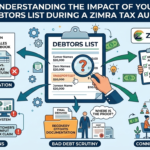
When ZIMRA (Zimbabwe Revenue Authority) audits a business, a deep dive into the Debtors (Accounts Receivables) List is a standard procedure. The implications of this are far-reaching, directly impacting the assessment of your Value Added Tax (VAT) liability, Income Tax, and overall risk profile.
We analyse on some of the key implications of debtors during a ZIMRA audit:
1. Revenue Verification (The matching game)
ZIMRA will use the Debtors List to verify if you have correctly recorded all your sales in your books of accounts. This is the foundation of the audit.
-
Under-declaration of Income: If the list shows significant sales to clients that are not reflected in your general ledger or tax returns, ZIMRA will suspect you are hiding income to pay less tax.
-
Reconciling Invoices: Auditors will often take a sample of customers from the Debtors List and trace their specific purchases back through your sales daybook, VAT invoices, and the sales account in the general ledger. They need to see that an invoice was issued and that it was properly accounted for.
-
Timing of Income Recognition: ZIMRA will look at when sales were recorded. According to the “accrual basis” of accounting (which ZIMRA requires for most businesses), income must be recognized when the sale is made and the invoice is issued, not when the cash is eventually collected.
-
VAT Liability: The issuance of a VAT invoice typically triggers the liability to pay VAT to ZIMRA (the output tax). The auditors will verify that the VAT component of the sales on the Debtors List has been correctly calculated, declared on the VAT return, and paid in the correct tax period, regardless of whether the customer has paid you yet.
Key Risk: If ZIMRA discovers unrecorded sales derived from the Debtors List, they will assess additional Income Tax, VAT, and then add penalty and interest charges.
2. Value Added Tax (VAT) Implications
This is the most critical area where debtors create complex problems for a business during an audit.
a. Input Tax Claims by Debtors
ZIMRA’s focus on your debtors isn’t just about what you owe them; it’s also about checking up on your customers. They will look at whether your debtors have properly claimed input tax on the supplies you made to them.
-
Verification of Input Tax: For your debtors to legitimately claim the VAT on your invoice as input tax, your business must have charged it correctly, issued a valid fiscal tax invoice (complete with your TIN and the required details), and most importantly, you must have declared that same amount as output tax and paid it to ZIMRA.
-
The “Output/Input” Mismatch: A major red flag for ZIMRA is when a debtor has claimed input tax from a supplier, but that supplier (you) has not declared the corresponding output tax. They are likely using a computerized system that automatically highlights this type of discrepancy.
Key Risk: If ZIMRA finds that your debtors have claimed input tax on invoices you did not declare, they will not only disallow the debtor’s input tax claim but also assess you for the undeclared output tax, penalties, and interest. This is a very common way that VAT frauds or simple clerical errors are detected.
b. Bad Debt Deductions
When a business determines a debt is unrecoverable, it can write it off as a bad debt, allowing them to claim back the VAT they previously paid on that sale. However, ZIMRA will scrutinize this deduction meticulously.
-
Claiming Back VAT: A business can claim an input tax deduction for the VAT component of a written-off bad debt. To do this, certain conditions must be met:
-
The sale must have been correctly declared, and the output tax paid.
-
The debt must have been a bona fide bad debt (not just a delayed payment).
-
A significant amount of time must typically pass (the standard is often 6 months after the debt became due).
-
The business must have taken reasonable steps to recover the money (e.g., sending final notices, engaging a debt collector, or taking legal action).
-
-
ZIMRA’s Review: Auditors will ask for documentation proving the steps taken to recover the debt. If you written off a debt easily without proper proof, ZIMRA may disallow the deduction, which would mean you effectively paid output tax on sales you never collected cash for.
Key Risk: If bad debt claims are disallowed, ZIMRA will reverse the VAT deduction, assessing additional tax, penalties, and interest.
3. Verification of Business Purpose
ZIMRA will assess the names on your Debtors List to ensure that the sales are real and related to your trade.
-
Fictitious Debtors: There’s a high risk if auditors find debts owed by non-existent companies or individuals with suspicious names. This would suggest “sham” transactions to inflate sales figures or to set up future “bad debt” write-offs to reduce tax.
-
Transactions with Connected Parties: If your Debtors List includes related parties (e.g., directors, their spouses, or companies you also own), ZIMRA will apply a much higher level of scrutiny. They will check if the transactions were done at “arm’s length” (market prices) and if there were genuine business reasons for them.
Key Risk: If transactions are deemed fictitious or not at arm’s length, ZIMRA can adjust your income, disallow deductions, and apply penalties.
4. Financial Status and Liquidity Assessment
An unusually high or growing Debtors List can signal several non-compliance issues.
-
Poor Cash Flow: If your debtors aren’t paying, you may not have the cash flow to pay your current tax liabilities, like P.A.Y.E. or VAT. ZIMRA may see this as a warning sign of broader cash management issues.
-
Profitability vs. Cash Flow: A business can be profitable on paper (using accrual accounting) but have very little cash. ZIMRA will look at how much of your profit is tied up in uncollected accounts and whether you are paying your taxes based on unreceived cash.
Summary of Audit Impact & Practical Steps
The Debtors List serves as a powerful verification tool for ZIMRA to cross-check sales, revenue, VAT compliance, and to check your customers’ compliance. The implications are often negative—focusing on additional tax liabilities and penalties, unless your records are perfect and easily verifiable.
What you should do to be prepared:
-
Maintain Accurate and Up-to-Date Records: Your Debtors List should always match your general ledger and sales daybook.
-
Ensure Proper Timing of Sales Recognition: Record sales when the invoice is issued, not when the cash is received.
-
Document All Bad Debt Collection Efforts: Keep emails, final notices, and letters from debt collectors. Don’t write off a debt without being able to prove you tried to get the money back.
-
Verify Connected Party Transactions: Ensure all transactions with related persons are done on standard business terms and supported by documentation.
-
Reconcile Your Debtors Monthly: Regularly match customer balances to your main accounts. This will help you identify any potential issues before an audit begins.