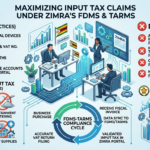
This article provides a comprehensive guide for Zimbabwean businesses on navigating the Fiscalisation Data Management System (FDMS) and the Tax and Revenue Management System (TaRMS) to legally maximize input tax claims while avoiding the pitfalls of non-compliance.
Maximizing Input Tax in the Era of FDMS: A Comprehensive Guide for Zimbabwean Businesses
The introduction of the Fiscalisation Data Management System (FDMS) by the Zimbabwe Revenue Authority (ZIMRA) has fundamentally transformed the Value Added Tax (VAT) landscape. While the system aims to close the “VAT Gap” and curb fraudulent claims, it has placed a significant administrative burden on businesses. In this digital-first environment, claiming input tax is no longer just about keeping a paper trail; it is about real-time data integrity and system synchronization.
1. Understanding the FDMS-TaRMS Ecosystem
To maximize input tax, a business must first understand that ZIMRA now operates on a “Matching Principle.” The FDMS records every sale in real-time, and the TaRMS portal pre-populates your input tax schedule based on what your suppliers have reported.
-
The FDMS: The “engine” that captures transactional data at the Point of Sale (POS).
-
The TaRMS: The “ledger” where your tax returns are filed.
-
The Link: If a supplier’s fiscal device is not interfaced with FDMS, the invoice they give you effectively does not exist in the eyes of TaRMS, making it impossible to claim the 15.5% (standard rate) .
2. Strategic Ways to Maximize Input Tax
Maximizing input tax isn’t about “creating” claims; it’s about ensuring that every cent of VAT you pay is legally recoverable.
A. Rigorous Supplier Vetting (The “15.5% Rule”)
In the current regime, a non-compliant supplier is a direct cost to your business. If you buy goods for $1,000 + $155 VAT from a non-interfaced supplier, you lose that $155.
-
The Strategy: Only trade with “Interfaced” Registered Operators.
-
The Action: Before onboarding a new supplier, use the ZIMRA FDMS Validation Portal to check if their fiscal devices are active and “Valid.”
B. Capture Buyer Details at Source
Under the 2026 guidelines, “orphaned” invoices (invoices without a Buyer TIN) are a primary reason for missed claims.
-
The Strategy: Ensure your procurement team provides your Taxpayer Identification Number (TIN) and VAT Number for every purchase, regardless of size.
-
The Action: Standardize a “Buyer Profile” sheet that is sent to all vendors to ensure your details are correctly entered into their fiscal systems.
C. Timeous Claiming (The 12-Month Window)
Section 15 of the VAT Act allows you to claim input tax within 12 months from the date of the invoice.
-
The Strategy: Don’t let invoices expire.
-
The Action: Perform a monthly reconciliation between your accounting software (e.g., Pastel, Xero) and the TaRMS “Invoice Management” module. If an invoice appears in your accounts but not on the portal, contact the supplier immediately.
3. The “Do’s and Don’ts” of Input Tax Compliance
| Category | The DO’s (Best Practices) | The DON’Ts (Red Flags) |
| Invoicing | DO ensure the words “Fiscal Tax Invoice” are prominent. | DON’T accept “Pro-forma” or manual invoices for VAT claims. |
| Verification | DO scan the QR code on every major invoice to verify it is “Valid” on FDMS. | DON’T assume a “Fiscal Receipt” is interfaced; verify the transmission status. |
| Corrections | DO insist on a Fiscal Credit Note if a transaction is reversed. | DON’T simply delete or ignore incorrect invoices in TaRMS. |
| Currency | DO claim in the currency of transaction (USD for USD, ZiG for ZiG). | DON’T cross-claim VAT across different currency “buckets.” |
4. Prohibited Input Tax Claims: What the Law Forbids
Even with a valid fiscal invoice, the VAT Act [Chapter 23:12] expressly prohibits input tax claims on certain items. Claiming these can lead to 100% penalties and interest.
1. “Passenger Motor Vehicles”
VAT paid on the purchase or lease of a “passenger motor vehicle” is generally not deductible.
-
Definition: This includes most sedans, SUVs, and double-cab vehicles.
-
The Exception: Only businesses that trade in vehicles (car dealers) or run transport services (car hire) can claim this.
2. Entertainment Expenses
Input tax on goods or services acquired for “entertainment” is prohibited under Section 16.
-
Includes: Staff lunches, client dinners, corporate golf days, and staff parties.
-
The Logic: These are deemed “final consumption” by the business rather than an input into production.
3. Membership Fees and Club Dues
VAT paid on subscriptions to sporting, social, or recreational clubs (e.g., gym memberships or golf club fees) is not claimable, even if used for business networking.
4. Exempt Supplies
If your business makes “Exempt Supplies” (e.g., residential rentals, medical services, or educational services), you cannot claim input tax on the expenses incurred to provide those services.
-
Mixed Supplies: If you provide both taxable and exempt services, you must use the Apportionment Rule to calculate what percentage of input tax is claimable.
5. Navigating Technical Hurdles in 2026
With the 2026 integration of TaRMS and FDMS, businesses often face “Missing Invoices” due to network outages at the supplier’s end.
How to Handle Missing Invoices:
-
Check the Sync Status: Some devices only sync at the end of the “Fiscal Day.” Wait 24 hours.
-
Contact the Supplier: Ask them to “force sync” their device or check for transmission errors.
-
Manual Upload (If Permitted): ZIMRA occasionally allows manual uploads during system downtime, but these are highly scrutinized.
-
Whistle-Blower Portal: As a last resort, if a supplier refuses to provide a fiscal invoice despite being registered, use the ZIMRA portal to report them. This protects your right to claim once the issue is rectified.
6. Conclusion
The FDMS is a “good” development for transparent businesses because it automates the refund process and reduces the need for physical audits. However, it is “bad” for those who are lax with record-keeping. To maximize your input tax, your finance department must shift from “historical recording” to “real-time validation.”
Summary Checklist for Management:
-
Is our VAT Registration status updated on TaRMS?
-
Have we verified our top 20 suppliers on the FDMS portal?
-
Does every purchase requisition include our TIN and VAT number?
-
Are we reconciling the TaRMS “Invoice Management” module weekly?