Economic Analysis of Statutory Instrument 195 of 2026
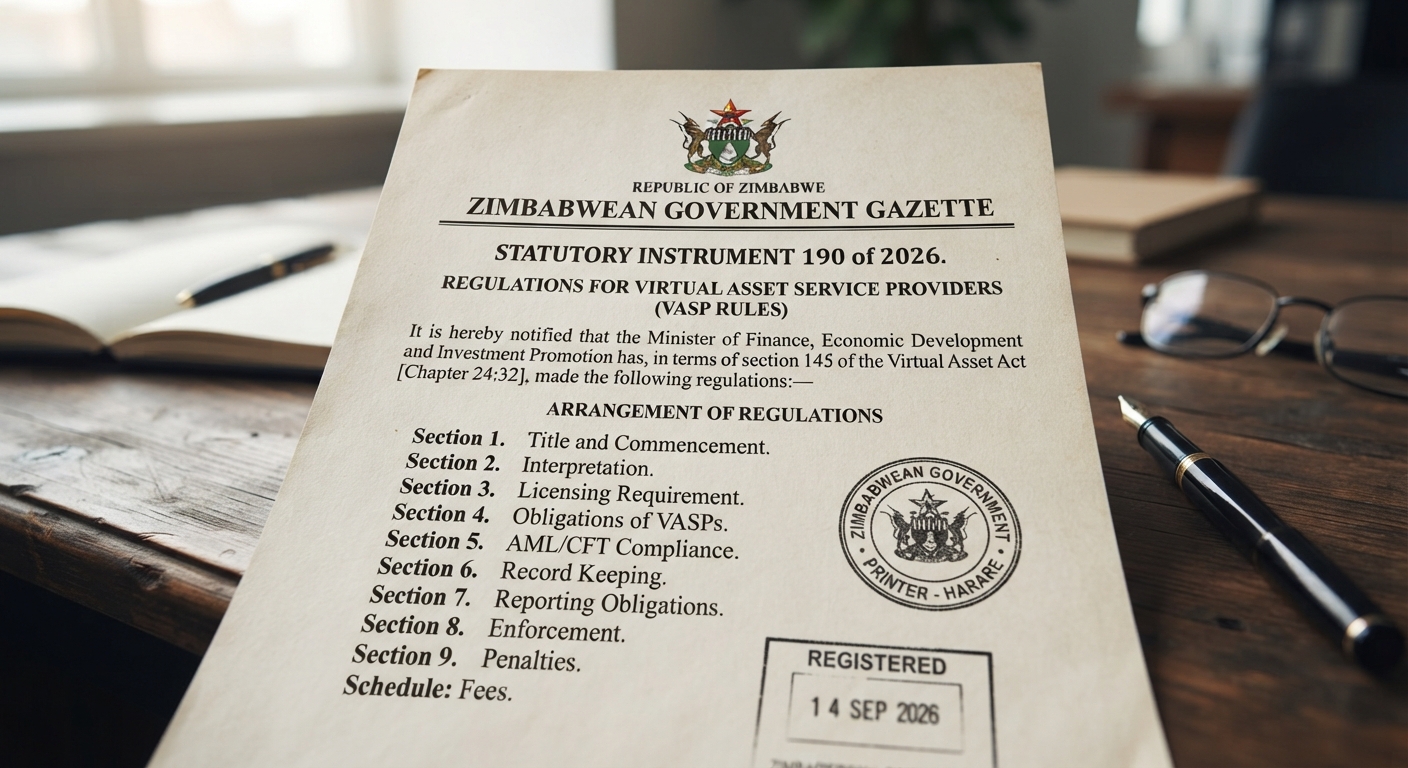
Statutory Instrument: S.I. 195 of 2026 — Customs and Excise (Tariff) (Amendment) Notice, 2026 (No. 19)
Enabling Legislation: Section 225 of the Customs and Excise Act [Chapter 23:02]
Amends: First Schedule of the Customs and Excise (Tariff) Notice, 2022 (S.I. 203 of 2022)
Gazetted Date: 27 November 2026
Overview.
Statutory Instrument 195 of 2026 introduces a decisive protectionist overhaul to Zimbabwe’s textile import tariff regime. Gazetted on 27 November 2026 by the Minister of Finance, the notice repeals existing duty rates across 74 specific eight-digit tariff lines covering woven cotton fabrics, synthetic filament and staple fibre fabrics, and knitted or crocheted fabrics, and replaces them with a single, uniform compound tariff: 40% ad valorem plus US$2.50 per kilogram (applicable to both General and Most Favoured Nation (MFN) rates).
While cotton fabrics previously attracted a compound duty of 30% + US$2.50/kg, synthetic woven fabrics (Chapters 54 and 55) and knitted or crocheted fabrics (Chapter 60) previously entered Zimbabwe at low ad valorem rates of just 5% or 10%, with no weight-based surcharge. By eliminating this tariff differential and imposing a steep specific floor per kilogram across all listed textile inputs, the government has effectively closed a major substitution loophole that allowed cheaper synthetic and knitted fabrics to undercut domestic cotton and textile production.
Technical Breakdown of the Tariff Amendments
S.I. 195 of 2026 standardizes customs duties across three primary Harmonized System (HS) chapters—Chapter 52 (Cotton), Chapters 54 & 55 (Man-Made Filaments and Staple Fibres), and Chapter 60 (Knitted or Crocheted Fabrics)—covering 13 four-digit tariff headings in total.
| HS Chapter & Headings | Product Coverage | Previous Duty (General / MFN) | New Duty (General / MFN) | Magnitude of Change |
| Chapter 52 (52.08, 52.09, 52.10, 52.11, 52.12) | Woven cotton fabrics (plain weave, 3- or 4-thread twill, canvas >= 340 g/sq.m; unbleached, bleached, dyed, printed) | 30% + US$2.50/kg | 40% + US$2.50/kg | +10 percentage points on value; weight charge retained |
| Chapter 54 (54.07) | Woven fabrics of synthetic filament yarn (“Other” subheadings across 11 tariff lines) | 5% or 10% | 40% + US$2.50/kg | +30 to +35 percentage points + new US$2.50/kg specific duty |
| Chapter 55 (55.12, 55.13, 55.14, 55.15) | Woven fabrics of synthetic/polyester staple fibres (plain weave, twill, canvas >= 340 g/sq.m, other woven fabrics) | 10% | 40% + US$2.50/kg | +30 percentage points + new US$2.50/kg specific duty |
| Chapter 60 (60.03, 60.04, 60.05, 60.06) | Knitted or crocheted fabrics (cotton, elastomeric yarn >= 5%, unbleached/bleached, dyed, printed) | 10% | 40% + US$2.50/kg | +30 percentage points + new US$2.50/kg specific duty |
Why the Compound Tariff Structure Matters
The shift from a pure ad valorem percentage (5% or 10%) to a compound tariff (40% + US$2.50/kg) fundamentally alters import economics:
- Disproportionate Impact on Low-Cost Bulk Imports: A percentage duty scales down when an importer sources cheaper fabric. A weight-based duty of US$2.50/kg does not. For example, on a synthetic fabric invoiced at US$3.00/kg, the old 10% duty cost US$0.30/kg. Under S.I. 195 of 2026, the duty jumps to US$1.20 (40%) + US$2.50 = US$3.70/kg—an effective tariff rate of 123.3%, representing more than a twelve-fold tax increase.
- Heavyweight Fabrics Face Severe Penalization: Canvas weighing not less than 340 grams per square metre (covered under Headings 52.09, 55.12, and 55.14) and dense twills carry high mass per linear metre, making the US$2.50/kg surcharge particularly punitive for industrial, tenting, upholstery, and heavy workwear applications.
Impact on Individuals and Households
Although S.I. 195 of 2026 targets intermediate fabric rolls rather than finished retail garments directly, the cost-push transmission to everyday consumers is direct and significant:
- Higher Cost of School Uniforms and Workwear: Polyester-cotton blends (Chapters 52 and 55) and knitted fabrics (Chapter 60) form the backbone of school uniforms, corporate wear, and protective clothing. Gazetted in late November, the measure hits right ahead of the peak December–January back-to-school procurement cycle, squeezing household disposable incomes.
- Price Escalation in Everyday Clothing and Tailoring: Informal and formal tailors, boutique dressmakers, and local clothing retailers rely heavily on imported printed cottons, polyesters, and stretch knits (including elastomeric fabrics under Heading 60.04). Higher landed fabric costs will translate into higher retail prices for dresses, shirts, sportswear, and casual wear.
- Household Textiles and Furnishings: Heavy canvas, sheeting, curtaining, and upholstery fabrics—particularly synthetic and blended weaves that previously enjoyed a 10% tariff—will become noticeably more expensive, raising household furnishing and renovation costs.
- Regressive Consumer Impact: Low- and middle-income households spend a higher share of their income on basic clothing and affordable synthetic blends. Because the specific US$2.50/kg levy hits inexpensive fabrics hardest in percentage terms, the price shock falls disproportionately on budget-conscious consumers.
Impact on Businesses
S.I. 195 of 2026 creates sharp winners and losers across Zimbabwe’s textile and apparel value chain, depending on where a firm sits in the production process.
Garment, Uniform and Cut-Make-Trim (CMT) Manufacturers
- Immediate Raw Material Cost Shock: Domestic apparel producers who import woven polyester, poly-cotton blends, or knitted fabrics face an overnight surge in landed input costs. Because fabric typically accounts for 45% to 60% of a garment’s manufacturing cost, unit production costs will rise substantially.
- Working Capital Strain: Customs duties are payable upfront at clearance. Companies holding orders priced prior to 27 November 2026 face immediate cash-flow pressure and margin erosion if contracts lack tariff-escalation clauses.
- Risk of Inverted Tariff Disadvantage: Unless finished imported garments face equally strict duties and border enforcement, local garment manufacturers paying 40% + US$2.50/kg on raw fabric risk becoming less price-competitive than imported ready-made clothing.
Upstream Domestic Textile Mills and Spinners
- Substantial Market Protection: Local textile mills producing woven cotton, poly-cotton, canvas, and knitted fabrics gain a decisive price shield against Asian and regional fabric imports. Previously, importers bypassed local cotton fabrics (protected at 30% + US$2.50/kg) by substituting synthetic or knitted fabrics taxed at just 5% to 10%. S.I. 195 of 2026 closes that gap.
- Execution and Capacity Bottlenecks: Tariff protection creates market space, but domestic mills must still overcome structural constraints—such as reliable electricity supply, aging machinery, dyeing and finishing limitations, and consistent lead times—to supply garment makers with the exact fabric weights, weaves, and colours required.
Fabric Wholesalers, Haberdashers, and Importers
- Business Model Disruption: Merchants whose core business relies on importing low-cost rolls of polyester, suiting, and knitwear for resale to tailors and small-scale manufacturers face severe volume contraction and margin compression.
- Compliance and Classification Scrutiny: Importers will face heightened customs verification by the Zimbabwe Revenue Authority (ZIMRA) regarding fabric weight declarations (kilograms vs. square metres), fibre composition, and tariff subheading classification.
Industrial and Commercial End-Users
- Mining, Agriculture, Logistics, and Hospitality: Enterprises that procure heavy canvas (tarpaulins, tents, grain bags, vehicle covers) and bulk staff uniforms will experience higher operating and procurement expenses.
Macroeconomic and Policy Implications
At the national level, S.I. 195 of 2026 reflects a deliberate industrial policy choice with important macroeconomic trade-offs:
- Cotton-to-Clothing Value Chain Localization: Zimbabwe is a significant regional producer of raw cotton, yet much of its value has historically been lost through raw lint exports alongside heavy imports of finished fabrics and clothing. Harmonizing duties at 40% + US$2.50/kg reinforces import substitution and incentivizes domestic spinning, weaving, knitting, and dyeing.
- Closing Tariff Arbitrage: Prior to this notice, the wide gap between cotton duties (30% + US$2.50/kg) and synthetic/knit duties (5%–10%) distorted market demand away from locally grown cotton toward imported synthetics. Uniform tariff treatment restores competitive neutrality for cotton-based textiles.
- Short-Term Cost-Push Inflation: While textiles carry a smaller weight in the Consumer Price Index (CPI) than food or energy, the abruptness and scale of the increase on synthetic and knitted inputs will generate localized cost-push inflation in apparel, footwear/textiles, and household goods over the next two quarters.
- Fiscal Revenue vs. Informality Risk: In the immediate term, customs duty collections on essential fabric imports will increase. However, international trade experience shows that steep compound tariffs on high-demand consumer inputs can incentivize under-invoicing, misdeclaration of tariff codes, or smuggling through porous borders—requiring strengthened ZIMRA post-clearance audits and border surveillance to prevent revenue leakage.
- Regional Trade Agreement Dynamics: The notice amends General and MFN rates. Businesses importing qualifying fabrics manufactured within SADC or COMESA member states—supported by valid Rules of Origin certificates—may retain preferential duty treatment, potentially shifting sourcing patterns away from Asia toward regional suppliers.
Recommendations for Businesses
- Conduct an Immediate HS Code and Landed-Cost Audit: Map every imported fabric SKU against the 74 amended commodity codes in S.I. 195 of 2026 and recalculate unit costs incorporating both the 40% ad valorem charge and the US$2.50/kg weight levy.
- Review Supplier Contracts and Pricing Clauses: For garment and uniform manufacturers, update customer quotes immediately and invoke force majeure or statutory tax-adjustment clauses on unfulfilled supply contracts where legally permissible.
- Evaluate Domestic and Regional Sourcing: Engage local textile mills to test sample quality, minimum order quantities, and lead times, while assessing whether SADC/COMESA preferential origin suppliers offer a viable landed-cost advantage over MFN imports.
- Explore Rebate and Inward-Processing Regimes: Manufacturers producing garments for export or qualifying under approved industrial rebate schemes should verify eligibility for duty drawbacks, inward processing relief, or manufacturer rebates under the Customs and Excise Act to preserve export competitiveness.