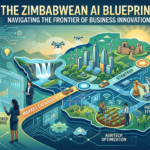
The Zimbabwean AI Blueprint – Navigating the frontier of business innovation
The “Pause” and the “Pivot”
If you are a business registered in Zimbabwe, whether a small-scale retail shop in downtown Harare, a commercial tobacco farm in Mashonaland West, or a financial services provider in Bulawayo and you haven’t yet integrated Artificial Intelligence (AI) into your operations, you are likely operating under a dangerous illusion of stability.
Pause.
Think again. The global economy is no longer “approaching” an AI revolution; the revolution is currently being televised, and Zimbabwe is not an exception. In 2024 and 2025, the Zimbabwean government signaled a massive shift with the approval of the National Artificial Intelligence Strategy (2026–2030). This isn’t just a policy document; it is a declaration that the “resource-based” economy of the past is being forcibly upgraded to a “knowledge-based” economy.
For the Zimbabwean executive, AI is not a luxury or a “Western trend.” It is the most potent tool available to navigate the specific volatilities of the Zimbabwean market: fluctuating exchange rates, unpredictable supply chains, and a consumer base that is increasingly digital-first. Lets dive into it;
1. The Local Context – Why Zimbabwe, Why Now?
Before diving into technical tools, we must address the “Zimbabwean Factor.” Our business environment is unique. We deal with multi-currency dynamics, infrastructure gaps, and specific regulatory hurdles like the Cyber and Data Protection Act (SI 155 of 2024).
The National AI Strategy (2026–2030)
The government’s new strategy focuses on “Ubuntu-based ethics” and “Sovereign Data Platforms.” This means that as a business, you aren’t just looking for global tools; you are looking for ways to align with a national movement that seeks to bridge the urban-rural divide. The government is setting up a Regulatory Sandbox (the “Innovation Crucible”), allowing businesses to test AI solutions without the immediate fear of crushing compliance fines. If you aren’t at the table during this rollout, you will be on the menu.
Economic Resilience
In an environment where “every dollar counts,” AI provides the efficiency needed to maintain margins. It is the difference between a supermarket over-ordering perishables during a price hike and an AI-driven inventory system predicting exact demand to zero out waste.
2. Sector-Specific Applications – Where to Start
a. Agriculture: From Rainfall Betting to Precision Farming
Agriculture remains the backbone of Zimbabwe’s GDP. However, climate change and fluctuating input costs make traditional farming a high-stakes gamble.
- Predictive Weather & Yield Modeling: Using tools like FAO’s ASIS (Agricultural Stress Index System), Zimbabwean farmers can now move beyond “looking at the clouds.” AI models analyze satellite imagery to flag crop water stress weeks before the human eye can detect it.
- The “CropFix” Revolution: Locally developed startups like CropFix are already using image recognition via WhatsApp to diagnose pests. For a commercial farm, integrating a dedicated AI to monitor soil moisture via sensors (like DripTech-Daab) can reduce water and fertilizer costs by up to 30%.
- Market Intelligence: AI can analyze pricing trends at Mbare Musika or the Tobacco Sales Floor (TSF) to advise farmers exactly when to bring their produce to market to maximize ROI.
b. Finance and Fintech – The Battle for the Wallet
Zimbabwe has one of the highest mobile money penetration rates in the world. This generates a mountain of data that most businesses are currently ignoring.
- Credit Scoring for the “Unbanked”: Traditional banks often struggle to lend to SMEs because they lack formal credit histories. AI algorithms can analyze mobile money transaction patterns (EcoCash/Innbucks) to create alternative credit scores, opening up capital for thousands of businesses.
- Fraud Detection: As we move toward a digital economy, cybercrime is rising. AI-driven security tools can flag “impossible” transactions—such as a card being swiped in Mutare and Gweru within 10 minutes—saving banks and customers millions in potential losses.
- Conversational Banking: Chatbots at institutions like CBZ and Steward Bank are already handling 90% of basic queries. If your financial business still requires a customer to visit a physical branch for a balance inquiry, you are losing them to a more agile competitor.
c. Retail and E-commerce – Hyper-Personalization
In Harare’s retail scene, the competition is fierce. The difference between OK Zimbabwe and a boutique shop in Sam Levy’s Village is increasingly becoming about the “Customer Experience.”
- Dynamic Pricing: In a multi-currency environment, prices change fast. AI can monitor competitor prices and local demand in real-time to suggest optimal pricing for your goods.
- Smart Inventory: Retailers like Mega Market are starting to use AI to predict which styles or products will trend next season. This prevents “dead stock” from sitting on shelves and eating up capital.
- AI Shop Assistants: Imagine an e-commerce site where the search bar doesn’t just look for keywords but understands intent. “I need an outfit for a wedding in Kariba in November” should prompt the AI to suggest breathable fabrics and summer styles.
3. The Practical Roadmap – 5 Steps to Implementation
Step 1: The Data Audit (The “Garbage In, Garbage Out” Rule)
AI is only as good as the data you feed it. Most Zimbabwean businesses have data siloed in Excel sheets, physical ledgers, and various WhatsApp groups.
- Action: Centralize your data. Move your records to a cloud-based CRM (Customer Relationship Management) system.
- Ensure your data is “clean” (accurate and consistent).
Step 2: Compliance First
With the Cyber and Data Protection Act, you cannot simply scrape customer data and feed it into an offshore AI.
- Action: Appoint a Data Protection Officer (DPO) as required by POTRAZ. Ensure that any AI tool you use complies with local privacy laws regarding where “Personal Identifiable Information” (PII) is stored.
Step 3: Start Small (The “Pilot” Phase)
Do not try to automate your entire company overnight.
- Action: Identify one “pain point.” Is it customer service? Install a ChatGPT-based chatbot on your website. Is it logistics? Use a route-optimization AI for your delivery trucks. Measure the ROI before scaling.
Step 4: Upskilling, Not Replacing
The biggest fear in Zimbabwe is job displacement. However, the National AI Strategy emphasizes “Human-AI Collaboration.”
- Action: Train your staff. An accountant who knows how to use AI-driven software like Zoho Books is 10 times more valuable than one who does manual entry. Shift your workforce from “doers” to “reviewers” of AI output.
Step 5: Leverage Local Hubs
The government is converting Community Information Centres into Digital Hubs.
- Action: Engage with local tech hubs and universities (like UZ or NUST) that are part of the “Education 5.0” philosophy. Many young Zimbabwean developers are looking for “real-world” business problems to solve with their AI prototypes.
4. Addressing the Hurdles: Power, Data, and Connectivity
We cannot discuss AI in Zimbabwe without acknowledging the “ZESA Factor” and the cost of data.
- Offline-First AI: Look for AI tools that offer “Edge Computing” or offline capabilities. Many image recognition models for agriculture can now run locally on a smartphone without a constant 4G connection.
- Sovereign Infrastructure: The National AI Strategy aims to build “Sovereign Data Centers.” As these come online, businesses will have access to high-performance computing without the latency and cost of routing data through Europe or the US.
- Data Costs: Use AI to reduce data usage. For example, instead of sending high-res videos for remote monitoring, use an AI at the source to send only “alert summaries” in text format.
5. Ethical AI: The “Unhu/Ubuntu” Perspective
Zimbabwe is unique in its push for “Ethical AI” based on African values. This means:
- Transparency: If a customer is talking to a bot, they should know it.
- Inclusivity: Your AI shouldn’t just speak English; it should understand Shona and Ndebele dialects to ensure the rural market isn’t left behind.
- Accountability: If an AI makes a mistake in a loan application, there must be a human “Override” process.
6. Conclusion: The Cost of Inaction
The Zimbabwean business landscape is a “survival of the smartest” environment. Those who “pause” for too long will find that their competitors have used AI to cut their costs by 20%, double their customer engagement, and predict market shifts before they happen.
The National AI Strategy (2026–2030) has laid the tracks. The question is: will your business be the locomotive, or will you be left standing on the platform?
Think again. Then, take the first step.
Actionable AI Tools for Zimbabwean Businesses
| Sector | Recommended AI Use Case | Potential Tool/Platform |
| Retail | 24/7 Customer Support | ChatGPT/Gemini API via WhatsApp |
| Finance | Alternative Credit Scoring | Custom Machine Learning Models |
| Agriculture | Pest/Disease Diagnosis | CropFix / Plantix |
| Logistics | Route Optimization | Google Maps Platform / LogiNext |
| HR/Admin | Automated Bookkeeping | Zoho Books / Xero with AI extensions |