Analysis of the IMF Staff Report on Zimbabwe (November 2026)
Reference Document: Zimbabwe: Second Review under the Staff-Monitored Program — Press Release and Staff Report (IMF Country Report No. 2026/274, published November 10–11, 2026).
Overview
In November 2026, the International Monetary Fund (IMF) released its Second Review under Zimbabwe’s 10-month Staff-Monitored Program (SMP) (initially approved in April 2026). While an SMP does not provide direct financial disbursements from the IMF, it serves as a vital policy scorecard designed to build a credible track record for external arrears clearance, debt restructuring, and international re-engagement.
The report presents a striking macroeconomic paradox: surging fiscal revenues, single-digit inflation, and strong headline GDP growth coexist alongside severe domestic arrears to private suppliers, acute social spending shortfalls, quasi-fiscal governance risks (notably surrounding the Mutapa Investment Fund), and looming climate shocks.
Impact on the Broader Macroeconomy
The Positives
- Strong Headline Growth Momentum: Following an impressive 8.3% real GDP expansion in 2025, the economy is projected to grow by 5.0% in 2026, underpinned by resilient gold production, strong tobacco output, and recovering platinum and lithium volumes.
- Single-Digit Inflation & Currency Stability: Tight monetary policy and improved liquidity management by the Reserve Bank of Zimbabwe (RBZ) successfully anchored the Zimbabwe Gold (ZiG) currency, bringing annual inflation down into the low-to-mid single digits (~4.4%–4.7% in mid-2026, projected around 6%–8% through end-2026/2027).
- Robust External Sector & Reserves: Zimbabwe recorded a current account surplus of roughly US$2.1 billion (3.6% of GDP) in 2025, buoyed by elevated international gold prices and diaspora remittances. Net foreign exchange reserves have continued to grow, exceeding program floors.
- Banking Sector Resilience: Capital adequacy ratios remain healthy (~23%, well above the 12% regulatory minimum) and non-performing loans (NPLs) declined to a low 2.6%, signaling a shift from speculative FX trading back toward traditional interest-based lending.
The Negatives
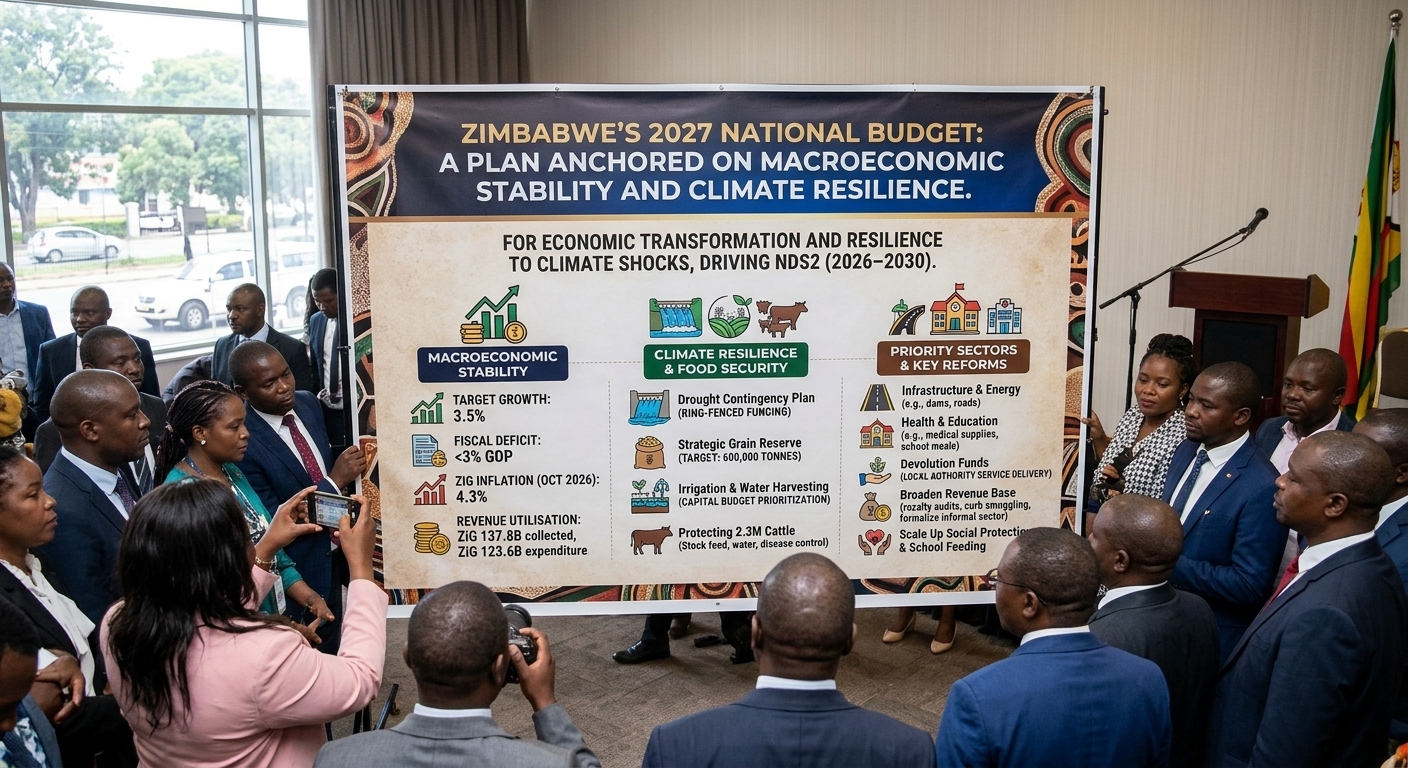
- Moderating Growth & Climate Vulnerability: Quarterly momentum slowed to 3.1% in Q2 2026 due to softer mining activity. Worse, the IMF downgraded Zimbabwe’s 2027 growth forecast from 4.2% to 3.5%, warning that an anticipated El Niño-induced drought could slash growth to between 1.2% and 2.5% if unmitigated, while pushing food inflation higher.
- Unsustainable Public Debt Distress: Total public debt stands at approximately US$22.7 billion, classified by the IMF as unsustainable and in distress. Without completing the SMP and executing a formal arrears-clearance strategy, Zimbabwe remains locked out of concessional international financing.
- Uneven Growth (“Jobless/Non-Inclusive Expansion”): Macroeconomic stability has not yet translated into broad-based poverty reduction, as growth remains heavily concentrated in capital-intensive mining and commercial export agriculture.
Impact on the Private Business Sector
The Positives
- Predictable Pricing & Operating Environment: Single-digit inflation and a stable exchange rate eliminate the hyperinflationary distortion, frequent repricing, and balance-sheet revaluation shocks that previously crippled corporate planning and working capital.
- Increased Credit Availability: As banks can no longer rely on easy foreign exchange trading margins, financial institutions are actively expanding loan books to the private sector, supported by low default rates.
- Re-engagement Signal for Foreign Investors: Passing two consecutive SMP reviews lowers perceived sovereign policy risk, improving the long-term environment for cross-border trade finance and foreign direct investment (FDI).
The Negatives
- Severe Liquidity Squeeze from Government Domestic Arrears: One of the sharpest warnings in the report is that the government owes local service providers, contractors, and farm input suppliers US$1.36 billion in unpaid bills (as of end-2025), alongside US$298.9 million owed to miners in unpaid export-surrender proceeds. These arrears starve private firms of working capital and force businesses to bear the financing cost of state procurement.
- Heavy Tax Burden: Record revenue collections (up nearly 40% year-on-year) have been driven aggressively by corporate income tax, PAYE, and VAT enforcement—placing a heavy compliance and cash-flow burden on formal businesses while the informal sector remains largely untaxed.
- Crowding Out & State-Owned Enterprise (SOE) Competition: The IMF flagged significant fiscal and market risks surrounding the Mutapa Investment Fund and its subsidiaries, raising concerns over opaque borrowing, off-budget operations, and uneven competitive playing fields between state-backed entities and private enterprises.
- Costly Gold Incentive Distortions: The Treasury spent US$173 million in the first half of 2026 alone on gold incentive schemes, an expenditure the IMF deemed costlier than planned—prompting upcoming reforms to the Gold Trade Act that will reshape compliance and pricing for gold producers and dealers.
Impact on the Government & Public Finance
The Positives
- Record Fiscal Revenue & Cash Surplus: The IMF revised Zimbabwe’s 2026 revenue projection sharply upward to US$11.6 billion (up from US$8.4 billion in 2025, and well above initial budget targets). First-half collections hit US$5.3 billion (29% above target), putting the Treasury on track for an estimated US$1.4 billion cash surplus in 2026.
- Strong Program Scorecard: The government met all quantitative targets and structural benchmarks through the First Review and secured Staff-Level Agreement on the Second Review, proving it can enforce cash budgeting and curb RBZ quasi-fiscal money printing.
- Enhanced Debt & SOE Oversight Frameworks: Under SMP structural benchmarks, Treasury has agreed to enforce strict borrowing caps, require ministerial approval and parliamentary notification for Mutapa Investment Fund loans above set thresholds, and publish an explicit Fiscal Risk Statement for SOEs in the national budget.
The Negatives
- Failure to Meet Social Spending Floors: Despite booming tax revenues, the government missed its indicative target on protected social spending—disbursing only US$221 million in H1 2026 against a target of US$414 million. The IMF pointedly noted this was due to implementation and procurement bottlenecks rather than a lack of money, creating political and humanitarian reputational risks.
- Strict Expenditure Caps Ahead: To prevent election-cycle or unbudgeted spending slippages, the government has committed to capping discretionary spending at US$300 million through the remainder of 2026 and maintaining tight expenditure ceilings in the 2027 National Budget.
- Mounting Pressure to Clear Domestic Arrears: While the government used part of its 2025/2026 surpluses to accelerate external debt amortization, the IMF emphasized that accumulating US$1.66 billion in combined domestic supplier and miner arrears undermines fiscal credibility. Treasury faces immediate pressure to audit, verify, and clear these arrears without reigniting inflation.
Summary
| Stakeholder | Key Wins (Positives) | Key Pain Points & Risks (Negatives) |
| Macroeconomy | • 5.0% GDP growth (2026)
• Single-digit inflation (~4.5%–6%) • US$2.1B current account surplus & rising FX reserves |
• 2027 growth cut to 3.5% (El Niño drought risk)
• US$22.7B debt still in distress • Narrow, commodity-driven expansion |
| Businesses | • Exchange rate & price stability
• Expanding bank credit (2.6% NPLs) • Improved credibility for international partners |
• US$1.36B in unpaid govt bills to suppliers + US$298.9M owed to miners
• Heavy formal-sector tax burden • Mutapa SOE governance/competition risks |
| Government | • Revenue surging ~40% to US$11.6B
• Projected US$1.4B cash surplus • Passing SMP reviews toward arrears clearance |
• Missed social spending floor (US$221M vs. US$414M target)
• Tight spending caps (US$300M limit for rest of 2026) • High cost of gold incentives (US$173M in H1) |