Navigating the “Age of Competition”- A Strategic Analysis of the WEF Global Risks Report 2026 and the Zimbabwean Economy
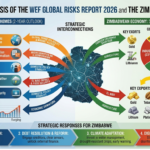 The World Economic Forum’s (WEF) Global Risks Report 2026 arrives at a pivotal moment for the global community, characterizing the current era as the “Age of Competition.” For Zimbabwe, a nation currently experiencing a fragile yet ambitious economic rebound, the findings of the 21st edition of this report serve as both a warning and a roadmap.
While the global risk landscape is dominated by geo-economic confrontation, misinformation, and societal polarization in the short term, Zimbabwe faces a unique intersection of these global threats and localized structural vulnerabilities. This article provides a deep-dive analysis into how the top risks identified by over 1,300 global experts translate to the Zimbabwean context, exploring the implications for the ZiG currency, mining-led growth, and agricultural resilience.
1. The Global Context: Multipolarity without Multilateralism
The 2026 report highlights a definitive shift in the world order. For decades, the global economy operated under a US-led multilateral framework. Today, we see “multipolarity without multilateralism.” The report identifies Geo-economic Confrontation as the number one risk for 2026, with 18% of respondents citing it as the most likely trigger for a systemic crisis.
The Zimbabwean Mirror
For Zimbabwe, this global fragmentation is a double-edged sword. Historically, the country has navigated a complex relationship with the West, characterized by sanctions and restricted access to international capital markets. As major powers (USA, China, EU) and middle powers increasingly use economic policy tools like tariffs, export controls, and “weaponized” supply chains as instruments of pressure, Zimbabwe find itself in a precarious position.
However, the “Age of Competition” also provides Zimbabwe with strategic leverage. As the world scrambles for critical minerals like lithium, platinum, and rare earth elements. Zimbabwe’s vast mineral wealth positions it as a key player in the global energy transition. The risk lies in becoming a “resource battleground” where geo-economic rivalry dictates internal policy and economic stability.
2. Short-Term Risk #1: Geo-economic Confrontation and Trade Volatility
The WEF report warns that geo-economic confrontation could escalate into “full-scale economic war,” involving port blockades and capital controls.
Impact on Zimbabwe’s Mining and Exports
Zimbabwe’s 2026 economic growth target of 8.5% is heavily reliant on the mining sector. Mining currently accounts for over 60% of foreign exchange earnings.
- The Risk: If geo-economic tensions lead to fragmented trade blocs, Zimbabwe’s mineral exports could face restricted markets or predatory pricing.
- The Opportunity: By maintaining a policy of “friend to all and enemy to none,” Zimbabwe can diversify its export destinations. The recent record levels of platinum production from the Great Dyke and the expansion of lithium projects are vital, but they require stable global trade routes to translate into domestic prosperity.
3. Short-Term Risk #2: Misinformation, Disinformation, and AI
For the second year running, Misinformation and Disinformation rank among the top three short-term concerns globally. The rise of Generative AI has made the production of false content cheaper and more scalable.
Societal and Economic Trust in Zimbabwe
In Zimbabwe, trust is the “currency of cooperation.” The introduction of the ZiG (Zimbabwe Gold) currency in 2024 was a bold move to rebuild trust after years of hyperinflation.
- The Risk: AI-generated misinformation regarding currency stability, central bank reserves, or political stability can trigger market panic. In an economy where informal markets often react faster than official ones, a single “deepfake” or viral false report about the Reserve Bank of Zimbabwe (RBZ) could destabilize the currency overnight.
- Digital Infrastructure: As Zimbabwe pushes for digital transformation and financial inclusion, the lack of robust cyber-governance makes the population vulnerable to information disorder.
4. The Economic Reckoning: Inflation and Debt
The WEF report notes that Economic Downturn and Inflation have surged in the risk rankings, rising eight positions to #11 and #21 respectively. Globally, the combination of high debt and volatile returns on frontier technologies like AI is creating “asset bubbles.”
Zimbabwe’s Macroeconomic Stability
Zimbabwe enters 2026 with an improved but sensitive macroeconomic environment.
- Inflation Success: Weighted year-on-year inflation eased to 13.3% by late 2025, with ZWG (ZiG) inflation around 15%. This is a monumental shift from previous years.
- The Debt Trap: The African Development Bank and IMF have consistently pointed to Zimbabwe’s public debt (estimated at 87% of GDP) as the primary inhibitor of structural transformation.
- Global Contagion: A global economic downturn – driven by the “economic reckoning” mentioned in the WEF report, would likely lead to a slump in commodity prices (gold, platinum, lithium). For Zimbabwe, a drop in commodity prices means a direct hit to the fiscal budget and the ability to service debt or fund infrastructure.
5. Societal Polarization and Inequality
Inequality is identified as the most “interconnected” global risk in 2026. It fuels social unrest, weakens the social contract, and drives political fragmentation.
The Zimbabwean Social Contract
Despite a projected GDP growth of 8.5%, poverty in Zimbabwe remains high (estimated at 38.7%).
- Human Capital Flight: The WEF report discusses the “brain drain” as a consequence of societal stress. Zimbabwe has lost an estimated 3 million skilled workers over the last two decades.
- Rural-Urban Divide: While the mining sector booms, the benefits often fail to reach the rural poor who are most susceptible to climate shocks. Societal polarization in Zimbabwe is not just political; it is an economic divide between the formal “mineral-rich” economy and the informal “subsistence-driven” economy.
6. Environmental Risks: The Long-Term Storm
The WEF report highlights a “de-prioritisation” of environmental risks in the short term as leaders focus on war and economics. However, over the 10-year horizon, Extreme Weather is the number 1 risk.
Agriculture and Climate Resilience
Zimbabwe’s economy is a “hostage to the clouds.” Agriculture is expected to expand by 5.4% in 2026 due to favorable weather, rebounding from the devastating El Niño-induced drought of 2024.
- The Systemic Risk: The “stormy” environmental outlook predicted by the WEF means that “favorable weather” can no longer be a baseline for economic planning.
- Infrastructure Endangered: The report’s focus on “endangered infrastructure” is highly relevant to Zimbabwe’s energy sector. Reliance on hydro-power (Kariba) makes the national grid vulnerable to droughts. Without massive investment in solar and wind, climate change will continue to be a “growth-killer” for Zimbabwean industry.
7. Technological Acceleration: AI and Quantum
The WEF report warns of “unbalanced AI outcomes.” While AI offers efficiency, it also threatens to widen the gap between the Global North and South.
Zimbabwe’s Leapfrog Potential
Zimbabwe has a highly literate population and a history of rapid tech adoption (e.g., mobile money).
- The Risk: If Zimbabwe does not invest in AI governance and local talent, it will remain a consumer of technology rather than a creator, leading to further value extraction.
- The Opportunity: AI can be used to optimize small-scale mining and precision agriculture, directly mitigating the risks of resource waste and climate change.
8. Strategic Recommendations for Zimbabwe
Based on the WEF 2026 risk profile, Zimbabwe should adopt the following strategies:
- Fiscal Discipline: As suggested by the IMF, aligning the 2026 budget with sustainable financing is critical to prevent the “asset bubble” risks mentioned by the WEF.
- Trade Diversification: To mitigate geo-economic confrontation, Zimbabwe must strengthen ties within the SADC and AfCFTA, reducing reliance on any single global superpower.
- Information Resilience: The government and private sector must invest in “reputation resilience” to combat the threat of AI-driven disinformation.
- Climate-Smart Infrastructure: Shifting from “weather-dependent” agriculture to irrigation-led growth and diversifying the energy mix is no longer optional.
Conclusion
The WEF Global Risks Report 2026 describes a world of “turbulence and uncertainty.” For Zimbabwe, the path to 8.5% growth is paved with both immense opportunities and systemic perils. By recognizing that global risks, from geo-economic wars to AI-led misinformation, are now domestic realities, Zimbabwe can build a more resilient, inclusive, and adaptive economy. The “Age of Competition” does not have to result in conflict; for a resource-rich and resilient nation, it can be the catalyst for the next phase of the Zimbabwean Renaissance.