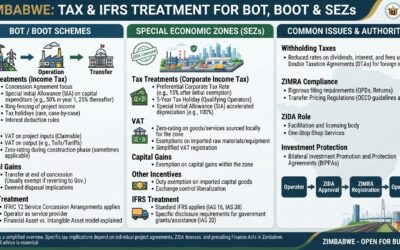
Legal, Fiscal and Strategic Analysis of Special Economic Zones (SEZs) in Zimbabwean Tax Legislation
1.Overview
In the quest to catalyze rapid industrialization, attract foreign direct investment (FDI), boost export-oriented manufacturing, and generate employment, the Government of Zimbabwe has established a sophisticated legal and fiscal framework anchored on Special Economic Zones (SEZs). Regulated primarily under the Finance Act [Chapter 23:04], the Income Tax Act [Chapter 23:06], and previously administered through the Zimbabwe Special Economic Zones Authority (and subsequently consolidated under the Zimbabwe Investment and Development Agency – ZIDA Act [Chapter 14:37]), SEZs represent geographically demarcated enclaves or sector-specific regimes designed to offer preferential regulatory treatment, streamlined licensing, and aggressive tax incentives.
For domestic and international investors, navigating the Zimbabwean SEZ framework is both an exercise in strategic tax planning and rigorous statutory compliance. The economic rationale is clear: by isolating high-growth, export-focused, or strategic enterprises from the broader bureaucratic red tape and heavy tax burdens of the domestic economy, the State attempts to create a competitive oasis for capital deployment. However, the operational reality is mediated by historical currency transitions, evolving fiscal legislation, strict foreign exchange controls, and complex judicial interpretations regarding executive powers and tax enforcement.
This comprehensive analysis evaluates the Zimbabwean SEZ framework through an academic and professional lens. It dissects statutory definitions, qualifying criteria, investor requirements, specific tax terms and rates, the economic appeal of these arrangements, their inherent advantages and disadvantages, and critical judicial precedents that govern tax litigation and administrative powers in Zimbabwe.
2. Statutory Definitions and Legal Triggers
2.1 Statutory Definition and Evolution under Zimbabwean Law
The concept of a “licensed investor” operating within a privileged economic enclave has undergone significant statutory evolution in Zimbabwe. While earlier iterations were governed by Export Processing Zones (EPZs) and later the Zimbabwe Special Economic Zones Authority Act, the current legislative architecture integrates SEZ operators under the broader framework of the Finance Act [Chapter 23:04] and the Income Tax Act [Chapter 23:06].
Under Section 2(1) of the Income Tax Act [Chapter 23:06] and cross-referenced in Section 14 of the Finance Act [Chapter 23:04], a “licensed investor” refers to:
“…a person who holds a valid license issued by the Zimbabwe Investment and Development Agency (ZIDA) or its predecessor authorities, authorizing them to operate within a designated Special Economic Zone or to carry out a qualifying SEZ-endorsed enterprise.”
2.2 Core Legal Triggers for SEZ Operations
An SEZ operation is legally and operationally triggered by a convergence of investment licensing, spatial demarcation, and administrative approvals:
- ZIDA Licensing and Sectoral Alignment: The investor must submit a comprehensive business proposal to the Zimbabwe Investment and Development Agency (ZIDA), demonstrating that the proposed venture aligns with national priority sectors (e.g., export manufacturing, agro-processing, technology, mining beneficiation, or infrastructure development).
- Geographical or Sectoral Designation: The enterprise must be established within a gazetted Special Economic Zone or qualify as a sector-specific SEZ enterprise (such as a licensed investor engaged entirely in offshore or export operations).
- ZIMRA Registration and Tax Compliance: Activation of preferential SEZ tax rates is contingent upon formal registration with the Zimbabwe Revenue Authority (ZIMRA), holding a valid Tax Clearance Certificate (BP6), and maintaining strict compliance across all revenue statutes.
3. Investor Eligibility: Who Qualifies and What are the Requirements?
3.1 Corporate Personality and Structuring
To qualify as an SEZ-licensed investor and access preferential tax treatment under Zimbabwean law, an investor must satisfy rigorous legal and administrative criteria:
- Special Purpose Vehicle (SPV) Mandate: Investors must establish a dedicated corporate entity—typically a private limited company incorporated under the Companies and Other Business Entities Act [Chapter 24:31] or registered as an external company. Ring-fencing the SEZ project in an SPV ensures that qualifying SEZ income and assets are clearly demarcated from non-SEZ commercial activities.
- Export and Value-Addition Thresholds: SEZ licenses are heavily skewed toward enterprises that generate foreign exchange and add substantial value to local raw materials. Retail, wholesale, and purely domestic consumer-facing operations generally fail to qualify for SEZ status unless explicitly tied to strategic national development projects.
- Regulatory Compliance and ZIDA Certification: The investor must maintain active licensing with ZIDA, submit annual operational audits, and comply with environmental regulations enforced by the Environmental Management Agency (EMA) under the Environmental Management Act [Chapter 20:27].
4. Financial Architecture and Tax Terms: Are They Favourable?
Operating an SEZ-licensed enterprise in Zimbabwe unlocks a specific fiscal architecture designed to ease cash flow during the heavy capital expenditure (CapEx) construction phase and heavily incentivize profitability and export performance.
4.1 Preferential Corporate Income Tax (CIT) Rates for SEZ Investors
While standard corporate income tax in Zimbabwe is levied at 25.0% (plus a 3.0% AIDS Levy) under the Finance Act, qualifying SEZ-licensed investors enjoy significant tax holidays and concessional rates:
- The Five-Year Tax Holiday: Historically, newly established SEZ enterprises enjoyed a 0% corporate tax rate for the first five years of operation, followed by a preferential corporate tax rate (often capped at 15.0%) thereafter.
- Export-Oriented Concessions: Under Section 14(3) of the Finance Act, manufacturing and SEZ-aligned enterprises that export a significant portion of their output enjoy sliding-scale tax reductions:
- Exports > 30% and < 41%: 20.0% CIT rate.
- Exports > 41% and < 51%: 17.5% CIT rate.
- Exports > 51%: 15.0% CIT rate.
- Business and Knowledge Process Outsourcing (BKPO): Effective for tax periods commencing on or after 1st January 2026, Section 14(2)(e2) of the Finance Act introduces a preferential 15.0% CIT rate for qualifying BKPO services operating within designated tech and economic hubs.
4.2 Capital Allowances and Special Deductions
SEZ operations involve massive upfront capital outlays on industrial infrastructure, specialized machinery, and plant installation.
- Accelerated Wear and Tear: Under the Fourth Schedule to the Income Tax Act, SEZ contractors and licensed investors can claim accelerated capital allowances on industrial buildings, commercial infrastructure, and heavy machinery.
- Rebasing of Unredeemed Balances: In response to Zimbabwe’s currency evolution (from multi-currency systems to local currency transitions, ZiG implementations, and foreign currency retention frameworks), statutory provisions such as Section 4A(11) and (12) of the Finance Act govern the rebasing of unredeemed capital allowance balances. These provisions ensure investors do not lose the real economic value of historical foreign currency invoice values due to statutory currency switches.
4.3 Foreign Currency Retention and Tax Settlement Mechanics
Given that SEZ enterprises predominantly generate revenues in hard currency (e.g., USD-denominated export proceeds), Section 4A of the Finance Act governs the mandatory settlement of taxes in foreign currency:
- Currency of Trade Alignment: Under Section 4A(1)(c), corporate entities earning income in foreign currency must account for and pay corporate income tax, PAYE, and withholding taxes in the corresponding foreign currency.
- Nostro Account Liquidations: Where revenues deposited into nostro accounts are subjected to central bank liquidation rules, Section 4A(10) ensures that tax due on liquidated portions is calculated on the basis that it was earned in local currency, protecting investors from artificial exchange rate distortions.
4.4 Detailed Breakdown of Tax Rates Governing Corporate and SEZ Operations
Navigating the tax tables under the Finance Act [Chapter 23:04] reveals the following applicable rates:
| Category / Operation | Applicable Tax Rate | Statutory Reference |
| Standard Corporate Income Tax (CIT) | 25.0% (plus 3% AIDS Levy) | Income Tax Act / Finance Act |
| SEZ Licensed Investors (Post-Holiday / Concessional) | 15.0% | Finance Act, Section 14 |
| Manufacturing Output (Export-Oriented): | Finance Act, Section 14(3) | |
| – Exports > 30\% and < 41% | 20.0% | |
| – Exports > 41% and < 51% | 17.5% | |
| – Exports > 51% | 15.0% | |
| BKPO Services (Effective 2026) | 15.0% | Finance Act, Section 14(2)(e2) |
| Non-Resident Shareholders’ Tax (NRST): | Finance Act, Section 15 | |
| – VFEX-listed securities dividends | 5.0% | Section 15(b) |
| – General ZSE-listed securities dividends | 10.0% | Section 15(a) |
| – Unlisted / General dividends | 15.0% | Section 15(c) |
| Non-Residents’ Tax on Fees (Technical/Managerial) | 15.0% | Finance Act, Section 19 |
| Non-Residents’ Tax on Royalties | 15.0% | Finance Act, Section 21 |
| Non-Residents’ Tax on Remittances | 15.0% | Finance Act, Section 20 |
| Residents’ Tax on Interest (RTI): | Finance Act, Section 22 | |
| – Fixed-term deposits (ge 90 days tenure) | 5.0% | Section 22(a) |
| – All other interest scenarios | 15.0% | Section 22(b) |
| Intermediated Money Transfer Tax (IMTT): | Finance Act, Section 22G | |
| – Local currency electronic transactions | 1.5% (Flat cap of US10,150 equiv. for single transactions > US500,000) | Section 22G(a) |
| – USD electronic transactions | 0.02 per USD (Flat cap of US10,150 for single transactions > US500,000) | Section 22G(b) |
5. Are Investors Lured by Such Arrangements? Investor Sentiment Analysis
Private investors and international financiers view Zimbabwe’s Special Economic Zones and fiscal incentive framework with cautious optimism tempered by pragmatic realism.
5.1 The Lure and Strategic Appeal
- Aggressive Tax Holidays and Low Rates: The prospect of a 0% tax holiday during initial operational years, followed by a flat 15% corporate tax rate, provides an exceptionally attractive fiscal runway for capital recovery.
- Customs and Duty Exemptions: SEZ investors frequently enjoy zero-rated import duties on raw materials, capital equipment, and machinery required for production, drastically lowering initial setup costs.
- Hard-Currency Retention and VFEX Access: The ability to retain export earnings in foreign currency accounts and leverage the Victoria Falls Stock Exchange (VFEX) for hard-currency capital-raising and low dividend withholding taxes (5%) acts as a powerful magnet for foreign capital.
5.2 The Deterrents and Risk Factors
Despite legislative incentives, investors frequently highlight operational friction points:
- Bureaucratic Inconsistencies: Delays in securing ZIDA licensing approvals, conflicting mandates between local authorities and national agencies, and cumbersome customs clearance procedures can erode the time-to-market advantage.
- Foreign Currency & Exchange Control Friction: Central bank liquidation rules on export proceeds and stringent restrictions on externalizing dividends or debt service create liquidity anxiety.
- Infrastructure Deficits: Many designated SEZ enclaves historically suffered from inadequate reliable power generation, water supply, and rail connectivity, forcing investors to sink additional private capital into self-generation and captive infrastructure.
6. Comprehensive Analysis of Advantages and Disadvantages of SEZ Arrangements
6.1 Advantages of Special Economic Zones
- For the State / Host Country:
- Export Growth & Foreign Exchange Generation: SEZs directly stimulate value addition and export diversification, bolstering national foreign currency reserves.
- Employment Creation: Large-scale manufacturing and industrial parks absorb local labor pools, transferring technical skills and managerial expertise.
- Regional Development: SEZs can be strategically placed in underdeveloped or rural provinces to spur localized economic growth and infrastructure rollout.
- For the Investor / Contractor:
- Tax Minimization: Substantial exemptions, tax holidays, and concessional CIT rates maximize net operating cash flows.
- Streamlined Regulatory Approvals: ZIDA acts as a “one-stop-shop” intended to bundle investment licensing, environmental approvals, and immigration permits.
- Duty-Free Imports: Elimination of import tariffs on capital goods dramatically reduces initial capital expenditure thresholds.
6.2 Disadvantages and Operational Risks
- For the State / Host Country:
- Revenue Foregone: Aggressive tax holidays and duty exemptions deprive the fiscus of immediate tax revenues, placing a heavier tax burden on non-SEZ domestic businesses.
- Enclave Economies: Risk of creating isolated economic bubbles where SEZ entities have minimal backward and forward linkages with the surrounding domestic supply chain.
- For the Investor / Contractor:
- Policy Reversals and Legislative Instability: Frequent amendments to Finance Acts and periodic currency switches can introduce retroactive tax liabilities or alter the fiscal equilibrium agreed upon at licensing.
- Compliance Overhead: Maintaining dual accounting systems to separate SEZ-qualifying income from non-qualifying domestic trade requires rigorous auditing and exposes investors to aggressive ZIMRA enforcement audits.
7. Judicial Precedents and Tax Litigation in Zimbabwe
Tax disputes involving large-scale investments, foreign currency obligations, and ministerial powers have profoundly shaped the legal environment. SEZ investors must be cognizant of key judicial pronouncements:
7.1 Currency and Tax Obligations (Zimplats v ZIMRA 22-HH-845)
The High Court affirmed that while taxpayers earning in foreign currency must settle tax obligations in foreign currency pursuant to Section 4A, all administrative enforcement mechanisms of the Taxes Act apply strictly. This case underscores the rigidity with which ZIMRA enforces currency matching in tax remittances, meaning SEZ operators earning in USD must strictly remit taxes in USD without attempting arbitrary local currency substitutions.
7.2 Ministerial Powers and Ultra Vires Regulations (Gonese I v Minister of Finance and Economic Development 22-HH-265 & M. Mlilo v Minister of Finance 19-HH-605)
These landmark cases addressed the limits of executive power in amending tax statutes via Statutory Instruments without proper parliamentary validation. For investors, these rulings highlight the supremacy of Acts of Parliament (the Finance Act and Income Tax Act) over subordinate legislation, emphasizing the necessity of robust legal counsel when structuring long-term SEZ concessions against unilateral regulatory alterations.
7.3 Corporate Deductions and Trade Operations (Delta Corporation Limited v ZIMRA 24-SC-062 & C.T. (Pvt) Ltd v ZIMRA 19-HH-761)
The Supreme Court and High Court have consistently scrutinized the nexus between incurred expenditure and taxable income from trade. For SEZ operators claiming preferential tax rates or exemptions, establishing clear operational separation between exempt SEZ trade and general commercial trade is vital for securing allowable deductions under the Income Tax Act.
8. Conclusion and Strategic Recommendations for Market Entry
Special Economic Zones remain premier instruments for driving industrialization and attracting foreign direct investment in Zimbabwe. By leveraging preferential corporate tax rates under Section 14 of the Finance Act, maximizing capital allowance claims under the Fourth Schedule, and ensuring rigorous compliance with Section 4A foreign currency tax remittance rules, investors can structure highly lucrative operations.
Strategic Roadmap for Investors:
- Secure ZIDA Licensing and ZIMRA Endorsement Early: Ensure that SEZ status is formally certified by ZIDA and endorsed by the Commissioner-General of ZIMRA to legally activate tax holidays and concessional rates.
- Ring-Fence Project SPVs: Establish a dedicated Special Purpose Vehicle in Zimbabwe to clearly demarcate SEZ-qualifying operations, assets, liabilities, and revenue streams from domestic trading arms.
- Incorporate Change-of-Law Protections: Build robust change-of-law, currency convertibility, and international arbitration clauses into investment agreements with state authorities.
- Engage Local Tax and Legal Counsel: Collaborate closely with Zimbabwean legal experts to navigate evolving statutory amendments, periodic Finance Acts, ZIMRA binding rulings, and exchange control directives.