The Brick-and-Mortar Enigma: Deciphering Zimbabwe’s Growth Drivers, Real Estate Boom, and the Liquidity Paradox
A Lucent Consultancy Strategic Economic Analysis
Lets Analyse.
Drive through the bustling avenues of Harare, the industrial corridors of Bulawayo, or the rapidly expanding urban frontiers of Masvingo and Gweru, and a striking phenomenon hits you: crane-dotted skylines, multi-story commercial developments, and endless residential housing projects springing up in every direction.
Yet, in boardroom meetings, financial news, and formal banking halls, the dominant narrative remains constant: “Liquidity is extremely tight.”
How can a nation experiencing a perceived formal cash squeeze simultaneously witness a massive construction boom and robust underlying economic expansion? Is this growth sustainable, or is it a localized anomaly? More importantly: Where is the money coming from?
This article unpacks the underlying mechanics of the Zimbabwean economy. By blending core economic theories—from the Quantity Theory of Money and Asset Substitution Theory to Friedman’s Permanent Income Hypothesis and Lewis’s Dual Economy Model—we provide a comprehensive analysis for corporate leaders, investors, and policy thinkers.
1. The Paradox: Formal Illiquidity vs. Physical Capital Accumulation
To understand Zimbabwe’s current economic momentum, one must first dismantle a fundamental misconception: the conflation of formal banking illiquidity with a lack of overall national capital.
                         THE DUAL LIQUIDITY SYSTEM

   FORMAL FINANCIAL SYSTEM                       INFORMAL CASH ECONOMY
┌────────────────────────────┐               ┌────────────────────────────┐
│ • High Reserve Ratios      │               │ • Multi-Billion USD Cash   │
│ • Tight Monetary Controls  │  DISCONNECT   │ • Peer-to-Peer Circulation │
│ • Conservative Lending     │  ───────────► │ • Unbanked Wealth          │
│ • Limited USD Credit lines │               │ • Direct Asset Purchases   │
└────────────────────────────┘               └────────────────────────────┘
When market commentators report that “liquidity is tight,” they are typically referring to formal banking system liquidity—monetary metrics managed by central bank monetary policy, high reserve requirements, and constrained corporate lending portfolios.
However, beneath this formal ceiling lies a vibrant, cash-drenched informal and semi-formal economy where capital moves at high velocity without ever touching a commercial bank ledger.
The Quantity Theory of Money and Cash Velocity
This dynamic can be expressed through the classic Quantity Theory of Money:
M * V = P * Q
Where:
- M = Money Supply
- V = Velocity of Money (how frequently a unit of currency changes hands)
- P = Price Level
- Q = Real Output (Gross Domestic Product)
In the formal banking sector, money supply (M) is tightly restricted to manage exchange rate volatility. However, in the physical marketplace across Harare, Bulawayo, Masvingo, and Gweru, the velocity of foreign currency cash (V) is extraordinarily high. A single US dollar note received by an informal trader in the morning pays a bricklayer by midday, purchases cement from a hardware store by afternoon, and pays agricultural suppliers by evening.
High cash velocity (V) sustains elevated aggregate demand (P * Q), driving physical economic activity despite low formal bank credit (M).
2. Theoretical Frameworks: Why Brick and Mortar?
Why is this circulating capital heavily flowing into housing construction, commercial real estate, and physical infrastructure rather than sitting in banks or financial markets? Three key economic principles explain this structural shift:
┌─────────────────────────────────────────────────────────────────────────────┐
│                      ECONOMIC THEORIES AT WORK                              │
├────────────────────────────┬────────────────────────────────────────────────┤
│ Theory                     │ Economic Application in Zimbabwe               │
├────────────────────────────┼────────────────────────────────────────────────┤
│ Asset Substitution Theory  │ Capital flees monetary risks into inflation-   │
│                            │ resistant physical assets (land/real estate).   │
├────────────────────────────┼────────────────────────────────────────────────┤
│ Permanent Income           │ Diaspora remittances represent structural,     │
│ Hypothesis                 │ long-term income, leading to durable fixed     │
│                            │ asset investments rather than temporary consumption.│
├────────────────────────────┼────────────────────────────────────────────────┤
│ Lewis Dual Economy Model   │ Informal sector liquidity continuously feeds    │
│                            │ formal manufacturing supply chains (cement,     │
│                            │ steel, brickmaking).                           │
└────────────────────────────┴────────────────────────────────────────────────┘
A. Asset Substitution Theory & Inflation-Hedging Dynamics
Asset Substitution Theory posits that in economies characterized by historical exchange rate fluctuations and monetary policy shifts, rational economic agents substitute monetary assets (cash savings, bonds, paper deposits) for non-monetary, inflation-resistant tangible assets.
Real estate in Zimbabwe functions as a quasi-monetary store of value. Land and building structures offer three key advantages:
- Capital Preservation: They cannot be debased by monetary policy adjustments.
- Predictable Rental Yields: They yield resilient returns denominated in foreign currency.
- Collateral Quality: They represent the primary collateral accepted in private commercial transactions.
Therefore, building a house in Gweru or a cluster development in Harare is not merely residential development; it is an equity deposit into an unbanked, tangible savings vault.
B. Friedman’s Permanent Income Hypothesis & Remittance Economics
Milton Friedman’s Permanent Income Hypothesis (PIH) states that individuals shape their consumption habits based on expected long-term permanent income rather than temporary, transitory income.
For millions of Zimbabwean households, Diaspora Remittances have transitioned from emergency, transitory survival aid into a predictable stream of permanent household income. Because households perceive remittance inflows as stable, they allocate a significant portion toward structural capital investments—chiefly residential property construction and land acquisition.
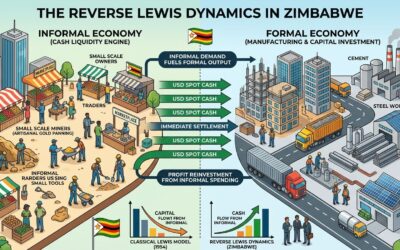
C. The Lewis Dual Economy Model & Supply Chain Spillovers
Nobel Laureate W. Arthur Lewis proposed the Dual Economy Model, which explains how economic development occurs through the interaction between a traditional/informal sector and a modern/formal sector.
In Zimbabwe, this model operates in reverse: the informal sector finances and sustains the formal industrial sector.
- An unbanked trader in Bulawayo or an artisanal miner in Masvingo generates USD cash.
- This cash is spent on building materials supplied by formal, listed corporate manufacturers (cement producers, steel fabricators, brick makers, timber suppliers).
- Thus, informal capital directly expands formal corporate earnings, driving industrial productivity and broader GDP growth.
3. Where Are the Funds Coming From? Unpacking the Drivers
The construction boom across Zimbabwe’s major cities is not fueled by speculative bank debt or mortgage leverage. It is a fully equity-funded, cash-backed expansion. The underlying capital originates from four primary pillars:
                      THE FOUR PILLARS OF CAPITAL INFLOW
                                       │
     ┌──────────────────┬──────────────┴──────────────┬──────────────────┐
     ▼                  ▼                             ▼                  ▼
Diaspora Inflows   Artisanal Mining            Cash-Crop Boom      Private Capital
($2 Billion+/yr)   & Mineral Exports           & Agriculture       & Micro-Leasing
(Direct Housing)   (Gold, Lithium, Platinum)   (Tobacco, Cotton)   (Private Equity)
Pillar 1: The Diaspora Remittance Lifeline
Official records consistently place diaspora remittances through formal international money transfer operators (MTOs) at over USD 2 billion annually, with significant additional flows entering through informal channels.
Unlike remittances in other developing nations—which are largely consumed through food and clothing—a substantial portion of Zimbabwean diaspora funds is explicitly designated for capital expenditure:
- Land Purchases: Suburban expansion in Harare (e.g., Mount Pleasant Heights, Borrowdale, Waterfall extensions), Bulawayo (e.g., Cowdray Park, Hillside), Masvingo, and Gweru.
- Direct Labor & Materials: Weekly disbursements paid directly to local builders, hardware vendors, and transport operators, generating a massive localized multiplier effect.
Pillar 2: The Small-Scale Mining & Commodity Boom
Zimbabwe’s mineral wealth—particularly gold, lithium, chrome, and platinum—serves as a primary generator of decentralized, unbanked wealth.
Artisanal and small-scale gold miners (ASGM), who account for a significant share of total national gold deliveries, receive direct cash payouts in hard currency. This liquidity bypasses formal financial intermediaries and is frequently deployed straight into physical assets—primarily residential real estate, commercial transport fleets, and retail outlets.
Pillar 3: Agriculture and the Cash-Crop Surge
The agricultural sector, particularly tobacco, has registered record-breaking harvest volumes. Hundreds of thousands of smallholder farmers receive direct USD payouts during auction season. This seasonal surge in rural and peri-urban liquidity manifests in property developments, home improvements, and commercial retail building across secondary cities such as Gweru, Masvingo, and Mutare.
Pillar 4: Structural Shift to Private Micro-Financing
With formal bank mortgages accounting for a tiny fraction of total property transactions due to high interest rates, the economy has adapted through private, owner-funded incremental building and developer-led micro-installment schemes:
- Incremental Construction: Property owners build over a 3-to-7-year horizon, adding structures as cash flow allows (“pay-as-you-go” real estate).
- Developer Terms: Land developers offer short-term (12-to-36-month) payment plans directly to buyers, effectively functioning as non-bank financial intermediaries.
4. The Multiplier Effect: How Construction Drives Broader GDP Growth
The real estate construction boom does not exist in isolation; it acts as a primary economic catalyst that stimulates multiple upstream and downstream industries across Zimbabwe.
                         THE REAL ESTATE MULTIPLIER EFFECT

                          ┌───────────────────────────┐
                          │   Real Estate Investment  │
                          └─────────────┬─────────────┘
                                        │
             ┌──────────────────────────┼──────────────────────────┐
             ▼                          ▼                          ▼
   UPSTREAM INDUSTRIES         LOCAL LABOR MARKETS        DOWNSTREAM RETAIL
  • Cement Production         • Bricklayers & Plumbers   • Hardware Retailers
  • Steel & Metal Roofing     • Architects & Surveyors   • Home Furnishings
  • Timber & Transport        • Transport Operators      • Solar & Utilities
             │                          │                          │
             └──────────────────────────┼──────────────────────────┘
                                        ▼
                          ┌───────────────────────────┐
                          │ Expanded National Output  │
                          │        (GDP Growth)       │
                          └───────────────────────────┘
When a new structure is built in Harare or Bulawayo, it triggers a chain reaction throughout the national economy:
- Industrial Manufacturing Demand: Local producers of cement, aggregates, roofing sheets, paint, and door frames experience sustained order volumes.
- Job Creation in the Informal/Semi-Formal Labor Market: Construction is labor-intensive. It absorbs skilled and semi-skilled workers—masons, electricians, plumbers, carpenters—who immediately re-spend their earnings on consumer goods and food.
- Green Energy Adoption: The growth of off-grid residential clusters has driven a secondary boom in solar technology installation, making Zimbabwe one of the fastest-growing residential solar markets in the region.
5. Strategic Implications for Investors, Business Leaders, and Policymakers
For corporate executives, legal advisors, and institutional investors reading Lucent Consultancy, this economic landscape presents distinct strategic choices:
1. Re-Evaluating Credit and Risk Assessment Models
Relying solely on formal bank statements or traditional credit scoring models often misrepresents a counterparty’s actual financial standing. Businesses must incorporate alternative metrics—such as physical asset backing, unbanked cash-flow indicators, and trade credit records—when assessing creditworthiness.
2. Capturing Capital at the Point of Origin
Companies seeking growth must align their distribution channels with the geographic sources of informal wealth creation. Expanding retail footprints and service centers into secondary cities (Masvingo, Gweru, Mutare) and high-density growth points allows corporate entities to access liquidity closer to where it is generated.
3. Formalizing Informal Supply Chains
Policy and corporate strategy should focus on building bridges between the cash economy and formal corporate systems. Products tailored to cash-funded, incremental construction—such as modular housing kits, structured trade credit for hardware dealers, and direct diaspora payment portals—represent significant growth opportunities.
6. Conclusion: A Resilient, Cash-Backed Economic Expansion
The visual evidence across Harare, Bulawayo, Masvingo, and Gweru is not an illusion. The cranes, scaffoldings, and brick structures represent a fundamental structural reality: Zimbabwe’s economic expansion is anchored by decentralized, cash-backed equity.
While formal banking liquidity remains constrained by design, the broader economy continues to operate on high cash velocity, robust diaspora remittances, small-scale resource extraction, and agriculture.
By viewing the Zimbabwean economy through modern economic frameworks, corporate leaders can cut through superficial liquidity narratives and position themselves to capitalize on this underlying economic expansion.
Lucent Consultancy provides strategic corporate advisory, regulatory guidance, and tax compliance solutions tailored to operating in complex emerging markets.