The VAT and Income Tax Paradox
A Legal and Economic Analysis of the Dual-Pricing Dilemma for Registered SMEs in Zimbabwe
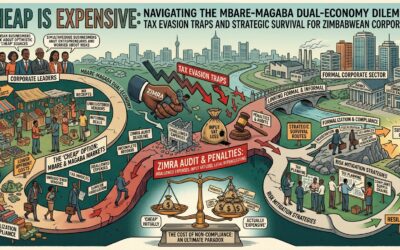
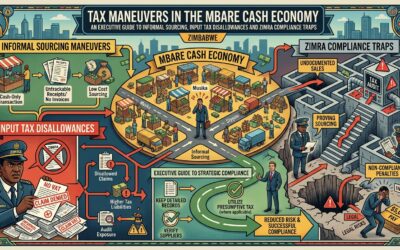
Small and Medium Enterprises (SMEs) operating within Zimbabwe’s formal sector navigate one of the most complex, multi-layered, and volatile tax environments in Sub-Saharan Africa. While registration for Value Added Tax (VAT) in terms of the Value Added Tax Act [Chapter 23:12] is intended to integrate businesses into the formal credit-input tax system, it frequently operates as a double-edged sword. This paper presents an exhaustive legal and economic analysis of the statutory friction faced by VAT-registered SMEs that procure inventory from the informal sector (exemplified by major trading hubs such as Mbare Musika and Magaba).
We examine the compounding legal penalties arising from the interaction between the Value Added Tax Act [Chapter 23:12], the Income Tax Act [Chapter 23:06], and the Finance Act [Chapter 23:04]. Specifically, when a registered operator purchases goods from an unregistered informal trader offering an attractive “cash price” without a fiscalised tax invoice, the registered business suffers a dual statutory forfeiture: the loss of a 15.5% Input VAT claim and the disallowance of the expenditure under Section 16 of the Income Tax Act when preparing the annual Self-Assessment Return (Form ITF12C), triggering an effective corporate tax exposure of 25.75% (inclusive of the 3% AIDS Levy).
Evaluating landmark tax litigation—including Mlilo v Minister of Finance (19-HH-605), Gonese v Minister of Finance (22-HH-265), Redan Petroleum v ZIMRA (23-HH-637), and Contitouch Technologies v ZIMRA (25-HH-057)—this study demonstrates how ministerial regulations, dual-currency compliance mandates (Section 4A of the Finance Act), and strict fiscalisation rules inadvertently incentivize informalisation while penalizing tax compliance. Finally, actionable policy recommendations are proposed to harmonize Zimbabwean tax statutes and preserve SME viability.
1. Contextual Background
Zimbabwe’s economic structure is characterized by a high degree of informalization. A substantial percentage of wholesale trade, agricultural distribution, hardware, and fast-moving consumer goods (FMCG) flows through informal trading hubs such as Mbare Musika, Gazaland, and Magaba in Harare. In these informal markets, commercial transactions are conducted overwhelmingly in cash (primarily United States Dollars) without standard accounting records, fiscal electronic registers, or VAT registration.
For formal Small and Medium Enterprises (SMEs), these informal hubs present a market reality: raw materials, trading stock, and agricultural commodities are often available at significantly lower “cash prices” than those offered by fully compliant, formal corporate suppliers. However, when an SME is registered as a “registered operator” for Value Added Tax (VAT) purposes under the Value Added Tax Act [Chapter 23:12], entering into transactions with unregistered informal vendors creates a severe statutory trap.
The legislative design of a VAT system relies on an unbroken chain of tax credits: a registered supplier charges Output VAT, collects it on behalf of the Revenue Authority, and issues a statutory “Tax Invoice.” The registered buyer then deducts this “Input VAT” from its output liability, remitting only the net difference to the Zimbabwe Revenue Authority (ZIMRA). When an SME purchases stock from an unregistered trader in Mbare:
- No statutory tax invoice is issued, precluding any 15.5% Input VAT credit under Section 15 of the VAT Act.
- Under audit or upon filing the annual Corporate Income Tax Return (Form ITF12C) pursuant to Section 37A of the Income Tax Act [Chapter 23:06], ZIMRA disallows the underlying purchase price as an allowable deduction under Section 15(2)(a) as read with Section 16 due to lack of proper fiscalised documentation.
As a result, the SME faces an aggressive double tax burden: it loses the 15.5% input tax credit and pays an additional 25.75% effective corporate tax on the disallowed expenditure. This structural dynamic transforms VAT registration from a mark of commercial maturity into a competitive disadvantage that squeezes margins, starves cash flow, and drives formal businesses into the shadow economy.
2. Legislative and Statutory Framework
Understanding the SME tax trap requires a detailed examination of three primary tax statutes in Zimbabwe: the Value Added Tax Act [Chapter 23:12], the Income Tax Act [Chapter 23:06], and the Finance Act [Chapter 23:04] (as amended up to Act 7 of 2025 and SI 106 of 2025).
                      +-----------------------------------+
                      |   REGISTERED SME (BUYER)          |
                      |   - VAT Registered                |
                      |   - Income Tax Compliant (ITF12C) |
                      +-----------------+-----------------+
                                        |
                                        | Purchases Stock
                                        v
                      +-----------------------------------+
                      |   UNREGISTERED VENDOR (MBARE)     |
                      |   - No VAT Registration           |
                      |   - No Fiscalised Tax Invoice     |
                      |   - Cash-only Transactions        |
                      +-----------------+-----------------+
                                        |
             +--------------------------+--------------------------+
             |                                                     |
             v                                                     v
+--------------------------+                             +-------------------+
|  VAT ACT [CAP 23:12]     |                             | INCOME TAX ACT    |
|  Section 15 & 20         |                             | [CAP 23:06]       |
+-------------+------------+                             +---------+---------+
              |                                                    |
              v                                                    v
+--------------------------+                             +-------------------+
| Input Tax Claim DENIED   |                             | Expense Deduction |
| Loss: 15.5% Input VAT    |                             | DISALLOWED        |
+--------------------------+                             | Section 15/16     |
                                                         +---------+---------+
                                                                   |
                                                                   v
                                                         +-------------------+
                                                         | Corporate Tax     |
                                                         | Penalty: 25.75%   |
                                                         +-------------------+
2.1 The Value Added Tax Act [Chapter 23:12]
Section 6: Imposition of Value Added Tax
Section 6 of the VAT Act levies tax on the supply of goods or services by a registered operator in the course or furtherance of an enterprise carried on by that person, as well as on the importation of goods. The standard rate of VAT in Zimbabwe stands at 15.5% (having been adjusted from historical rates of 14.5% and 15%).
Section 15: Calculation of Tax Payable and Input Tax Deduction
Section 15(1) establishes the mechanics of calculating net VAT payable for any tax period:
VAT Payable = Output Tax Charged – Input Tax DeductibleUnder Section 15(2), a registered operator is permitted to deduct from output tax an amount equal to the input tax paid in respect of goods or services supplied to them, provided that the supply was incurred in the course of making taxable supplies.
Crucially, Section 15(3) imposes a strict condition precedent:
“No deduction of input tax shall be made… unless a tax invoice or debit note or credit note in relation to that supply has been provided in accordance with section 20 or 21 and is held by the registered operator at the time any return in respect of that supply is furnished.”
Section 20: Requirements of a Valid Tax Invoice and Fiscalisation
Section 20 prescribes the mandatory requirements of a valid tax invoice. Following the implementation of the Value Added Tax (Fiscalised Recording of Taxable Transactions) Regulations, a tax invoice must not only state the name, address, VAT registration number, and Taxpayer Identification Number (TIN) of the supplier, but it must also be generated through a Fiscalised Electronic Register (FER) or an integrated Fiscalisation Data Management System (FDMS) containing:
- A unique fiscal signature.
- A ZIMRA-verifiable QR Code.
- Serialized transaction data transmitted in real-time to ZIMRA servers.
When an SME purchases goods from an unregistered trader in Mbare, the supplier cannot lawfully issue a tax invoice under Section 20. Consequently, by command of Section 15(3), the input tax deduction of 15.5% is disallowed.
2.2 The Income Tax Act [Chapter 23:06] and the ITF12C Return
Section 15(2)(a): The General Deduction Formula
The foundational rule governing corporate income tax deductions in Zimbabwe is embedded in Section 15(2)(a) of the Income Tax Act [Chapter 23:06]:
“The deductions allowed shall be expenditures and losses to the extent to which they are incurred for the purposes of trade or in the production of the income…”
In tax accounting, the cost of acquiring trading stock (Cost of Goods Sold) is a core deduction under Section 15(2)(a). Without deducting stock purchase costs, a business would be taxed on gross revenue rather than net commercial profit.
Section 16: Prohibited Deductions and Documentation Rules
Section 16 of the Income Tax Act sets out explicit statutory prohibitions. Section 16(1)(a) disallows deductions for expenses not incurred for the purpose of trade or in the production of income. Furthermore, under ZIMRA’s audit guidelines and statutory documentation rules, any expenditure claimed under Section 15(2)(a) must be substantiated by verifiable, legally valid documentary evidence.
When a corporate taxpayer files its annual Self-Assessment Return (Form ITF12C) pursuant to Section 37A:
- The taxpayer must declare gross revenues, cost of sales, operating expenses, and tax computations.
- ZIMRA systematically conducts post-assessment audits under Section 45.
- Where stock purchases are backed only by handwritten receipts, informal cash vouchers, or invoices lacking ZIMRA fiscal verification from unregistered suppliers, ZIMRA routinely disallows the expense under Section 16 on the grounds that the expenditure is unverified or non-compliant with statutory invoicing laws.
Section 37A: Self-Assessment Framework
Under Section 37A, taxpayers calculate their own tax liabilities. However, Section 37A(4) gives the Commissioner-General sweeping powers to issue revised assessments with heavy penalties (up to 100% of the tax avoided) and statutory interest under Section 71 where deductions are claimed without proper fiscal substantiation.
2.3 The Finance Act [Chapter 23:04]
The Finance Act serves as the charging statute that sets tax rates, currency conversion parameters, and specific levies. Key provisions relevant to SMEs include:
Corporate Income Tax Rate
Under Chapter I, Part III, Section 14(2)(c) of the Finance Act, the base corporate tax rate is set at 25%. Under Section 14(8), an AIDS Levy equal to 3% of the calculated income tax payable is charged on companies and trusts.
Effective Corporate Tax Rate = 25% + (3% times 25%) = 25.75%
Section 4A: Payment of Taxes in Foreign Currency
Section 4A of the Finance Act mandates that where income is earned, received, or accrued in foreign currency (such as USD), the tax liability must be paid in foreign currency.
Section 4A(9) establishes a statutory presumption:
“It shall be presumed that every transaction to which the provisions of this section apply was conducted using the United States dollar only, unless the taxpayer or registered operator… provides documentary proof in the form of an invoice or other documentary proof satisfactory to the Commissioner that the transaction in question was conducted using the Zimbabwe dollar or a foreign currency other than the United States dollar.”
This provision places the burden of proof squarely on the SME. If an SME buys stock in cash USD from Mbare without a compliant invoice, ZIMRA applies Section 4A(9) to assess both output revenues and disallowed expenses entirely in USD.
Section 22C: Presumptive Taxes
Section 22C prescribes presumptive taxes for informal operators (e.g., informal cross-border traders, operators of taxicabs, hairdressing salons, cottage industry operators). While presumptive tax (e.g., 10% on informal traders’ rentals under Section 22C(1)(a)) is designed to capture revenue from the informal market, it does not confer VAT-registered status on these informal operators, nor does it generate input tax credits or proper tax invoices for formal businesses purchasing from them.
3. The Informal Market Reality and Dual-Pricing Mechanics
To understand the operational pressures on registered SMEs, one must examine the price discovery process in markets like Mbare Musika.
3.1 The Informal Market Arbitrage
Informal traders in Mbare operate outside the formal tax net. They do not register for VAT, do not pay corporate income tax, do not implement FDMS fiscal devices, and frequently bypass formal customs clearance (using informal cross-border smuggling or grey-market channels).
As a consequence, informal traders operate with dramatically lower overhead costs. When selling goods—whether agricultural produce, imported fast-moving consumer goods, electricals, or hardware—they offer two distinct price points:
                      +-----------------------------------+
                      |         INFORMAL MARKET SUPPLY    |
                      +-----------------+-----------------+
                                        |
               +------------------------+------------------------+
               |                                                 |
               v                                                 v
+-------------------------------+               +-------------------------------+
| OPTION 1: "CASH PRICE"        |               | OPTION 2: FISCALISED PRICE    |
| - Unregistered Seller         |               | - Formal Wholesaler / Trader  |
| - Price: $100.00              |               | - Price: $115.50              |
| - No Tax Invoice              |               | - Includes 15.5% VAT ($15.50) |
| - Sourced from Mbare          |               | - Compliant Fiscal Device     |
+-------------------------------+               +-------------------------------+
- The Informal “Cash Price” ($100.00): The seller demands immediate payment in hard currency (USD cash). No invoice is generated, or a non-fiscalized handwritten receipt is provided. The price reflects zero tax compliance cost.
- The Formal “Fiscalised Price” ($115.50 – $125.00): Formal, registered distributors sell the identical product at $100.00 base cost + 15.5% VAT ($15.50) = $115.50 (or higher, to cover corporate tax, compliance software, and administrative costs).
3.2 The SME’s Dilemma
A registered SME facing fierce retail or commercial competition is drawn to the lower upfront cash price of $100.00 in Mbare. Sourcing from formal distributors at $115.50 consumes substantially more working capital.
However, as shown in the next section, the apparent $15.50 cash saving on the informal price is an illusion. The structural interaction of Zimbabwe’s tax laws converts that $15.50 saving into an immediate, severe net financial loss once tax liabilities are computed.
4. The Tax Trap: Quantitative and Mathematical Diagnosis
To illustrate the mathematical reality of this statutory paradox, consider a registered SME (Company A) operating in Harare. Company A purchases 1,000 units of trading stock to resell at a retail price of $150.00 per unit (excluding VAT).
We contrast two scenarios:
- Scenario A: Company A buys stock from a fully compliant formal supplier who issues a Section 20 Fiscalised Tax Invoice at $100.00 + 15.5% VAT per unit.
- Scenario B: Company A buys identical stock from an unregistered trader in Mbare at the informal “Cash Price” of $100.00 per unit with no fiscalised tax invoice.
4.1 Comparative Mathematical Model
Baseline Transaction Parameters
- Quantity: 1,000 units
- Resale Price (excl. VAT): $150.00 per unit Total Sales = $150,000.00
- Output VAT Collected (15.5%): $150,000 \times 15.5% = $23,250.00
- Gross Revenue (incl. VAT): $173,250.00
- Base Corporate Income Tax Rate: 25.0%
- AIDS Levy: 3.0% of Corporate Tax (Effective Rate = 25.75%)
Scenario Analysis Table
| Financial & Tax Component | Scenario A: Formal Procurement (Fiscalised Invoice) | Scenario B: Informal Procurement (Mbare Cash Price) | Variance / Penalty on Scenario B |
| Supplier Base Price (excl. VAT) | $100,000.00 | $100,000.00 | $0.00 |
| Input VAT Paid to Supplier (15.5%) | $15,500.00 | $0.00 (Unregistered) | -$15,500.00 (Cash Outlay Saved Upfront) |
| Total Cash Outlay for Stock | $115,500.00 | $100,000.00 | +$15,500.00 Upfront Cash Saved |
| Gross Sales Revenue (excl. VAT) | $150,000.00 | $150,000.00 | $0.00 |
| Output VAT Collected (15.5%) | $23,250.00 | $23,250.00 | $0.00 |
| Less: Claimable Input VAT (Sec 15) | ($15,500.00) | $0.00 (DISALLOWED) | +$15,500.00 VAT Paid to ZIMRA |
| Net VAT Remitted to ZIMRA | $7,750.00 | $23,250.00 | +$15,500.00 Extra VAT Liability |
| Income Tax Computation (Form ITF12C) | |||
| Gross Revenue for Tax Purposes | $150,000.00 | $150,000.00 | $0.00 |
| Less: Deductible Cost of Goods Sold | ($100,000.00) | $0.00 (DISALLOWED Sec 16) | +$100,000.00 Disallowed Expense |
| Taxable Income Assessed | $50,000.00 | $150,000.00 | +$100,000.00 Phantom Profit |
| Corporate Tax Payable (25%) | $12,500.00 | $37,500.00 | +$25,000.00 |
| AIDS Levy Payable (3% of Corp Tax) | $375.00 | $1,125.00 | +$750.00 |
| Total Income Tax Liability (25.75%) | $12,875.00 | $38,625.00 | +$25,750.00 Extra Tax Liability |
| Comprehensive Financial Summary | |||
| Total Cash Received from Customers | $173,250.00 | $173,250.00 | $0.00 |
| Less: Cash Paid for Stock | ($115,500.00) | ($100,000.00) | +$15,500.00 |
| Less: Net VAT Paid to ZIMRA | ($7,750.00) | ($23,250.00) | -$15,500.00 |
| Less: Income Tax Paid to ZIMRA | ($12,875.00) | ($38,625.00) | -$25,750.00 |
| Net Commercial Cash Profit | $37,125.00 | $11,375.00 | -$25,750.00 Loss in Profitability |
| Effective Tax Drag on Gross Margin | 35.75% | 123.75% | +88.00% Tax Overburden |
4.2 Comprehensive Analysis of the Numbers
SCENARIO A: Formal Supplier (Compliant)
   Gross Revenue: $150,000
 - Allowable Stock Cost: $100,000
 = True Profit: $50,000
   Tax Paid (25.75%): $12,875
   NET CASH PROFIT: $37,125

SCENARIO B: Mbare Informal Cash Purchase (Non-Compliant)
   Gross Revenue: $150,000
 - Disallowed Stock Cost: $0 (ZIMRA Disallows $100k Expense)
 = Phantom Assessed Profit: $150,000
   Tax Paid (25.75%): $38,625
   Extra Net VAT Remitted: $15,500
   NET CASH PROFIT: $11,375  <-- 69.4% PROFIT DESTRUCTION!
- Destruction of Commercial Profitability:
In Scenario A, the compliant business realizes a net cash profit of $37,125.00 on its $50,000 gross margin. In Scenario B, buying at the informal “cash price” slashes net profit to $11,375.00—a 69.4% reduction in net commercial earnings.
- The “Phantom Profit” Tax Trap:
In Scenario B, because ZIMRA disallows the $100,000 purchase cost under Section 16 due to lack of a fiscalised invoice, the SME is assessed for corporate tax on an artificial “phantom profit” of $150,000 rather than its true profit of $50,000. The SME pays $38,625 in income tax on $50,000 of actual earnings—an effective corporate tax rate of 77.25% on real income!
- Total Statutory Loss Percentage:
The financial penalty for buying informally equals:
Input VAT Forfeited (15.5%) + Disallowed Income Tax Deduction (25.75%) = 41.25%For every $100 spent in Mbare without a fiscalised tax invoice, the registered SME incurs $41.25 in combined statutory tax friction.
5. Judicial Precedents and Legislative Uncertainties
The tax enforcement landscape in Zimbabwe is complicated by continuous legislative changes through Statutory Instruments (SIs), backdated acts, and constitutional challenges regarding the powers of the Minister of Finance.
+-----------------------------------------------------------------------------------+
|                        KEY JUDICIAL PRECEDENTS & DOCTRINES                        |
+-----------------------------------------------------------------------------------+
| 1. Mlilo v Minister of Finance (19-HH-605)                                        |
|    - Declared SI 205/2018 (IMTT under Sec 22G) ultra vires.                       |
|    - Established that executive decrees cannot override statutory provisions.    |
+-----------------------------------------------------------------------------------+
| 2. Gonese v Minister of Finance (22-HH-265)                                       |
|    - Reaffirmed that the Minister of Finance cannot create primary law via SI.    |
|    - Highlighted constitutional limits under Section 134 of the Constitution.     |
+-----------------------------------------------------------------------------------+
| 3. Redan Petroleum v ZIMRA (23-HH-637) & Contitouch v ZIMRA (25-HH-057)           |
|    - Addressed Section 4A foreign currency payment liabilities.                   |
|    - Confirmed ZIMRA's powers to demand payment in currency of transaction.       |
+-----------------------------------------------------------------------------------+
| 4. Unki Mines v ZIMRA (22-HH-729) & Delta Corp v ZIMRA (24-SC-062)                |
|    - Settled multi-currency valuation and statutory conversion disputes.          |
+-----------------------------------------------------------------------------------+
5.1 Executive Decree vs. Constitutional Validity: Mlilo and Gonese
The legislative background of the Finance Act [Chapter 23:04] contains repeated instances of executive law-making through Statutory Instruments, followed by retrospective Parliamentary validation.
In M. Mlilo v Minister of Finance and Economic Development (19-HH-605), the High Court struck down Statutory Instrument 205 of 2018 (which sought to introduce the Intermediated Money Transfer Tax (IMTT) under Section 22G of the Finance Act). The High Court declared SI 205/2018 ultra vires the powers of the Minister, ruling that the Executive cannot alter primary tax legislation by ministerial regulation. Parliament subsequently passed Section 32 of Act 13 of 2019 to retrospectively validate the tax.
This principle was reinforced in Gonese v Minister of Finance and Economic Development (22-HH-265), where the High Court again ruled that the Minister of Finance lacked statutory authority to enact substantive tax legislation via regulations, citing Section 134 of the Constitution of Zimbabwe (Act No. 20 of 2013), which strictly limits delegated legislative authority.
Relevance to SME Invoicing and Fiscalisation Rules
SMEs often face sudden changes to tax requirements, invoicing parameters, and penalty structures introduced via Statutory Instruments (such as SI 74 of 2024, SI 80 of 2024, SI 50 of 2025, and SI 106 of 2025). When ZIMRA penalizes an SME for non-compliant documentation under regulations issued via SI without primary legislative backing, those assessments may be vulnerable to challenge under the doctrine established in Mlilo and Gonese. However, individual SMEs rarely have the financial resources to litigate these constitutional issues in the High Court, leaving them subject to ZIMRA’s administrative enforcement.
5.2 Currency of Assessment and Tax Remittal: Redan Petroleum and Contitouch Technologies
The multi-currency tax framework under Section 4A of the Finance Act has generated substantial litigation regarding the currency in which tax liabilities must be settled.
In Redan Petroleum (Pvt) Ltd v ZIMRA (23-HH-637), the High Court addressed ZIMRA’s authority to assess tax liabilities in foreign currency where transactions were conducted in foreign currency. The court affirmed that ZIMRA is statutorily mandated by Section 4A to collect taxes in the actual currency of trade.
In Contitouch Technologies (Pvt) Ltd v ZIMRA & CBZ (25-HH-057), the court confirmed that taxpayers cannot unilaterally choose to settle foreign currency tax obligations in local currency at artificial exchange rates. The ruling established that ZIMRA may freeze bank accounts and issue garnishee orders under Section 33 of the Value Added Tax Act and Section 69 of the Income Tax Act to recover foreign currency taxes owed.
Impact on SMEs Sourcing from Mbare
When an SME purchases stock in cash USD from Mbare:
- ZIMRA applies Section 4A(9) to assess the SME’s sales revenues fully in USD.
- Output VAT is demanded in USD.
- Corporate Income Tax on the disallowed expense is assessed in USD.
- Under Redan Petroleum and Contitouch, ZIMRA enforces payment strictly in USD, preventing the SME from settling its back-assessed liabilities in local currency.
5.3 Currency Adjustments and Accounting Conversion: Unki Mines and Delta Corporation
In Unki Mines (Pvt) Ltd v ZIMRA & Stanbic Bank (22-HH-729) and Delta Corporation Limited v ZIMRA (24-SC-062), the High Court and Supreme Court considered the legal complexities of translating balance sheets, capital allowances, and cost of sales across changing currency regimes (from ZWL to USD, ZiG, and multi-currency frameworks).
The courts affirmed that tax accounting requires strict alignment between the currency of expense exposure and the currency of revenue recognition. Where an SME incurs undocumented cash USD expenses in Mbare, it cannot adjust or convert those expenses on its ITF12C return to mitigate its corporate tax exposure.
6. Fiscalisation, FDMS, and Intermediated Tax Friction
6.1 The Fiscalisation Data Management System (FDMS)
Under current statutory regulations, all VAT-registered operators must integrate their point-of-sale (POS) systems with ZIMRA’s Fiscalisation Data Management System (FDMS). Under this framework:
- Every sale generates an encrypted fiscal receipt containing a digital signature and QR code.
- The transaction data transmits automatically to ZIMRA servers in real time.
- Input VAT claims submitted on VAT 7 returns are cross-checked by automated reconciliation algorithms against the output VAT reported by the supplier’s FDMS device.
                    FDMS AUTOMATED MATCHING SYSTEM

   SUPPLIER POS                     ZIMRA FDMS                     BUYER RETURN
+-----------------+            +------------------+            +------------------+
| Fiscal Device   |--Data----->| Central Server   |<--Claim----| VAT 7 Return     |
| Output VAT Logged| Transmission| Cross-Check     | Input VAT  | Input VAT Claimed|
+-----------------+            +--------+---------+            +------------------+
                                        |
                               Match Successful?
                                 /           \
                               YES            NO
                                /               \
                               v                 v
                   +------------------+   +-------------------+
                   | Input Tax Credit |   | CLAIM REJECTED    |
                   | Approved         |   | - Sec 15 Audit    |
                   +------------------+   | - Sec 16 Disallow |
                                          +-------------------+
When an SME claims Input VAT based on an invoice from a supplier whose FDMS device failed to transmit the transaction—or when the purchase was made from an unregistered trader in Mbare with no FDMS record—ZIMRA’s automated system instantly flags and rejects the claim.
6.2 Intermediated Money Transfer Tax (IMTT) as a Compounding Cost
In addition to VAT and Income Tax, SMEs are subject to the Intermediated Money Transfer Tax (IMTT) governed by Section 22G of the Finance Act:
- Local Currency Transactions: Charged under Section 22G(a) at 1.5% per transaction (subject to statutory thresholds and flat caps on large transactions).
- Foreign Currency (USD) Transactions: Charged under Section 22G(b) at 2.0% (US$0.02 per dollar) per transaction.
FORMAL PROCUREMENT CHAIN (IMTT Charged at Multiple Stages)
Manufacturer ---> Wholesaler (IMTT 2%) ---> Retailer SME (IMTT 2%) ---> Final Consumer
Cumulative Financial Friction: ~4% - 6% Additional Overhead

INFORMAL PROCUREMENT CHAIN (Cash-based, Bypasses IMTT)
Mbare Cash Supplier === Cash USD (0% IMTT) ===> Retailer SME
IMTT creates additional cost friction in formal supply chains:
- When a formal supplier sells to an SME, electronic bank transfers or mobile payments attract IMTT at 2% for the buyer and 2% for the seller, adding cumulative friction to the supply chain.
- In contrast, transactions in Mbare are conducted in physical cash USD, bypassing IMTT entirely at the point of purchase.
This dynamic creates a distortion: IMTT makes formal, electronic purchases more expensive, nudging struggling SMEs toward cash transactions in the informal market. However, when the SME tries to integrate those cash purchases into its formal tax returns (ITF12C), it runs straight into Section 16 disallowances and penalties.
7. Systemic Consequences for SME Viability and the Economy
The statutory interplay between the VAT Act, the Income Tax Act, and the Finance Act produces several systemic consequences for the Zimbabwean economy:
+----------------------------------------------------------------------------------+
|                  SYSTEMIC ECONOMIC IMPACTS OF THE TAX PARADOX                    |
+----------------------------------------------------------------------------------+
| 1. PERVERSE INCENTIVE TO INFORMALISE                                             |
|    - Formal registration creates a 41.25% cost penalty on informal purchases.    |
|    - Businesses choose to de-register or operate in the shadow economy.          |
+----------------------------------------------------------------------------------+
| 2. CAPITAL EROSION & LIQUIDITY CRUNCHES                                          |
|    - Disallowance of stock costs creates "phantom profits."                      |
|    - Corporate tax assessments consume operational working capital.              |
+----------------------------------------------------------------------------------+
| 3. SUPPLY CHAIN DISTORTIONS                                                      |
|    - Compliant SMEs are locked out of competitive informal supply channels.      |
|    - Large formal monopolies consolidate control over distribution.               |
+----------------------------------------------------------------------------------+
| 4. AGGRESSIVE ZIMRA AUDIT EXPOSURE                                               |
|    - Post-assessment audits lead to 100% penalties under Section 45.             |
|    - Garnishee orders under VAT Sec 33 / Income Tax Sec 69 freeze operations.    |
+----------------------------------------------------------------------------------+
7.1 The Perverse Incentive to De-Formalize
Rather than encouraging informal traders in Mbare to register for VAT, the current tax framework incentivizes registered SMEs to operate off the books.
When a registered SME realizes that buying stock informally incurs a 41.25% tax penalty on its ITF12C return, it faces two choices:
- Stop buying from informal suppliers entirely (which may make its retail prices uncompetitive against informal sellers).
- Hide its informal purchases and corresponding cash sales from ZIMRA, creating a parallel, unrecorded operating cycle.
The tax code thus unintentionally drives compliant businesses into the shadow economy.
7.2 Working Capital Depletion and “Phantom Profit” Taxation
As demonstrated in the mathematical model in Section 4, disallowing cost of sales under Section 16 taxes businesses on gross revenue rather than net income.
For an SME operating on thin profit margins (e.g., 5% to 10%), paying a 25.75% tax on un-deducted stock purchases completely wipes out its operating margin and consumes its underlying working capital. This dynamic contributes significantly to high SME failure rates in Zimbabwe.
7.3 Audit Exposure, Penalties, and Garnishee Orders
Under Section 45 of the Income Tax Act and Section 33 of the VAT Act, ZIMRA routinely audits corporate taxpayers up to six years retroactively.
Where an audit reveals that an SME claimed stock deductions supported only by non-fiscalized receipts:
- ZIMRA issues amended assessments disallowing the expenses.
- Additional tax is charged at standard rates (25.75%).
- A 100% penalty is levied on the unpaid tax under Section 45.
- Statutory interest is calculated under Section 71.
To enforce payment, ZIMRA uses Section 69 of the Income Tax Act to issue garnishee orders against the SME’s bank accounts. Bank funds are swept directly to the Consolidated Revenue Fund, often forcing the business into liquidation.
8. Policy Recommendations and Legislative Reforms
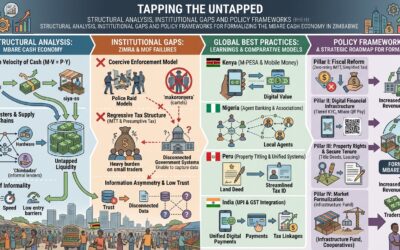
To resolve this statutory paradox and support formal SME growth without undermining revenue collection, the government of Zimbabwe should consider targeted legislative adjustments to the Finance Act, Income Tax Act, and VAT Act.
+-----------------------------------------------------------------------------------+
|                        PROPOSED LEGISLATIVE & POLICY REFORMS                      |
+-----------------------------------------------------------------------------------+
| 1. Presumptive Input Tax Credit Mechanism                                         |
|    - Allow registered buyers to claim a standard input tax credit (e.g., 5-7%)   |
|      on verified purchases from presumptive-tax-paying informal traders.          |
+-----------------------------------------------------------------------------------+
| 2. Standardised Wholesale Expense Allowance under Section 15                      |
|    - Amend Section 16 to allow a deemed cost-of-sales deduction (e.g., 70-80%    |
|      of verified market cost) supported by banking or mobile money records.       |
+-----------------------------------------------------------------------------------+
| 3. Graduated Fiscalisation for Micro-Wholesalers                                  |
|    - Roll out low-cost, smartphone-based FDMS applications for traders in Mbare. |
+-----------------------------------------------------------------------------------+
| 4. Rationalisation of IMTT under Section 22G                                      |
|    - Reduce or eliminate IMTT on formal B2B electronic transactions to encourage  |
|      digital banking over cash trading.                                          |
+-----------------------------------------------------------------------------------+
8.1 Introduction of a Presumptive Input Tax Credit
The legislature should amend Section 15 of the Value Added Tax Act to introduce a Presumptive Input Tax Credit for registered operators purchasing agricultural goods or basic commodities from unregistered informal traders who pay Presumptive Tax under Section 22C of the Finance Act.
- Proposed Mechanism: Where a registered SME purchases goods from an informal vendor who can demonstrate payment of Presumptive Tax (or where the transaction occurs within a designated presumptive tax market zone like Mbare), the SME should be permitted to claim a flat presumptive input credit (e.g., 5% to 7%).
- Economic Effect: This would reduce the input tax penalty, lower final retail prices, and provide a paper trail linking informal traders to formal supply chains.
8.2 Amendment of Section 16 to Allow Verified Cost-of-Sales Deductions
Section 16 of the Income Tax Act should be amended to establish a clear distinction between completely unverified, fraudulent claims and real cost-of-sales expenditures incurred in recognized informal wholesale markets.
- Proposed Rule: Where a taxpayer can establish physical receipt of trading stock and corresponding cash withdrawal records (or verified bank/mobile transfers), Section 16 should allow a deemed cost-of-sales deduction equal to a specified percentage (e.g., 70% to 80% of wholesale market value).
- Economic Effect: This would prevent the assessment of tax on “phantom profits,” ensuring that corporate income tax remains a tax on net profits rather than gross sales.
8.3 Mobile and Smartphone Fiscalisation for Informal Traders
Rather than requiring expensive hardware-based Fiscal Electronic Registers (FERs), ZIMRA should introduce lightweight, smartphone-based mobile FDMS software for micro-wholesalers in trading hubs like Mbare.
- Mechanism: Informal traders could issue simplified, digital VAT invoices via mobile phone at a lower threshold.
- Economic Effect: Lowers the barrier to entry for formal invoicing, allowing micro-suppliers to issue compliant receipts to registered SME buyers.
8.4 IMTT Alignment for Business-to-Business (B2B) Transactions
To remove the incentive for cash transactions, Section 22G of the Finance Act should be amended to exempt or reduce IMTT on formal B2B bank transfers between registered operators.
- Mechanism: Zero-rate IMTT on electronic payments made for verified commercial stock purchases backed by tax invoices.
- Economic Effect: Makes electronic banking competitive with cash trading, encouraging SMEs to remain fully integrated within formal financial channels.
9. Conclusion
The statutory tax framework governing small and medium enterprises in Zimbabwe presents a challenging paradox. While VAT registration offers formal commercial status, the rigid interaction between Section 15 of the Value Added Tax Act [Chapter 23:12], Section 16 of the Income Tax Act [Chapter 23:06], and Section 14/4A of the Finance Act [Chapter 23:04] creates a severe structural trap for businesses sourcing from the informal economy.
When a registered SME purchases inventory from an unregistered trader in Mbare at an attractive informal cash price, it forfeits its 15.5% Input VAT claim and faces disallowance of its purchase costs on its annual ITF12C return. This generates a combined statutory tax penalty of 41.25%, creating artificial “phantom profits” and levying an effective tax burden that can exceed 100% of real commercial earnings.
Judicial precedents—such as Mlilo, Gonese, Redan Petroleum, and Contitouch Technologies—highlight the legal complexities surrounding statutory instruments, foreign currency tax obligations, and ZIMRA’s administrative enforcement powers. Without statutory reforms—such as presumptive input tax credits, deemed cost-of-sales allowances, and simplified mobile fiscalisation—the current tax structure will continue to strain formal SMEs, encourage shadow-market trading, and hamper broader economic formalization in Zimbabwe.
References and Statutory Authorities
Primary Legislation
- Finance Act [Chapter 23:04] (as amended up to Act 7 of 2025 and SI 106 of 2025).
- Income Tax Act [Chapter 23:06] (including Thirteenth Schedule, Section 15, Section 16, Section 37A, Section 45, and Section 71).
- Value Added Tax Act [Chapter 23:12] (including Section 6, Section 15, Section 20, and Section 33).
- Revenue Authority Act [Chapter 23:11].
- Constitution of Zimbabwe Amendment (No. 20) Act, 2013 (Section 134 on Delegated Legislation).
Case Law Precedents
- M. Mlilo v Minister of Finance and Economic Development & ZIMRA 19-HH-605.
- Gonese & Anor v Minister of Finance and Economic Development 22-HH-265.
- Redan Petroleum (Pvt) Ltd v Zimbabwe Revenue Authority 23-HH-637.
- Contitouch Technologies (Pvt) Ltd v ZIMRA & CBZ Bank Ltd 25-HH-057.
- Unki Mines (Pvt) Ltd v ZIMRA & Stanbic Bank Zimbabwe 22-HH-729.
- Delta Corporation Limited v Zimbabwe Revenue Authority 24-SC-062.
- Berncorn (Pvt) Ltd t/a Two Keys Transport v ZIMRA 10-HH-042.
- Paperhole Investments (Pvt) Ltd v Profeeds (Pvt) Ltd & ZIMRA 25-HH-063.