
The Architecture of Predictability: Why Your Small Business Needs Standard Operating Procedures (SOPs)
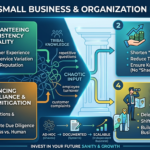 For many small business owners, the early days of an enterprise are fueled by pure adrenaline, instinct, and a hands-on approach to every problem. In this “startup phase,” the founder acts as the central nervous system of the organization. Every decision passes through them, every quality check is performed by them, and the entire business model lives inside their head.
While this centralized, high-energy approach is necessary to launch a business, it is entirely unsustainable if the goal is growth, stability, or eventual exit. As a business expands from a solopreneur venture or a tight-knit team into a larger organization, relying on memory, verbal instructions, and ad-hoc problem-solving becomes a recipe for chaos.
This is where Standard Operating Procedures (SOPs) come into play. Often misunderstood as rigid corporate bureaucracy reserved only for multinational conglomerates, SOPs are actually the single most powerful tool a small or growing business can deploy to achieve operational freedom, consistency, and scale.
What is a Standard Operating Procedure (SOP)?
At its core, a Standard Operating Procedure is a documented, step-by-step set of instructions compiled by an organization to help workers carry out routine operations. The ultimate objective of an SOP is to achieve efficiency, quality output, and uniformity of performance, while reducing miscommunication and failure to comply with industry regulations.
Think of an SOP as a recipe for a specific business outcome. If you give a premier recipe to ten different chefs, you expect the resulting dish to taste remarkably similar, regardless of who was holding the pan. An SOP brings that exact same culinary predictability to your business processes—whether that process is onboarding a new client, running weekly payroll, manufacturing a physical product, or handling a customer complaint.
The Anatomy of an Effective SOP
An SOP does not have to be a dry, 50-page text document. In fact, the most effective modern SOPs are dynamic and multimodal. Depending on the complexity of the task, an SOP might include:
-
Written Step-by-Step Instructions: Clear, concise, imperative sentences (“Click the ‘Submit’ button,” “Verify the invoice amount matches the purchase order”).
-
Flowcharts and Process Maps: Visual representations of decision trees (e.g., “If the customer demands a refund over $100, route to Manager; if under $100, process automatically”).
-
Video Walkthroughs: Screen recordings showing exactly how to navigate a piece of software or perform a technical task.
-
Checklists: Simple, actionable bullet points that ensure no critical step is forgotten during high-stress or routine operations.
The Strategic Void: The Cost of Operating Without SOPs
Before examining why your organization needs SOPs, it is instructive to look at the alternative. What happens to a small business that refuses to document its processes?
Without SOPs, a business suffers from Tribal Knowledge. Tribal knowledge is information that is known by a specific individual or group within an organization but is not documented anywhere else.
If your head of sales is the only person who knows how to navigate your custom CRM, or if your office manager is the only one who knows how to open the building and configure the morning inventory, your business is highly vulnerable. If that person gets sick, goes on vacation, or leaves the company to work for a competitor, a portion of your business infrastructure effectively walks out the door with them.
Operating without SOPs creates several operational bottlenecks:
-
The Founder’s Trap: The owner cannot take a vacation or focus on big-picture strategy because they are constantly dragged into daily firefighting.
-
Inconsistent Customer Experience: Customer service or product quality depends entirely on which employee happens to be working that day.
-
Wasted Time and Money: Employees waste hours guessing how to do a task, correcting errors, or asking colleagues repetitive questions.
Why Your Small Business and Organization Needs SOPs
Implementing SOPs transforms a business from a chaotic job owned by the founder into a scalable asset that runs independently. Below is a deep dive into the primary reasons why your organization must prioritize process documentation.
1. Guaranteeing Consistency and Quality Control
Your brand is not your logo, your color scheme, or your slogan; your brand is the promise of a consistent experience. Whether you run a boutique coffee shop, a digital marketing agency, or a plumbing service, customers return because they expect the same level of quality they received the first time.
Without written procedures, variation inevitably creeps in. Employee A might treat a customer with impeccable care, while Employee B, lacking clear guidelines, might cut corners. An SOP establishes a baseline for what “excellence” looks like in your company. It removes subjectivity from the equation. When operations are standardized, output variance drops, ensuring your customers receive a predictable, high-quality experience every single time they interact with your brand.
2. Accelerating Employee Onboarding and Training
Hiring new team members is one of the most expensive and time-consuming activities a small business undertakes. In an undocumented business, training usually looks like “shadowing”—a new hire sits next to an experienced employee for two weeks, trying to absorb habits via osmosis. This method is incredibly inefficient, pulls your best workers away from their actual jobs, and accidentally passes down bad habits or shortcuts.
When you have a robust library of SOPs, onboarding changes completely. On day one, a new hire can be handed a training module comprised of your documented procedures. They can read the checklists, watch the screen recordings, and understand the workflow with minimal supervision. This drastically shortens the “time-to-productivity,” allowing new employees to contribute meaningfully to the business much faster, while saving your existing team valuable time.
3. Delegation and Liberating the Founder
Most small business owners start their companies to achieve freedom—both financial and chronological. Yet, many find themselves working 60-hour weeks, trapped by the operational dependency of their business. They cannot delegate tasks because “no one else can do it as well as I can.”
This is a self-fulfilling prophecy. Employees cannot do the task to your standards because your standards only exist in your head. Documenting your exact methodology for creative, analytical, or administrative tasks allows you to delegate with confidence. You are no longer passing off vague responsibilities; you are handing over a proven system. This shifts the founder’s role from operator to strategic leader, freeing up time to focus on business development, partnerships, and long-term scaling.
4. Enhancing Business Valuation and Audit-Readiness
If your ultimate goal is to sell your business, pass it on to a successor, or secure institutional investment, SOPs are non-negotiable. A buyer does not want to purchase a business that collapses the moment the founder leaves. They want to buy a well-oiled machine that generates predictable cash flow.
A comprehensive library of SOPs serves as tangible proof that your business is an independent asset. It shows a potential buyer that the business possesses operational infrastructure that can be easily transferred to new ownership. When a company is systemic rather than personality-driven, it commands a much higher valuation multiple in the market.
5. Compliance, Safety, and Risk Mitigation
As small businesses grow, they encounter legal, regulatory, and financial compliance requirements. Whether it is health and safety regulations, data protection acts (like GDPR or local equivalents), or strict financial accounting rules, the penalties for non-compliance can be catastrophic.
SOPs ensure that critical safety and regulatory steps are never skipped. If an industry regulator audits your business, being able to produce documented procedures demonstrates organizational due diligence. In the unfortunate event of an operational error or accident, having an established SOP protects the organization by proving that a standard, safe process was designed and expected, isolating the incident to human error rather than corporate negligence.
Step-by-Step: How to Write Your First SOP
The prospect of documenting an entire business can feel overwhelming. Many business owners make the mistake of trying to write every procedure at once, resulting in unfinished manuals and operational fatigue. The key is to approach SOP creation systematically.
Step 1: Identify and Prioritize High-Impact Tasks
   │
   ▼
Step 2: Define the End Goal and Target Audience
   │
   ▼
Step 3: Capture the Current Reality (Shadow & Record)
   │
   ▼
Step 4: Write Clearly, Concisely, and Objectively
   │
   ▼
Step 5: Test, Refine, and Distribute
Step 1: Identify and Prioritize
Do not start with rare, obscure processes. Instead, list the top five activities that happen every day or every week that cause the most friction, take up the most time, or are prone to mistakes. This could be your invoicing process, your lead intake workflow, or your social media posting schedule.
Step 2: Define the Goal and Audience
Before writing, determine exactly what the successful completion of the task looks like. Additionally, consider who will be reading the document. An SOP written for an experienced software engineer will use different terminology than an SOP designed for an entry-level virtual assistant.
Step 3: Capture the Process
Perform the task yourself or watch your best employee do it. Document every single action taken. Use tools like screen-recording software for digital tasks, or take photos for physical tasks. Do not write what you think should happen; write what actually happens to achieve the desired result.
Step 4: Write, Test, and Optimize
Draft the procedure using simple, direct language. Avoid jargon where possible. Once the draft is complete, give it to someone who has never performed the task before and ask them to execute it using only the document. If they get stuck, your SOP needs refinement. If they succeed smoothly, your SOP is ready for implementation.
Maintaining a Living System
The greatest danger to an SOP program is obsolescence. A business is an organic, evolving ecosystem; software updates, customer preferences change, and more efficient methods emerge. If your SOPs are printed out, bound in a plastic folder, and left on a shelf to gather dust, they will become useless within six months.
To prevent this, treat your SOPs as living documents. Store them digitally in a centralized, easily accessible knowledge base (such as Notion, Google Workspace, or dedicated SOP software). Assign ownership of specific documents to the team members who execute those tasks daily. Encourage a corporate culture where employees are empowered to update and optimize procedures when they discover a faster, safer, or cheaper way to achieve the same or better outcome.
Conclusion: Systems Run the Business, People Run the Systems
Michael Gerber, author of the seminal business book The E-Myth Revisited, famously noted that the owner of a successful business should work on their business, not in it. He argued that the true product of a business owner is not the commodity they sell, but the business itself.
Standard Operating Procedures are the blueprints for that business asset. By converting your abstract expertise and tribal knowledge into clear, actionable systems, you build an organization that can scale efficiently, adapt swiftly, and withstand personnel changes.
Investing time into creating SOPs today is a direct investment in your future sanity, profitability, and operational freedom. Stop firefighting your way through daily operations. Build the systems that allow your organization to run predictably, excellently, and independently.