Navigating the ZIMRA 2026 Voluntary Disclosure Window:
A call for Businesses and Individuals
A Rare Window of Opportunity
On April 21, 2026, the Zimbabwe Revenue Authority (ZIMRA) issued Public Notice 25 of 2026, announcing an “Offer of Voluntary Disclosure Opportunity on Tax Matters.” This initiative, which focuses on the 2025 year of assessment, represents a significant policy shift aimed at encouraging tax compliance while minimizing disruptions to business operations.
For taxpayers who may have inadvertently or intentionally omitted income or failed to meet specific tax obligations, this notice is not merely a request—it is a critical “grace period.” With a firm deadline of May 30, 2026, businesses and individuals have a narrow window to regularize their affairs under highly favorable terms. This article provides a deep-dive analysis into the notice and offers strategic advice for navigating this process.
Deconstructing the Scope: Who is Affected?
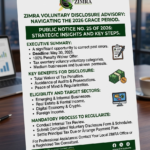 The 2026 Voluntary Disclosure Opportunity is notably broad. ZIMRA has explicitly stated that it applies to all business and investment categories, including emerging businesses (micro and small), medium enterprises, and large corporations.
However, the most revealing aspect of the notice is its specific focus on sectors that have traditionally operated on the fringes of formal tax monitoring. The notice lists several high-priority categories:
The Digital and Informal Economy
ZIMRA is clearly targeting income generated from online platforms and digital services. As the global economy digitizes, many Zimbabwean residents earning through freelance platforms, social media monetization, or remote digital work have operated under the radar. This notice signals that ZIMRA’s data-matching capabilities for digital payments are improving.
Real Estate and Rentals
Rental income remains a significant area of non-compliance. Property owners who receive residential or commercial rent but do not declare it as part of their taxable income are a primary target for this disclosure window.
Trade in Minerals and Specialized Services
Gold and mineral trading, along with transport and taxi services, are highlighted. Given the prominence of the artisanal mining sector and the informal “kombi” or taxi industry, ZIMRA is offering a path to formalization that avoids the crushing weight of backdated penalties.
The “Lifestyle Audit” Warning
Perhaps most critically, the notice mentions persons who have “significant assets or developments inconsistent with their tax declarations.” This is a direct reference to lifestyle audits. If your physical wealth (cars, houses, investments) does not match your reported income, this voluntary disclosure window is your primary defense against a future aggressive audit.
The Carrot and the Stick: Why Disclose?
The primary incentive offered in Public Notice 25 is the waiver of penalties in full. In the Zimbabwean tax framework, penalties for non-compliance or tax evasion can often reach 100% of the principal tax due.
The Incentives (The Carrot):
- Full Penalty Waiver: If a “full and truthful disclosure” is made, the Commissioner General will waive all penalties.
- Audit Immunity: The disclosure will not automatically trigger an audit or prosecution. This is a massive “safe harbor” provision. It allows you to clean your books without the fear that opening one door will lead to ZIMRA tearing down the entire house.
- Business Continuity: By regularizing now, businesses avoid the risk of sudden garnishment orders or the freezing of bank accounts, which usually occur when ZIMRA discovers non-compliance through its own investigations.
The Consequences (The Stick):
- Interest Still Applies: It is important to note that while penalties are waived, interest will still apply as provided by law. Taxpayers should not expect a “tax holiday,” but rather a “penalty holiday.”
- Post-Deadline Aggression: The notice explicitly states that after May 30, 2026, any non-compliance identified will be treated with the “full provisions of the tax laws.” This implies that once this window closes, ZIMRA will likely launch a nationwide audit campaign, and the leniency currently on the table will vanish.
Applicable Tax Types
The disclosure window is not limited to corporate income tax. It covers virtually every head of tax administered by ZIMRA:
- Income Tax: Both corporate tax and individual tax on trade/investment.
- Value Added Tax (VAT): Especially relevant for businesses that crossed the registration threshold ($US or ZiG equivalent) but failed to register or charge VAT.
- Pay As You Earn (PAYE): For employers who may have provided “fringe benefits” or allowances to staff without properly taxing them.
- Capital Gains Tax (CGT): Applicable to the sale of specified assets like immovable property or shares.
How to Regularize
To take advantage of this offer, taxpayers must follow a specific three-step process:
Step 1: Internal Review and Health Check
Before approaching ZIMRA, businesses should conduct a private tax health check. This involves:
- Reviewing all bank statements for 2025.
- Checking asset purchases against declared profits.
- Identifying any “off-book” transactions or cash payments that were not recorded.
Step 2: Submission of Documentation
You must submit a fully completed Voluntary Disclosure Form along with detailed schedules. These schedules must clearly show how the undisclosed income was calculated. Honesty is paramount; a “partial” disclosure that ZIMRA later finds to be incomplete can void the penalty waiver.
Step 3: Payment or Payment Plan
Once the tax due is calculated, the taxpayer must either pay the amount in full or arrange a payment plan. ZIMRA’s willingness to mention payment plans in the notice suggests they are open to negotiation regarding the liquidity constraints of businesses, provided the debt is acknowledged.
Strategic Advice for Businesses
Don’t Wait for the Deadline
With a May 30 deadline, you effectively have very little time. Preparing the detailed schedules required for a “full and truthful disclosure” takes time. Waiting until the final week may result in errors that disqualify you from the penalty waiver.
Use Professional Intermediaries
While you can submit the forms yourself, engaging a tax consultant or a chartered accountant is highly recommended. Professionals can ensure that your disclosure is framed in a way that maximizes your protection and correctly calculates the interest due, preventing future disputes with the Authority.
The “Foreign Income” Trap
The notice specifically mentions “income from foreign companies while residing in Zimbabwe.” With the rise of remote work for global firms, many residents believe their income is exempt because it is earned “abroad.” Under Zimbabwean source-based and residency rules, if the work is performed while you are physically in Zimbabwe, it is generally taxable. This window is the perfect time for remote workers to formalize their status.
Address Crypto Assets
For the first time in a prominent public notice, ZIMRA has mentioned “conducting business using crypto assets.” This indicates that the Authority is monitoring the blockchain and local crypto-off-ramps. If you have been trading or receiving payments in cryptocurrency without declaration, this is a clear signal that the “anonymity” of crypto is no longer a shield.
Strategic Advice for Individuals and Informal Traders
If you are an informal trader or an individual with rental property:
- Register Now: If you are not registered for tax, use this window to get your BP (Business Partner) number.
- Separate Personal and Business Finance: Moving forward, ensure business income does not sit in personal accounts where it becomes harder to justify during a lifestyle audit.
- Document Everything: Even if your records for 2025 are messy, do your best to reconstruct them now. ZIMRA is offering a “grace period” for record-keeping errors as long as the income is declared.
Conclusion: The Cost of Silence
The 2026 Voluntary Disclosure Opportunity is a strategic move by ZIMRA to widen the tax base. For the taxpayer, it is an exercise in risk management.
The math is simple:
- Disclosure: Pay Principal Tax + Interest. (Savings: 100% of Penalties + Peace of Mind).
- Silence: Risk paying Principal Tax + Interest + 100% Penalty + Possible Prosecution + Business Disruption.
In an era of increasing digitalization and information sharing between financial institutions and the revenue authority, the “chance of being caught” is higher than ever. We advise all clients and businesses to treat Public Notice 25 of 2026 as a high-priority directive. Review your 2025 affairs immediately, seek professional counsel, and ensure your submission is made well before May 30, 2026.