
 In Zimbabwe, we deal with unique challenges from fluctuating exchange rates to intermittent power supply. When things get hectic, human error spikes.
An SOP ensures that whether you are in the office or away, your staff knows exactly how to handle a transaction, price a product, or start a generator safely. It moves the “knowledge” out of one person’s head and into a system that guarantees the same quality of service every single time.
We explore the psychological, economic, and operational layers of running a business in Zimbabwe without a “rudder.”
The Silent Business Killer: Why Zimbabwean SMEs Fail Without SOPs
In the bustling corridors of Mbare Musika or the sleek boardrooms of Sam Levy’s Village, a common thread ties every successful Zimbabwean business together: Systemization. Conversely, the graveyard of failed local startups is littered with “hustlers” who thought they could manage everything by memory and “vibes.”
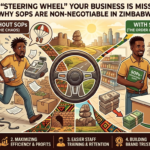
Operating a business without Standard Operating Procedures (SOPs) is like trying to drive a 30-tonne truck down the steep slopes of the Ngundu-Chiredzi road with no steering wheel and a blindfold on. You might move forward for a while, but a crash isn’t just a possibility, it’s an mathematical certainty.
1. The Myth of the “Genius Founder”
In Zimbabwe, we have a culture of the “Big Boss.” The person who knows where every bolt is, who has the login to every bank account, and who decides the price of a tomato on a whim. While this feels like control, it is actually a bottleneck.
If the business cannot breathe without your physical presence, you don’t own a business; you own a high-stress job. SOPs decentralize power. They take the “genius” out of the founder’s head and put it into a manual that an intern can follow. This is the first step toward moving from a “tuckshop mentality” to a corporate legacy.
2. Navigating the “Zimbabwean Factor”
Our economy is unique. We deal with “Triple-V” conditions: Volatility, Variable power, and Value preservation.
An SOP in Zimbabwe isn’t just about how to file a folder; it’s about survival protocols. A robust SOP for a local business includes:
-
The Power Protocol: What happens the moment the ZESA goes out? Who switches the inverter? Which machines are turned off to preserve the battery?
-
The Currency Protocol: If the exchange rate moves by 5% at midday, how is that reflected in the POS system? Who authorizes the change? Without an SOP, your staff might sell goods at a loss for four hours before you realize it.
3. The “Relative & Friend” Trap
Many Zimbabwean businesses are staffed by family or people from the same “kumusha.” This often leads to a breakdown in discipline because “Uncle John” doesn’t think he needs to follow rules.
SOPs remove the personality from the conflict. When you correct an employee, you aren’t attacking them; you are pointing to the Document. > “Uncle John, the SOP says the cold room must be locked at 6 PM. It wasn’t. We need to follow the system to protect our stock.” It turns a potential family feud into a professional standard.
4. Quality: The Only Way to Compete with Imports
We often complain about cheap imports from South Africa or China. Why do people buy them? Consistency. When you buy a branded product, you know exactly what you’re getting.
If your “Zimbo-made” furniture is high-quality in January but falling apart in March because you hired a new carpenter who uses different glue, your brand is dead. SOPs define the Quality Floor. They dictate exactly what grade of timber, what type of screw, and what sanding process is used. This is how you build a brand that can eventually export to the region.
5. Scalability: From Bulawayo to Mutare
You cannot be in two places at once. If you want to open a second branch of your butchery or your consultancy firm, how do you ensure the second one is as good as the first?
You “clone” the business using SOPs.
McDonald’s doesn’t have the world’s best chefs; they have the world’s best SOPs. A teenager in Harare can make the same burger as a teenager in New York because the manual is foolproof. If you want to expand across Zimbabwe, your SOPs are your “blueprint.”
How to Start Building Your Steering Wheel
You don’t need a consultant from UK to write your SOPs. You just need a pen, paper, and a bit of time.
Step A: The “Brain Dump”
List the top 10 things that happen in your business every day.
-
Opening the shop.
-
Invoicing a customer.
-
Handling a refund.
-
Ordering new stock.
-
Cleaning the workspace.
Step B: The “Simple Six” Format
For every task, write down:
-
Name of Task: (e.g., End of Day Cash Up)
-
Frequency: (Daily)
-
Owner: (Till Operator)
-
Steps: (1. Print Z-Report, 2. Count USD, 3. Count ZiG, 4. Compare…)
-
The “If-Then” Clause: (If the cash is short by more than $2, call the Supervisor).
-
The Storage: Where is this recorded?
Step C: The “Litre of Milk” Test
Give your written SOP to someone who doesn’t do that job. If they can complete the task without asking you a single question, your SOP is perfect. If they get stuck, your “steering” is still a bit loose, tighten the instructions.
Stop Flying Blind
The Zimbabwean economy rewards the resilient, but it enriches the organized. By implementing SOPs, you reduce your stress, increase your profit, and build something that can last for generations. Don’t wait for the “crash” to realize you needed a steering wheel. Start documenting today.
Would you like our SOP drafting Services. Get in touch now.